Why Does Galvanometer Precision Matter in an Industrial SLA 3D Printer?
When we talk about precision manufacturing, the conversation inevitably turns to the small components that make massive differences. In the world of stereolithography additive manufacturing, the galvanometer system stands as one of those critical elements. An Industrial SLA 3D Printer uses a galvanometer scanning system to precisely position and deflect the laser beam across the resin surface, layer after layer. This precision directly influences dimensional accuracy, surface quality, and part repeatability—three pillars that determine whether a printed component meets aerospace tolerances or falls short of medical device standards. Understanding galvanometer precision is not just a technical detail; it is essential to achieving these outcomes while reducing avoidable scrap.

Technical Analysis of Galvanometer Precision and Its Impact on 3D Printing Performance
Several aspects of the stereolithography process are influenced by galvanometer performance, including laser positioning, scanning dynamics, dimensional accuracy, and surface quality.
Print Speed and Throughput Optimization
Production throughput is influenced by galvanometer scanning speed, but overall build time also depends on scan strategy, exposure parameters, layer thickness, recoating time, and part geometry. Magforms uses scan-path planning and process-control strategies to optimize laser movement and reduce unnecessary scanning motion. By optimizing scan paths and exposure strategies, an Industrial SLA 3D Printer can improve scanning efficiency across different part geometries and production requirements. High-speed scanning and precise positioning make it possible for operators to finish complex geometries in hours instead of days. This speeds up the product development process for consumer electronics samples and custom shoe molds.
Surface Finish and Layer Line Visibility
How accurately the laser follows each programmed contour is influenced by galvanometer positioning accuracy, while the final surface quality also depends on laser spot size, optical calibration, exposure parameters, layer thickness, and resin behavior. Inaccurate laser positioning can contribute to contour deviations, rough edges, or inconsistent feature reproduction, while visible layer transitions are also influenced by layer thickness, part orientation, resin behavior, and post-processing. Magforms also uses grayscale processing and exposure-control methods to improve edge definition and reduce the visual impact of stair-stepping on sloped or curved surfaces. These features, together with accurate laser positioning and process control, can help improve surface quality and reduce visible stair-stepping. The final surface roughness, however, depends on the resin, layer thickness, exposure parameters, part orientation, and post-processing conditions. This level of process control is particularly useful for clear-resin applications where surface uniformity, optical clarity, and controlled post-processing are important.

Failure Rate Reduction Through Consistent Laser Positioning
When laser positioning deviates from the programmed path, the exposure pattern can shift or become inconsistent in localized areas, potentially affecting feature dimensions, contour accuracy, or curing uniformity. The German SCANLAB galvanometer used in Magforms systems provides precise and repeatable laser positioning. Combined with optical calibration, laser control, and process parameters, this helps maintain consistent exposure conditions across the build area during long production runs. This consistency can improve first-pass yield and reduce avoidable rework and material waste during production. Galvanometer performance is also supported by the mechanical stability of the printer. HIWIN linear guides and precision transmission components help maintain stable Z-axis movement and build-platform positioning during long production runs. These components help maintain mechanical stability during large-format Z-axis movement and reduce the risk of positioning errors caused by vibration or mechanical deflection.
Case Study: Dimensional Accuracy in Aerospace Brackets
For small-batch aerospace bracket production, dimensional accuracy depends on the combined performance of the optical system, galvanometer, exposure parameters, recoating system, material, and machine structure. A precision galvanometer helps maintain accurate laser positioning across the build area, but achieving a specified tolerance requires calibration and validation of the complete printing system.
In practice, manufacturers should evaluate dimensional accuracy using representative test parts and measurement equipment such as a coordinate measuring machine (CMM) or optical metrology system. This approach helps identify whether dimensional deviations originate from laser positioning, optical distortion, material shrinkage, thermal effects, or mechanical movement.
Comparing Industrial SLA 3D Printers: The Role of Galvanometer Technology
Different manufacturers use different optical architectures and scanner configurations, which can result in meaningful differences in scanning performance, build strategy, and production capability between systems with similar specifications.
Galvanometer Systems Across Major Brands
Industrial additive manufacturing platforms use different optical architectures and material-management strategies. In laser-based stereolithography systems, the galvanometer scanner is one of the key components responsible for laser beam positioning and scanning dynamics. Some industrial additive manufacturing platforms use validated material ecosystems to ensure process consistency and qualification. These approaches can simplify process control, but they may also limit material selection compared with more open platforms. Different stereolithography platforms optimize galvanometer performance, build volume, optical configuration, and throughput for different production requirements. Therefore, galvanometer specifications should be evaluated together with build size, laser power, scan strategy, and validated production data. Magforms combines a 355 nm laser-based optical system with an open-material approach, allowing users to evaluate compatible third-party and application-specific photopolymer resins without a proprietary material lock. This gives purchasing managers greater flexibility to evaluate cost-effective materials without being restricted to a proprietary material ecosystem.
SLA Versus SLS and DLP: Precision Trade-offs
In laser-based Selective Laser Sintering (SLS) systems, galvanometer scanners can be used to direct the laser across the powder bed to selectively sinter polymer particles. Digital Light Processing (DLP) systems expose an entire layer using a projected image, which can provide high throughput. Their achievable feature resolution is influenced by factors such as projector pixel size, optical magnification, pixel-to-part scaling, and material behavior. An Industrial SLA 3D Printer using laser scanning provides a different balance of resolution, build size, scanning flexibility, and throughput compared with SLS and DLP systems. It combines localized laser exposure with flexible scan-path control, allowing manufacturers to adjust scanning strategies according to part geometry, layer thickness, and resin characteristics. The resulting part characteristics depend on the specific machine, material, exposure parameters, and process conditions. Compared with DLP, laser-based SLA provides flexible scan-path control, while DLP can expose an entire layer simultaneously and may offer advantages in throughput for suitable geometries. Neither approach is universally superior; actual dimensional accuracy and surface quality depend on the specific machine, optical system, material, and process parameters.

Galvanometer Performance and Material Compatibility
A precision galvanometer can help provide consistent laser positioning across different process conditions, but resin compatibility depends on a broader set of factors, including wavelength sensitivity, cure kinetics, viscosity, exposure requirements, and validated process parameters. Engineering resins with different viscosities and cure kinetics require appropriate exposure, recoating, and process-control parameters. Accurate laser positioning helps ensure that the programmed exposure pattern is reproduced consistently, while material behavior and thermal conditions also influence the final result. Magforms systems can be configured for different photopolymer applications, including ABS-like, PP-like, clear, and high-temperature formulations. Material performance depends on the resin formulation, 355 nm curing characteristics, exposure parameters, thermal conditions, and the complete optical and mechanical system, rather than galvanometer performance alone. The open-material design does not require proprietary material locking or supplier-issued parameter access, allowing users to evaluate different compatible resins for a wide range of uses, from application-specific dental and medical prototypes to heat-resistant automotive components.
Practical Procurement Considerations for Industrial SLA 3D Printers
When choosing the right stereolithography platform, you need to weigh the initial cost of the purchase against the ongoing costs of running the platform and its production capabilities.
How Galvanometer Quality Affects Total Cost of Ownership
Lower-cost scanning systems may offer a different balance of positioning accuracy, repeatability, drift performance, and service requirements. Procurement teams should evaluate these factors together with calibration frequency, downtime, scrap rate, and total operating cost. Over the equipment's service life, these factors can have a significant impact on total cost of ownership through material consumption, maintenance, downtime, and rework. The Magforms SL800 Industrial SLA 3D Printer combines a SCANLAB galvanometer system with an AOC laser source to provide a precision optical foundation for industrial SLA production. Final production performance still depends on system calibration, machine structure, process parameters, and material behavior. Magforms industrial systems use rigid machine structures, including thick sheet-metal construction and an adjustable marble build platform, to provide a stable mechanical foundation for the optical and motion systems.
Evaluating Supplier Support for Galvanometer Maintenance
Galvanometer systems should be inspected and calibrated according to the equipment manufacturer's maintenance recommendations. Depending on the system design, service procedures may include checking optical cleanliness, positioning accuracy, scanner diagnostics, and calibration status. Suppliers offering full after-sales service typically provide calibration protocols, replacement parts availability, and remote diagnostics capabilities. Magforms provides technical support for calibration, diagnostics, software, and process-related issues, with customer inquiries typically responded to within 24 hours. This can help reduce production disruption when calibration drift, scanner issues, or component wear are identified. This support system is especially helpful in factories with more than one shift, where machine downtime has a direct effect on revenue.
Bulk Purchasing and Financing Options
For manufacturers scaling their additive manufacturing capacity, procurement terms can be evaluated alongside equipment configuration, service coverage, and long-term maintenance requirements. Authorized distributors of industrial stereolithography equipment often offer lease-to-own plans or contracts that bundle materials together, which lower the initial cost of buying the equipment. When looking at these choices, procurement managers should make sure that bulk purchase agreements cover galvanometer calibration services and longer warranty periods. This will protect the investment in precision hardware for as long as the equipment is used.
Future Trends: Galvanometer Precision and the Evolution of Industrial SLA 3D Printing
Stereolithography technology is moving in the direction of even faster speeds, higher accuracy, and a wider range of uses. Improvements in scanning systems are one important part of this development.
Next-Generation Scanning Systems and AI Optimization
Advanced galvanometer systems use high-resolution position detection and feedback control to monitor mirror position and improve dynamic response, repeatability, and long-term stability. Advanced scanning software can optimize laser toolpaths according to part geometry, exposure requirements, and production parameters, helping reduce unnecessary scanning movements and improve process efficiency. As AI-assisted process optimization develops, future systems may use material characteristics, environmental conditions, machine status, and part geometry to recommend optimized exposure and scanning parameters. These developments could help an Industrial SLA 3D Printer improve scanning efficiency, process consistency, and the ability to handle increasingly complex geometries.
Expanding Applications in High-Value Industries

Aerospace manufacturers increasingly use additive manufacturing for prototypes, tooling, and selected production components, while flight-critical applications require material qualification, process validation, inspection, and regulatory approval. These parts must meet strict airworthiness standards in every way. Medical device applications can require highly controlled dimensional accuracy, surface quality, and material properties. Depending on the application, patient-specific surgical guides and other customized components may require dimensional tolerances at the sub-millimeter or finer scale. Automotive manufacturers use functional prototypes and validation parts to evaluate fit, assembly, form, and selected mechanical or thermal performance before committing to tooling or mass production. These applications depend on coordinated control of laser positioning, exposure energy, material formulation, machine structure, and post-processing to achieve consistent dimensions and mechanical performance. As materials science makes progress in making resins that are more resistant to heat and chemicals, the successful adoption of these formulations will depend on coordinated control of laser exposure, scanning strategy, material behavior, thermal conditions, and post-processing.
These applications are best evaluated through real production examples, where machine configuration, material selection, and process parameters can be assessed against specific manufacturing requirements. Explore Magforms industrial SLA application cases to see how SLA systems are used in practical engineering workflows.
Strategic Partnerships for Continuous Innovation
Companies that want to stay competitive know that technology partnerships accelerate innovation. Magforms integrates industrial components such as SCANLAB galvanometer scanners and Panasonic servo motors into its SLA systems to support precise optical scanning and stable mechanical movement. Magforms has more than 22 patents and 30 registered trademarks. Using established industrial components also helps Magforms build its SLA platforms around mature optical and motion-control technologies while maintaining a consistent system architecture. This approach can support component-level continuity while allowing improvements to scanning and motion-control performance over time.
Conclusion
Galvanometer precision is a critical part of the optical foundation of an Industrial SLA 3D Printer, directly influencing laser positioning, scanning dynamics, and repeatability. Industrial production systems must be evaluated against the specific dimensional, material, process-validation, and regulatory requirements of their intended applications. Industrial scanning systems can achieve very high positioning resolution and dynamic response at the galvanometer level. However, the final dimensional accuracy of an Industrial SLA 3D Printer depends on the complete optical, mechanical, material, and calibration system. When evaluating an industrial galvanometer system, manufacturers should consider positioning accuracy, repeatability, drift, dynamic response, optical compatibility, calibration support, and long-term serviceability. As more and more industries use additive manufacturing to make functional parts, galvanometer precision standards will become even more important for staying competitive.
FAQ
1. How often should galvanometer calibration occur on an Industrial SLA 3D Printer?
Calibration intervals should follow the printer manufacturer's maintenance recommendations and may depend on machine usage, operating environment, production requirements, and observed positioning drift. High-utilization production environments may also perform periodic verification checks to detect deviations before they affect production quality.
2. Can inferior galvanometer precision be compensated for through software adjustments?
Software calibration can compensate for certain predictable optical and positioning errors, but it cannot completely eliminate the physical limitations of scanner dynamics, mirror inertia, positioning repeatability, or optical distortion. High-quality galvanometer hardware, such as SCANLAB scanning systems, provides a stable hardware foundation that software calibration and process optimization can build upon.
3. What symptoms indicate galvanometer malfunction in stereolithography systems?
Potential galvanometer or optical-calibration issues may appear as position-dependent dimensional deviations position-dependent dimensional deviations, distorted small features, inconsistent contour placement, or repeatable geometric errors in specific areas of the build platform. However, these symptoms can also originate from material, exposure, recoating, or mechanical systems, so diagnostic testing should be used to identify the actual cause.
Partner with Magforms for Precision Industrial SLA 3D Printer Solutions
Magforms is an industrial 3D printing manufacturer specializing in Industrial SLA 3D Printers, photopolymer materials, and additive manufacturing solutions. The company provides industrial SLA systems, photopolymer materials, technical support, and application-focused additive manufacturing solutions. Our industrial SLA systems use German SCANLAB galvanometers, AOC laser sources, and Panasonic servo motors to support precise optical scanning and stable machine movement. For example, the SL800 specifies dimensional accuracy of ±0.15 mm for dimensions up to 100 mm and ±0.15% × L for dimensions above 100 mm, according to its published specifications. With an open-material architecture designed to support compatible 355 nm photopolymer resins, users can evaluate materials according to application requirements without a proprietary material lock. Our technical support team typically responds to customer inquiries within 24 hours and provides assistance with calibration, software, troubleshooting, and technical training. Contact us right away at info@magforms.com to talk about how our precision stereolithography platforms can help you make your manufacturing more competitive and shorten the time it takes to develop new products.
References
1. Gibson, I., Rosen, D., & Stucker, B. (2021). Additive Manufacturing Technologies: 3D Printing, Rapid Prototyping, and Direct Digital Manufacturing. Springer International Publishing.
2. Jacobs, P. F. (1992). Rapid Prototyping & Manufacturing: Fundamentals of Stereolithography. Society of Manufacturing Engineers.
3. Melchels, F. P., Feijen, J., & Grijpma, D. W. (2010). "A Review on Stereolithography and Its Applications in Biomedical Engineering." Biomaterials, 31(24), 6121-6130.
4. Stansbury, J. W., & Idacavage, M. J. (2016). "3D Printing with Polymers: Challenges Among Expanding Options and Opportunities." Dental Materials, 32(1), 54-64.
5. Zheng, X., Lee, H., Weisgraber, T. H., Shusteff, M., DeOtte, J., Duoss, E. B., & Spadaccini, C. M. (2014). "Ultralight, Ultrastiff Mechanical Metamaterials." Science, 344(6190), 1373-1377.
6. Huang, Y., Leu, M. C., Mazumder, J., & Donmez, A. (2015). "Additive Manufacturing: Current State, Future Potential, Gaps and Needs, and Recommendations." Journal of Manufacturing Science and Engineering, 137(1), 014001.

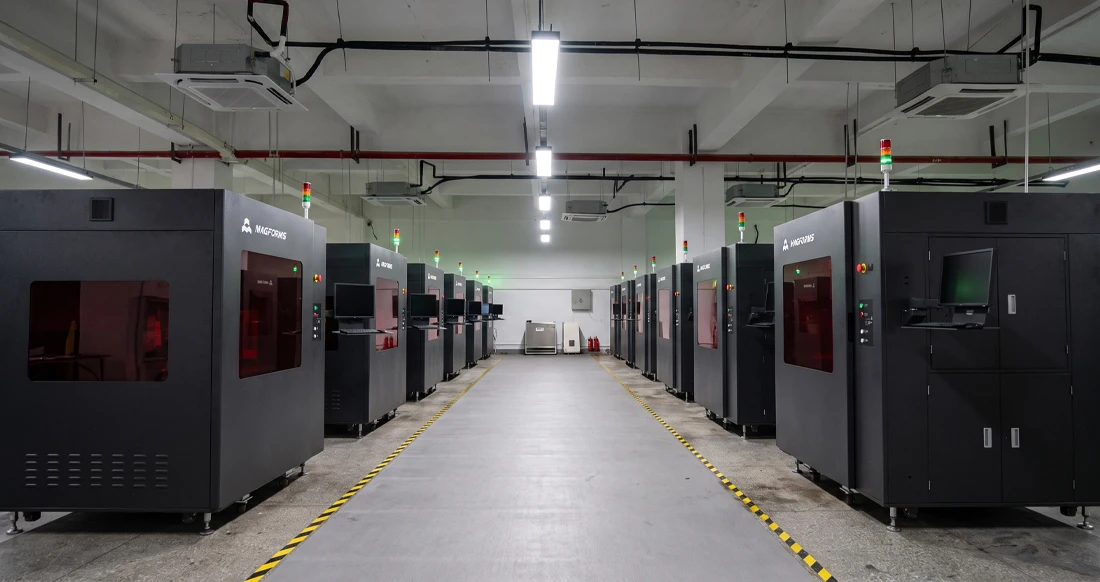
Magforms makes design and manufacture easier.
Popular Blogs
-
 Industry InsightsManufacturing Industry
FDM vs. SLA Printer: Which Technology Is Right for Your Project?
-
 Industry InsightsManufacturing Industry
Top 5 Applications of Industrial 3D Printers in Manufacturing Today
-
 Industry InsightsManufacturing Industry
Why Stereolithography 3D Printers Are Unmatched for Microfluidic Device Prototyping?