How Does Resin Viscosity Affect Industrial SLA 3D Printer Quality?
Resin viscosity is an important material property that affects the performance and output quality of an Industrial SLA 3D Printer. Its influence is particularly evident during resin recoating, where viscosity affects flow behavior, layer formation, and the time required for the resin surface to become sufficiently uniform for the next exposure. When resin flows too slowly or does not redistribute uniformly across the build area, it can affect layer formation and production consistency, which may subsequently influence surface finish and dimensional accuracy. High-viscosity resins can require longer recoating and leveling times, while very low-viscosity materials may require appropriate recoating and process control to prevent excessive flow or uneven resin distribution. The suitable viscosity range therefore depends on the resin formulation, layer thickness, recoating mechanism, and printer operating conditions. Understanding this balance allows manufacturers to optimize print parameters, select compatible resins, and leverage advanced equipment features—such as integrated temperature control, where available, and variable laser spot technology on compatible systems—to achieve superior results in demanding production environments.


How Resin Viscosity Directly Influences Industrial SLA Print Quality
Resin viscosity primarily influences resin flow and recoating behavior during the stereolithography process, which can affect layer formation and, indirectly, the consistency of the final surface texture. Manufacturers have to deal with higher failure rates, wasted materials, and longer post-processing steps when viscosity falls outside the printer's operational window.
👉 What is SLA 3D printing technology
Layer Uniformity and Surface Finish
How evenly photopolymer resin is distributed across the build area depends on the resin's rheological properties as well as the recoater design, recoating speed, blade clearance, layer thickness, and resin temperature. Low-viscosity resins generally flow and level more readily, which can shorten the time required for recoating. However, the recoating process still needs to be properly controlled to achieve a uniform liquid layer over the previously cured geometry. When resin viscosity is too high for the printer's recoating conditions, the resin may require more time to redistribute across the build area. Inadequate leveling can result in non-uniform layer thickness, which may contribute to surface irregularities and dimensional variation.
Stable resin viscosity can contribute to more consistent recoating conditions and therefore support more consistent surface quality. Stable resin flow can help maintain more uniform layer formation and surface consistency, while stair-stepping is influenced primarily by layer thickness, part orientation, geometry, and optical resolution. Some Industrial SLA 3D Printer systems use grayscale or exposure modulation strategies to control the delivered light dose in selected regions. When properly calibrated for a specific resin and layer thickness, these strategies can help improve edge definition and surface quality. When properly calibrated for the resin and layer thickness, exposure modulation can improve edge definition and reduce visible curing transitions. Its effectiveness depends on the resin's optical properties, exposure parameters, and overall process conditions.
Dimensional Accuracy and Fine Feature Resolution
Dimensional accuracy in SLA depends on multiple factors, including optical resolution, exposure control, resin shrinkage, recoating uniformity, thermal conditions, and mechanical stability during curing. When resin viscosity is too high for the printer's recoating conditions, incomplete or uneven resin redistribution can affect the consistency of the liquid layer, which may contribute to dimensional variation or surface defects. Very low-viscosity resin generally flows readily, but dimensional accuracy is influenced more directly by exposure parameters, resin shrinkage, optical characteristics, and process calibration than by viscosity alone.
Magforms' compatible SLA systems use variable laser spot technology to adjust the effective laser spot size according to different scanning requirements. For example, a smaller spot can be used for fine contours, while a larger spot can support more efficient exposure of broader regions. This approach can balance fine-feature definition and scanning efficiency for compatible resin formulations. For the SL800, the specified dimensional accuracy is ±0.15 mm for dimensions of 100 mm or less, and ±0.15% × L for dimensions greater than 100 mm, under the specified testing conditions.
For fine features such as threaded holes, thin walls, and sharp edges, consistent resin recoating must be combined with appropriate optical resolution, exposure control, part orientation, and support design. Low-viscosity materials can flow readily into narrow regions during recoating, but feature resolution and dimensional accuracy ultimately depend on the resin's optical and curing characteristics, exposure settings, and the overall print process. High-viscosity resins can require longer recoating or leveling times, depending on the resin formulation and printer configuration. Their exposure parameters should be determined from the resin's curing characteristics and validated process window rather than from viscosity alone.

Printing Throughput and Production Efficiency
The time it takes to recoat has a direct effect on the overall print speed, and the viscosity of the resin determines how quickly it balances out after each layer. Low-viscosity resins can allow faster recoating under suitable process conditions, which may reduce overall build cycle time. For low-viscosity resins and appropriately optimized process conditions, shorter recoating and leveling times can improve overall layer cycle time. However, the actual cycle time depends on exposure strategy, layer thickness, part geometry, recoating parameters, and machine configuration. High-viscosity resins may require additional time for resin redistribution and leveling, increasing the total cycle time when the recoating system needs more time to establish a uniform liquid layer.
Advanced Industrial SLA 3D Printer platforms can optimize scanning and recoating parameters according to validated material profiles and process conditions, helping reduce unnecessary cycle time while maintaining print quality. High-speed optical components, such as AOC lasers and Scanlab galvanometers, can support efficient laser scanning. However, overall layer cycle time still depends on both exposure strategy and resin recoating behavior, so optical scanning speed should not be treated as a direct substitute for longer recoating times.
Challenges Faced with High and Low Viscosity Resins in Industrial SLA Printing
Both levels of viscosity make operations more difficult and affect the dependability of production, the life of equipment, and the quality of parts. When procurement managers and technical directors are aware of these problems, they can choose SLA systems that are designed to handle a wide range of material portfolios.
Difficulties with High-Viscosity Resins
Recoating can impose greater mechanical resistance when high-viscosity resins are redistributed across the build area. If the recoating mechanism is not properly designed for the material's rheological characteristics, increased resistance can place greater demands on the recoater drive system and its mechanical components over long-term operation.
The effect of resin viscosity can become more pronounced when resin temperature varies significantly during a build. Because resin viscosity is generally temperature-dependent, lower ambient or resin temperatures can increase the viscosity of some photopolymer formulations. For high-viscosity materials, maintaining a stable and validated operating temperature can therefore improve recoating consistency. If the resin cannot form a sufficiently uniform layer under the selected recoating conditions, defects such as incomplete layer formation, surface irregularities, or poor interlayer bonding may occur.
Magforms systems address these process requirements through a rigid machine structure, precision linear guides, and a stable marble working platform designed to minimize mechanical and thermal variation during long builds. Where temperature control is available, maintaining a stable resin temperature helps reduce viscosity variation during long builds and provides more consistent recoating conditions. This can help maintain more consistent resin handling conditions when processing compatible engineering resins, provided that the material and print parameters have been properly validated.
Complications with Low-Viscosity Resins
Low-viscosity resins flow readily and can drain efficiently from the part and build platform. However, the recoating and platform-motion parameters still need to be optimized to maintain consistent resin distribution and minimize unnecessary resin accumulation.
Another risk is layer variation. Very low-viscosity resins generally settle quickly, but the printer still needs sufficient recoating time and controlled resin movement to establish a uniform liquid layer before exposure. These considerations are particularly important in medical and dental applications, where dimensional consistency, process validation, and material-specific requirements are critical.
Industrial SLA 3D Printer systems use stable platform designs and precise recoating control to manage different resin flow characteristics. Magforms equipment uses angled support rods that lift the platform holder after printing. This makes it easy for any extra resin to drain back into the vat. This easy-to-use design cuts down on cleanup time and resin waste, making the process more cost-effective and speeding up production.

How to Select and Optimize Resin Viscosity for Industrial SLA Printing Needs
To choose the right resin viscosity, you need to make sure that the properties of the material match the needs of the application, the capabilities of the equipment, and the goals of the production. Manufacturers can improve print consistency, reduce material waste, and maintain competitive production lead times by matching resin properties with the printer's validated operating window.
Matching Viscosity to Application Requirements
For aerospace and automotive development, resin selection should be based primarily on the required mechanical, thermal, chemical, dimensional, and environmental performance of the printed part. These considerations become particularly important when selecting materials for automotive, aerospace, medical, and other industrial workflows. See real-world Industrial SLA application cases to understand how manufacturers use SLA systems across different production scenarios. Resin formulations selected for these applications may support fit, form, and functional evaluation or certain low-volume production workflows when their mechanical, thermal, chemical, and environmental performance has been validated for the intended use.
For medical and dental applications, resin viscosity should be selected according to the material manufacturer's validated processing window and the printer's material-handling capability. Dimensional accuracy, mechanical performance, biocompatibility, and applicable regulatory requirements should be evaluated together.
Low-viscosity clear or bendable resins are useful in the consumer electronics and arts and culture industries. These materials make it easy to make quick prototypes of complicated designs, like cases for wearable tech or models for decorations. They also allow for quick feedback cycles that are necessary for product development.
Evaluating Printer Resin Handling Capabilities
Equipment compatibility is the most important thing to think about when choosing a resin. For manufacturers that regularly evaluate different resin formulations, an open-material Industrial SLA 3D Printer can provide greater flexibility than a system restricted to proprietary materials. Magforms platforms are designed to work with a range of photopolymer resins formulated for 355 nm SLA exposure, giving users greater flexibility when evaluating compatible third-party or application-specific materials. This lets users try out new formulations, cut costs, and quickly adjust to changing application needs.
Temperature control can help reduce viscosity variation during printing. Machines with built-in resin temperature control can help keep the material within a defined processing temperature range, reducing viscosity variation during extended builds. This function is very useful when working with materials that have a high viscosity or in places where the temperature changes often.
High-precision servo systems, such as the Panasonic servo motors used in Magforms equipment, support repeatable platform movement and positioning during the printing process. A precision-machined marble platform with controlled flatness can provide a stable mechanical reference for the build platform and recoating system, helping maintain consistent layer formation.
Best Practices for Resin Maintenance and Storage
Proper resin storage helps maintain material stability and preserve consistent processing characteristics throughout the specified shelf life. Photopolymer resins should be stored according to the manufacturer's technical data sheet, typically in a cool, controlled environment away from direct UV exposure and excessive heat. Containers should remain properly sealed when the material is not in use. Temperature changes can alter resin viscosity and, depending on the formulation and storage conditions, may also affect material stability. Maintaining the manufacturer's recommended storage and processing temperature helps preserve consistent print performance.
Filtering used resin can remove partially cured particles and other contaminants that may interfere with recoating or exposure during subsequent builds. When recommended by the resin manufacturer and printer workflow, filtering used resin after a build can remove partially cured particles and other contaminants before the material is reused.
Reuse ratios should not be treated as a universal fixed percentage. Instead, manufacturers should establish a validated reuse protocol based on the resin formulation, filtration method, exposure history, contamination level, and manufacturer's recommendations. Manufacturers can retire batches before viscosity drift affects production results by keeping an eye on the resin's age and history of exposure.
When these practices are put together, they help B2B clients increase productivity, lower material costs, and keep quality standards high across a wide range of industrial applications.
Future Trends and Innovations Impacting Resin Viscosity and SLA Print Quality
New developments in resin chemistry, hardware design, and process intelligence are quickly changing the additive manufacturing industry. These changes have a big impact on how viscosity affects print quality and operational efficiency.

Advances in Resin Chemistry
Advances in photopolymer chemistry are enabling some formulations to combine improved flow characteristics with targeted mechanical, thermal, or chemical performance. However, the relationship between viscosity and final part performance remains formulation-specific. These developments may reduce some of the traditional trade-offs between flow characteristics and targeted mechanical or thermal performance.
Biocompatible photopolymer formulations are also being developed for stereolithography-based medical and dental applications, with viscosity, curing behavior, mechanical properties, and biocompatibility considered together during material development. These formulations are developed to meet application-specific material and regulatory requirements, while their dimensional accuracy, surface quality, and mechanical performance must be validated for the intended medical or dental workflow.
Bio-based feedstocks and more sustainable material strategies are also being explored in photopolymer development. As concerns about the environment become more important, manufacturers demand materials that have less of an effect on the environment while still meeting performance standards. Optimizing the viscosity is a key part of making sure that these eco-friendly resins work well with current Industrial SLA 3D Printers.
Hardware Innovations Enhancing Viscosity Management
Advanced recoating systems are being developed to provide greater control over resin redistribution. Depending on the system design, recoating speed, blade position, and dwell time can be optimized for different resin flow characteristics and operating temperatures.
Open-material SLA platforms can be configured for different resin formulations across separate builds, provided that each material is compatible with the printer's wavelength, vat system, recoating mechanism, and validated process parameters. This flexibility allows manufacturers to evaluate different resin formulations on the same platform across separate builds, reducing the need to dedicate a printer to a single material family.
Laser technology keeps getting better, and now systems with variable spot sizes give us more control than ever over how things cure. Magforms' SLA systems use variable laser spot control to balance fine-feature definition and scanning efficiency according to the geometry and exposure requirements of the part. The scanning strategy can then be configured according to the resin's validated exposure parameters, part geometry, and required balance between feature definition and productivity.
AI-Powered Process Monitoring and Optimization
AI and machine-learning approaches are being investigated to improve process monitoring and identify potential relationships between resin behavior, machine parameters, and print quality. Machine-learning approaches are being investigated for additive manufacturing process monitoring, using build data to identify relationships between process parameters, material behavior, and part quality. Such analysis may help identify patterns associated with print failures, potentially supporting earlier intervention, higher yield, and lower material waste.
Future closed-loop systems may combine temperature, recoating, optical, and process-monitoring data to identify changes that could indicate unstable resin flow or layer formation and adjust process parameters accordingly. Such closed-loop control could eventually help maintain more consistent process conditions when material or environmental conditions change, although the effectiveness depends on the sensing, control strategy, and validated material process window.
Digital-twin and simulation approaches may help manufacturers evaluate how changes in material and process parameters could influence recoating behavior and part quality before conducting physical builds. This feature speeds up the approval of materials, lowers the cost of experiments, and cuts down on the time it takes for new uses to hit the market.
Market Dynamics and Strategic Considerations
Trends in resin viscosity are having a bigger effect on how suppliers are chosen and how goods are bought. As companies expand their ranges of materials to meet growing application needs, it is essential that their equipment can work with other pieces of equipment. Systems that can work with a lot of different resins and don't have any unique limits give you better long-term value and operating freedom.
Changes in the prices of raw materials have an effect on how resins are made and how thick they are. The people who work in procurement have to look at the total cost of ownership, which includes not only the price of the materials but also how viscosity affects print success rates, cycle times, and the need for regular maintenance on the equipment.
Localized resin production and multi-sourcing methods are in high demand because of the global supply chain. Having equipment that can handle different resin viscosities from different sources makes you less reliant on just one seller. This makes your supply more secure and your costs more competitive in volatile markets.
Conclusion
Resin viscosity is an important material parameter for an Industrial SLA 3D Printer, particularly because it influences resin flow, recoating behavior, layer uniformity, and production throughput. These factors can subsequently affect surface quality and dimensional consistency when the resin is processed outside its validated operating window. When manufacturers have to deal with high-viscosity engineering resins and low-viscosity specialty formulations, they need equipment that is stable across a wide range of materials. Features such as precision servo systems, variable laser spot control, and well-engineered recoating mechanisms can help maintain stable printing performance across compatible resin formulations when the material is operated within a validated process window. By understanding these relationships and choosing platforms that are made to work with a wide range of materials and be reliable, B2B clients can meet specific application needs while also making their manufacturing processes as efficient and cost-effective as possible in competitive markets.
FAQ
1. How can I control resin viscosity during Industrial SLA 3D Printer operations?
To keep the viscosity of resin stable, you need to actively control the temperature, store materials properly, and follow regular maintenance procedures. With equipment that provides controlled resin temperature, manufacturers can reduce viscosity variation during long builds and maintain more consistent recoating conditions. The target temperature should be established according to the resin manufacturer's specifications and validated printer settings. Resins should be stored according to the manufacturer's recommended temperature and light-exposure conditions, and used resin should be filtered when required by the material and printer workflow to remove contaminants.
2. What viscosity ranges suit different industrial-grade resins?
There is no universal viscosity range that applies to all industrial SLA resins. Suitable viscosity depends on the resin formulation, measurement temperature, layer thickness, recoating mechanism, and printer configuration. Manufacturers should therefore use the resin supplier's technical data and the printer's validated material-processing window rather than selecting a resin based on viscosity alone.
3. Does resin viscosity affect the mechanical properties of printed parts?
Resin viscosity does not directly determine the mechanical properties of a printed part. Tensile strength, flexural modulus, thermal resistance, and other properties are primarily determined by the resin's chemical formulation, curing behavior, degree of conversion, and post-curing conditions. Viscosity mainly affects material flow and recoating behavior during printing.
Partner with Magforms for Superior Industrial SLA 3D Printer Solutions
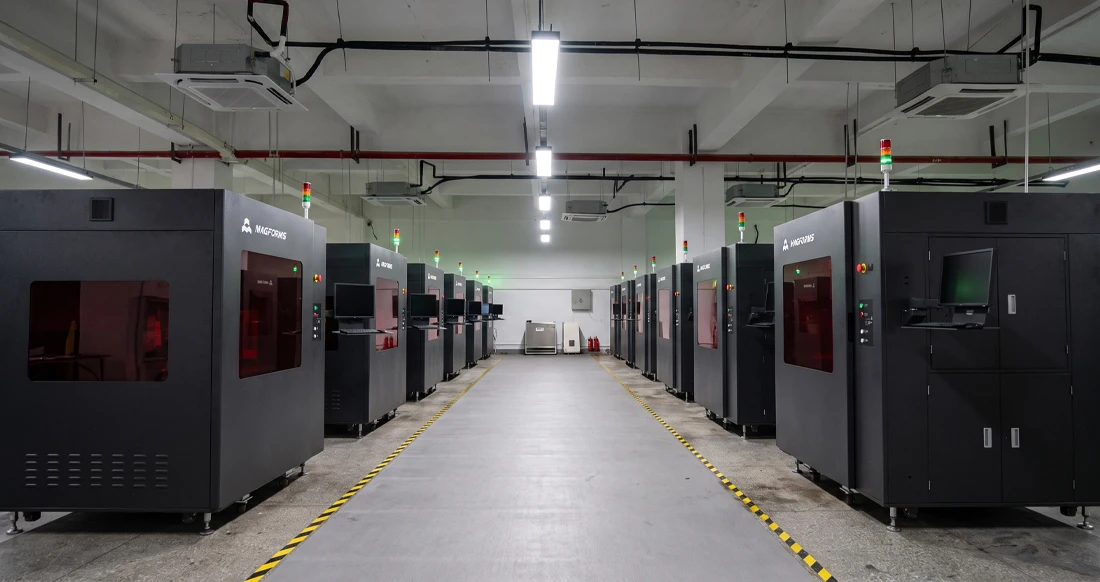
Magforms develops Industrial SLA 3D Printer systems designed to process a range of compatible photopolymer resins with controlled recoating, optical scanning, and mechanical stability. Our integrated approach combines our own materials with state-of-the-art hardware, such as German Scanlab galvanometers, AOC lasers, Panasonic servo motors, and temperature-control capabilities designed to help maintain stable resin processing conditions. When combined with resin-specific process parameters, these features can support consistent print quality across compatible engineering and specialty formulations. Our systems support rapid development, small-batch production, and selected end-use applications, no matter if you run a 3D printing service center, a car R&D department, a medical device maker, or an aircraft component provider. We provide technical and after-sales support designed to help reduce avoidable production interruptions and improve equipment utilization over the system's operating life. We have over 300 enterprise clients around the world, 22 patents, and a professional after-sales team that responds within 24 hours. Contact our knowledgeable staff at info@magforms.com to learn more about how Magforms, a reputable manufacturer of Industrial SLA 3D Printers, can improve your additive manufacturing capabilities with custom solutions, one-on-one consultations, and equipment that is designed for long-term operational excellence.
References
1. Gibson, I., Rosen, D., & Stucker, B. (2015). Additive Manufacturing Technologies: 3D Printing, Rapid Prototyping, and Direct Digital Manufacturing (2nd ed.). Springer.
2. Jacobs, P. F. (1992). Rapid Prototyping & Manufacturing: Fundamentals of Stereolithography. Society of Manufacturing Engineers.
3. Ligon, S. C., Liska, R., Stampfl, J., Gurr, M., & Mülhaupt, R. (2017). Polymers for 3D Printing and Customized Additive Manufacturing. Chemical Reviews, 117(15), 10212-10290.
4. Stansbury, J. W., & Idacavage, M. J. (2016). 3D Printing with Polymers: Challenges among Expanding Options and Opportunities. Dental Materials, 32(1), 54-64.
5. Chartrain, N. A., Williams, C. B., & Whittington, A. R. (2018). A Review on Fabricating Tissue Scaffolds Using Vat Photopolymerization. Acta Biomaterialia, 74, 90-111.
6. Bagheri, A., & Jin, J. (2019). Photopolymerization in 3D Printing. ACS Applied Polymer Materials, 1(4), 593-611.

Magforms makes design and manufacture easier.
Popular Blogs
-
 Industry InsightsManufacturing Industry
FDM vs. SLA Printer: Which Technology Is Right for Your Project?
-
 Industry InsightsManufacturing Industry
Top 5 Applications of Industrial 3D Printers in Manufacturing Today
-
 Industry InsightsManufacturing Industry
Why Stereolithography 3D Printers Are Unmatched for Microfluidic Device Prototyping?