Affordable Industrial SLA 3D Printers for Small Factories?
Small factories can benefit from affordable industrial SLA 3D printers. These printers are revolutionizing the manufacturing process. An Industrial SLA 3D printer uses high-precision laser-based stereolithography to cure photopolymer resins one layer at a time. his produces parts with surfaces approaching injection-mold-like quality and can achieve dimensional accuracy in the range of ±50–100 microns under optimized conditions. In contrast to desktop models or traditional tooling methods, these machines offer better dimensional stability, isotropic mechanical properties, and quick turnaround, all at a price point that makes sense for small-scale operations. This technology lets startups, service bureaus, and niche manufacturers make things between digital designs and physical production without having to pay a lot of money for expensive tools.
Understanding Industrial SLA 3D Printers and Their Benefits
What Makes an Industrial SLA 3D Printer Different?
A sophisticated piece of hardware is what makes an industrial SLA 3D printer unique. High-power solid-state lasers and advanced galvanometer scanning systems work together in these machines to allow for dynamic focusing and controllable spot size. This setup lets the printer do fine detail contouring on complex features while quickly filling in larger areas, which is something desktop printers can't do. The closed-loop platforms keep the temperature stable and the environment under control, which makes sure that the quality of the parts stays the same over long production runs. Industrial systems can consistently produce parts that are accurate within ±0.1% for sizes greater than 100mm, while consumer-grade equipment may have problems with dimensional drift or warping. They are typically designed in alignment with ISO/ASTM additive manufacturing standards (such as ISO/ASTM 52900 series), depending on the manufacturer.
Core Benefits for Small Factories
Small factories have to deal with special problems, like not having enough money, having to meet tight deadlines, and having to compete on both price and quality. These problems are dealt with directly by industrial SLA technology, which gets rid of the need for pricey injection molds or CNC setups for small-scale production. The laser curing process makes parts with smooth side walls—often with surface roughness values typically in the range of Ra 1–5 μm—that don't need much work after they're made. This directly leads to less work and a faster time to market.
The value is even higher when the material can be used in different ways. Modern photopolymer resins come in many different types. There are ABS-like resins for making functional prototypes, clear resins for optical parts, high-temperature resins that can bend at temperatures above 100°C, and flexible materials for gaskets or wearables. Because of these variations, one machine can be used for many things, from making prototypes for car dashboards to making molds for dental aligner systems, without the need to buy separate machines for each job.
You can feel the speed and efficiency gains. You can increase throughput by more than 30% compared to older systems by using more advanced scanning algorithms and adjustable laser parameters. This means finishing projects in days instead of weeks for small batch manufacturing or rapid design iteration. This lets you respond quickly to changes in the design or customer needs.
Solving Critical Pain Points
When you use traditional manufacturing methods, you often have to place large orders, which makes it impossible to make custom or low-volume parts cheaply. This can be fixed with an industrial SLA 3D printer that lets you make things exactly when you need them. It doesn't take long to make the tools, there are no setup fees, and it doesn't matter how complicated the design is—hollow internal channels, undercuts, and lattice structures print just as easily as solid blocks.
Another big benefit is the quality of the surface finish. FDM printers display layer lines, while CNC machining struggles with internal geometries. SLA technology gives parts the look of injection molding right off the build platform, which is important for client presentations, fit-check assemblies, and parts that will be used in real life where looks are essential.
Comparing Affordable Industrial SLA 3D Printers for Small Factories
Technology Comparison: SLA vs. SLS vs. DLP
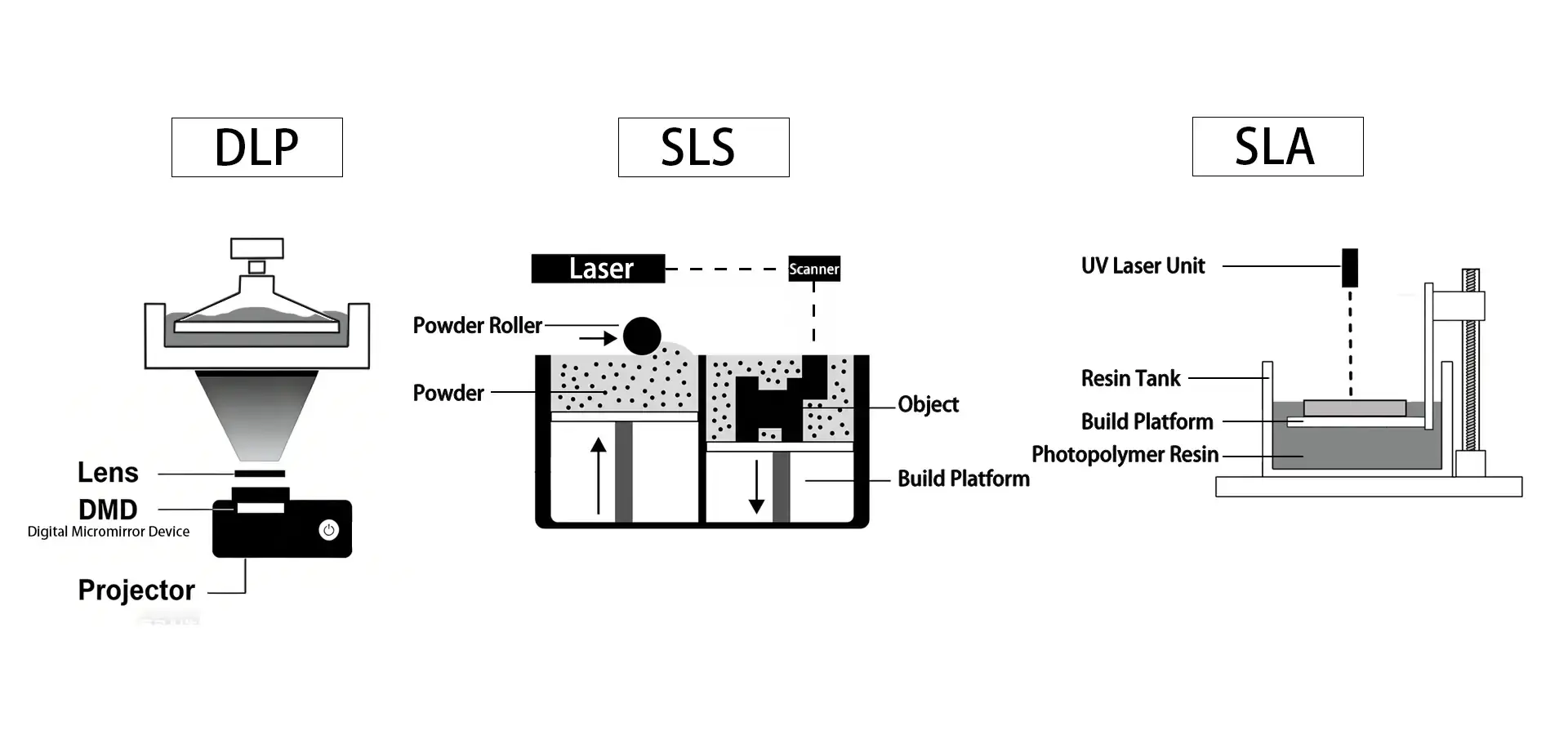
Figuring out how Industrial SLA 3D printer technology compares to other options helps make sense of its place in the manufacturing toolbox. Selective Laser Sintering (SLS) uses powdered nylon or polypropylene. It has better mechanical properties but costs more and makes the surface rougher. Digital Light Processing (DLP) uses a digital projector (DMD chip) to project entire layers at once, while LCD-based systems (MSLA) use masked LCD panels as a light source. This lets you build things faster vertically, but it often means lowering the resolution and making the materials less compatible than laser-based SLA systems.
SLA offers an excellent balance of surface quality and dimensional accuracy, though industrial systems still involve higher upfront costs compared to desktop mSLA or FDM solutions. Resin materials are somewhat more expensive per kilogram than SLS powders, but they make less waste because resin that hasn't hardened can be used again. Regular laser calibration and cleaning of the resin vat are some of the maintenance tasks that need to be done, but they are not nearly as challenging as those for SLS powder handling systems.
Key Specifications to Evaluate
When comparing affordable models, technical factors have a direct effect on how well they can be made. The build volume sets limits on part size. For example, small factories that make auto parts or shoe molds need platforms that are at least 300 x 300 x 400 mm. Surface finish and feature detail are controlled by resolution, which is set by the laser spot size (usually 80 to 140 microns) and layer thickness (50 to 250 microns). Advanced systems can scan up to 15 meters per second, which affects throughput and project turnaround times.
Metrics for reliability are crucial. Printers that have been tested continuously for thousands of hours have failure rates that are much lower than the industry average. This means that printers have less expensive downtime. Look for machines that have strong systems for delivering resin, automatic routines for calibration, and full error logging for easy troubleshooting.
Material Compatibility and Resin Options
Using resins specifically designed for it truly showcases the capabilities of the Industrial SLA 3D printer. Engineering-grade materials work like ABS or polypropylene, so they can make functional prototypes that can withstand impact and stay chemically stable. Optical prototyping for lenses or light guides is possible with clear resins. High-temperature versions can handle multiple sterilization cycles, which is important for medical device uses. Flexible formulations can work with gaskets, seals, and wearable parts.
Magforms stands out by offering integrated hardware-material solutions, supported by validated process parameters and real-world application testing. Our resins and printers go through a lot of optimization, which gets rid of the compatibility problems that happen when factories mix third-party supplies with off-the-shelf hardware. This cooperation makes sure that the dimensions are always the same, cuts down on print errors, and gets rid of unplanned stops, which are annoying when the chemistry of the material doesn't match up with the printer firmware.
How to Choose the Right Affordable Industrial SLA 3D Printer?
Evaluating Printing Accuracy and Throughput
It's not enough to just be accurate; it's a business requirement. Tolerances of within ±50 microns are needed for medical device prototypes, and feature dimensions must be the same across dozens of parts in automotive snap-fit assemblies. Check to see if the printer's claimed accuracy matches your strictest standards, and ask for sample prints using your CAD files to make sure the printer works well in real life.
How many projects you can finish each week is based on your throughput. Please determine the time required to build common parts at various layer thicknesses. Some systems choose between speed and resolution, while others find a balance between the two by using smart software that changes the height of each layer dynamically, making layers thicker for simple shapes and thinner for more complex ones. Machines with AI-optimized scanning paths can cut down on print times by minimizing the laser's travel distance automatically. This is useful for when you need to print quickly.
Total Cost of Ownership Analysis
The price of the purchase is just the beginning. Figure out ongoing costs like how much resin each part needs, how much electricity it uses, how long laser modules last, and yearly maintenance contracts. Some companies force their customers to buy expensive proprietary materials, while others offer open-platform flexibility that lets you find cheaper resins that work with their products.
Downtime costs can be much higher than consumable costs. A printer that breaks down often throws off production schedules and delays deliveries to customers. Give more weight to vendors with a history of success, machines that have been tested extensively in real-world settings, and technical support that can be reached quickly. Magforms' systems go through strict continuous-operation validation, which indicates that they are reliable. This means that output can be predicted and downtime is kept to a minimum.
Matching Capabilities to Production Needs
Demands vary depending on the application. When prototyping, speed and iteration are crucial. You need machines that can print overnight so that designers can look at physical models in the morning. In small-batch manufacturing, repeatability and material performance are crucial. Parts must have the same mechanical properties whether they are made in ten or one hundred units. To make parts for end use, you need resins that last and post-processing methods that give you finishes that are good enough for production.
Scalability is also important. Can you add printers and still easily divide up work as your factory grows? Does the vendor offer larger build volumes or configurations with more than one laser? By purchasing equipment that allows for future expansion, you can avoid costly mid-cycle replacements.
Supplier Credibility and After-Sales Support
Technical specs don't mean much if the infrastructure for support breaks down. Check the supplier's commitment to customer service after the sale. For example, is technical support available in your time zone? Does the supplier provide on-site training during the system setup? How long does it usually take to fix a problem? Magforms has a technical team with a lot of experience that can answer complicated operational questions and give your staff the hands-on training, machine maintenance, and software upgrades they need to be as productive as possible.
For factories in the US and Europe, having a local support presence, like direct offices or authorized service partners, makes sure that parts are delivered quickly and that problems are fixed as quickly as possible. Verify the warranty coverage, the quality of the documentation, and your access to online communities or knowledge bases.
Practical Considerations for Integrating Industrial SLA 3D Printers in Small Factories
Installation and Operational Best Practices
Preparing the environment correctly is the first step to successful integration. To maintain calibration, Industrial SLA 3D printer systems need stable ambient temperatures (20–25°C), low humidity, and vibration-free floors. When there is enough air flow, resin vapors can be handled during printing and after curing. Set aside space for pre-processing (moving the model and making supports) and post-processing (cleaning, curing, and removing supports).
Teaching staff how to use slicing software and printers can help avoid common mistakes. The best surface finish and the fewest support structures are achieved when parts are oriented correctly. Knowing how to handle resin, including the right storage temperature, shelf life, and safety rules, makes sure that the material always works the way it should. Magforms offers thorough onboarding programs that include ways to improve workflow, shorten the learning curve, and speed up the time it takes to get to work.

Maintenance and Troubleshooting
Systems work well when they get regular maintenance. It is important to clean the build platform and check the resin levels daily. As part of weekly procedures, the resin vat is checked for particles that have hardened, and the laser's calibration is confirmed. Updating the firmware and aligning the galvanometer are part of the monthly maintenance. Keeping detailed logs helps identify patterns before they become problems.
Common problems are easy to fix: layer adhesion issues are often caused by improper platform leveling; incomplete curing indicates insufficient laser power or expired resin; and errors in dimensions may be caused by thermal drift. Most problems can be resolved quickly with access to troubleshooting guides and helpful vendor support. This cuts down on downtime.
Financial Planning and Budget Optimization
The cost of industrial SLA systems for beginners ranges from $15,000 to $40,000, depending on the number of units built and their features. Between $40,000 and $80,000 are mid-range machines with bigger platforms and better automation. Small factories on a tight budget can get the equipment they need with the help of financing options like equipment leasing, payment plans, or discounts for buying in bulk.
To figure out return on investment, you have to compare the current costs of outsourcing to the costs of producing things in-house. If you pay $5,000 a month to have a service bureau print for you, a $30,000 machine will pay for itself in six months. In addition to substantial savings, think about the strategic benefits, such as shorter iteration cycles, better protection of intellectual property, and faster response times to customer requests.
Real-World Case Studies
consider a small studio that designs cars that used to hire outside help for all of their prototype work. They bought an industrial SLA 3D printer to do the printing themselves, which cut the time it took to make a prototype from two weeks to 48 hours. Because of this speedup, they were able to test more than one design version in a single development cycle. This improved the quality of the final product and helped them win contracts over bigger competitors.
 |
Success Story How Small Factories Accelerate Prototypes with SLA See how an automotive design studio cut prototype production time from two weeks to just 48 hours using an industrial SLA 3D printer. |
A dental lab serving regional orthodontists faced rising costs for outsourced aligner models. Installing an industrial SLA system allowed them to produce models internally at one-third the cost before they installed an industrial SLA system. This increased their profits while keeping patient turnaround times the same. Material compatibility made sure that thousands of models were all accurate, which helped the company build a reputation for dependability.
Future Outlook and Trends in Affordable Industrial SLA 3D Printing
Emerging Technological Advances
The Industrial SLA 3D printer market keeps changing quickly. During printing, variable spot-size lasers change the diameter of the beam on the fly, using narrow spots for fine details and wide spots for fast infill. This increases efficiency without lowering resolution. AI-driven slicing algorithms look at the shape of the part and automatically find the best places to put supports and scan paths. This cuts down on material waste and print times.
Multi-material printing systems that can change resins during the print process make it possible to make parts with different mechanical properties. For example, rigid frames with flexible hinges. This opens up more design options. Combining SLA with automated post-processing robotics enhances workflow efficiency and produces finished parts with minimal human involvement.
Resin Development and Material Innovation
As new photopolymer formulations come out, their uses keep growing. Biocompatible resins, approved for long-term skin contact, support medical wearables and dental appliances. Flame-retardant materials meet very strict safety standards for electronics and aerospace. Parts that can be used in high-temperature or investment casting environments can be made with filled resins that contain ceramic or metal particles.
Bio-based resins made from renewable resources are being developed because of sustainability efforts. These resins leave smaller environmental footprints. Faster-curing chemicals reduce layer exposure times, accelerating production without compromising mechanical properties.
Industry 4.0 Integration
When you connect Industrial SLA 3D printer systems to digital manufacturing ecosystems, you can do wonderful things. Monitoring machines in real time lets you see their status, resin levels, and print progress from afar. This lets you do preventative maintenance before problems happen. Cloud-based print queues automatically send jobs to multiple printers, making the best use of resources. Digital twins simulate print outcomes and identify issues before committing to materials.
Small factories embracing these digital workflows gain agility and efficiency that rival larger competitors. Magforms supports Industry 4.0 integration through open APIs and network connectivity, ensuring our printers fit seamlessly into modern production environments.
Competitive Advantage Through Early Adoption
Technologies once reserved for large corporations now reach small factories at accessible price points. Early adopters gain competitive edges: faster product development cycles, superior customization capabilities, and reduced dependency on external suppliers. As customer expectations shift toward personalized products and rapid fulfillment, additive manufacturing becomes less optional and more essential.
Staying informed about technological trends positions your factory to capitalize on innovations as they mature. Attending industry exhibitions, participating in technical workshops, and maintaining dialogues with equipment suppliers like Magforms keep you ahead of the curve.
Conclusion
In today's competitive manufacturing world, small factories that can afford industrial SLA 3D printer systems are making life-changing investments. The accuracy, adaptability, and speed of these machines are unmatched by traditional methods, and they do all of this at prices that make sense. Procurement professionals can confidently add SLA printing to production workflows if they understand the basics of the technology, look at the total cost of ownership, and choose suppliers that will provide long-term support. This led to better product quality, faster time-to-market, and more flexibility, all of which helped the business grow and made customers happy.
FAQ
Can affordable industrial SLA 3D printers produce high-precision parts?
Of course. Affordable Industrial SLA 3D printer models can achieve dimensional accuracy of ±50 to ±100 microns, which is good enough for functional prototypes, tooling aids, and a wide range of end-use applications. Laser-based systems have better resolution than filament extrusion methods for making smooth surfaces and fine details in features. When it comes to quality, material chemistry and machine calibration are more important than price. Your entry-level industrial units can compete with much more expensive equipment if they are kept in good condition.
What routine maintenance do these systems require?
Checking resin levels and cleaning build platforms are daily tasks. Once a week, maintenance workers check the resin vats for debris and make sure the laser is calibrated. Every month, procedures include updating the firmware and aligning the galvanometer. Maintenance stops most operational problems before they happen and makes equipment last longer. Magforms makes maintenance easier for small factory teams by giving them detailed maintenance schedules and straightforward access to technical support.
How accessible are financing options?
Many vendors, including Magforms, offer flexible ways to pay for their products, such as leasing programs, payment plans with installments, and discounts for buying in bulk. These options lower the amount of money needed up front, which means that even startups or small businesses with tight budgets can buy an industrial SLA 3D printer. Quickly justifying financing terms often involves calculating ROI based on current outsourcing costs, leading to positive cash flow within months.
Discover the Right Industrial SLA 3D Printer Supplier for Your Factory
Magforms offers Industrial SLA 3D printer solutions that are perfect for small factories. We do this by combining years of experience in the field with cutting-edge technology. Our integrated approach eliminates compatibility issues and guarantees consistent, high-quality output from the start by using self-developed photopolymer resins perfectly matched with our own printing hardware. Our systems print over 30% faster than the average in the industry while still being accurate to the micron level thanks to variable spot-size laser technology and AI-optimized scanning paths. With 22 patents and 30 registered trademarks to our name, over 300 companies around the world trust us to help them with everything from cars to medical devices. Our technical support team gives full training, quick troubleshooting, and proactive maintenance advice to make sure that your investment gives you the best return on investment (ROI). Email us at info@magforms.com right now to discuss your production needs and get sample prints. Magforms is a top company that makes industrial SLA 3D printers and is ready to help your factory use additive manufacturing to its fullest.
References
1. Gibson, I., Rosen, D., & Stucker, B. (2021). Additive Manufacturing Technologies: 3D Printing, Rapid Prototyping, and Direct Digital Manufacturing (3rd ed.). Springer.
2. Jacobs, P. F. (2019). Stereolithography and Other RP&M Technologies: From Rapid Prototyping to Rapid Tooling. Society of Manufacturing Engineers.
3. Ligon, S. C., Liska, R., Stampfl, J., Gurr, M., & Mülhaupt, R. (2017). Polymers for 3D Printing and Customized Additive Manufacturing. Chemical Reviews, 117(15), 10212-10290.
4. Ngo, T. D., Kashani, A., Imbalzano, G., Nguyen, K. T., & Hui, D. (2018). Additive manufacturing (3D printing): A review of materials, methods, applications, and challenges. Composites Part B: Engineering, 143, 172-196.
5. Stansbury, J. W., & Idacavage, M. J. (2016). 3D printing with polymers: Challenges among expanding options and opportunities. Dental Materials, 32(1), 54-64.
6. Wohlers, T., & Gornet, T. (2024). Wohlers Report 2024: 3D Printing and Additive Manufacturing Global State of the Industry. Wohlers Associates, Inc.

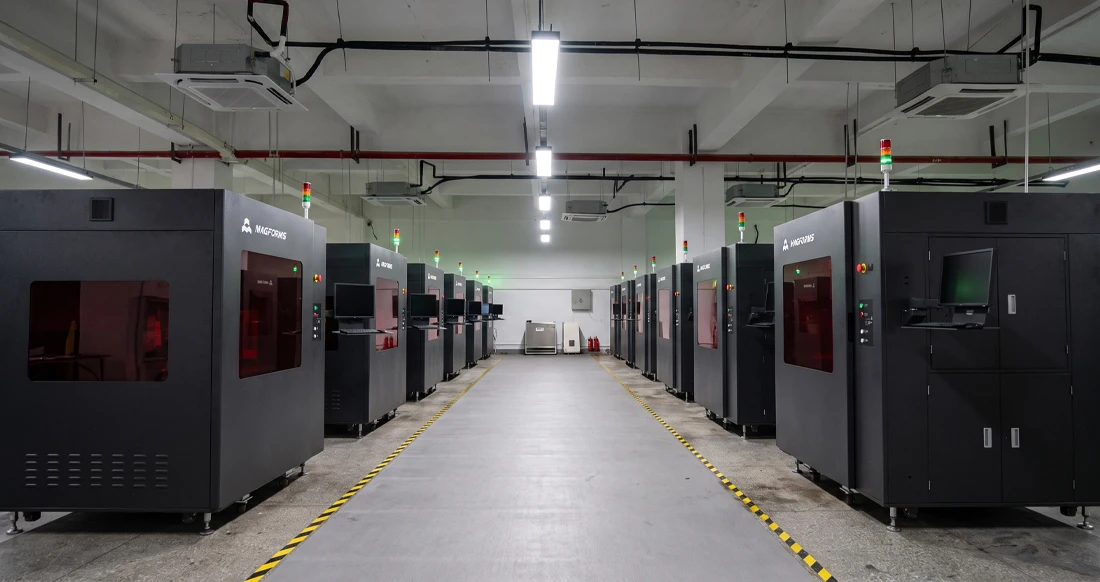
Magforms makes design and manufacture easier.
Popular Blogs
-
 Industry InsightsManufacturing Industry
FDM vs. SLA Printer: Which Technology Is Right for Your Project?
-
 Industry InsightsManufacturing Industry
Top 5 Applications of Industrial 3D Printers in Manufacturing Today
-
 Industry InsightsManufacturing Industry
Why Stereolithography 3D Printers Are Unmatched for Microfluidic Device Prototyping?