Big Format SLA 3D Printer Buying Guide for 2026
In 2026, choosing the right big format SLA 3D printer means giving careful thought to accuracy, build volume, and dependability. Businesses in the medical, aerospace, and automotive industries need equipment that consistently produces large prototypes and parts as stereolithography technology improves. This detailed guide looks at important things like material compatibility, printing speed, surface finish quality, and total cost of ownership to help businesses make smart buying decisions that help them reach their manufacturing goals.
Understanding Large Format Stereolithography Technology
Stereolithography has changed a lot over the years. Large-format systems can now make parts that are bigger than the old limits. Laser scanning is used by these high-tech machines to cure photopolymer resin layer by layer. This makes prototypes and working parts with a lot of detail. Modern systems are very accurate thanks to their layer curing process, which makes them good for uses that need tight tolerances.
Variable spot-size laser technology is now built into industrial 3D printers. This makes them faster and more accurate. With this new technology, manufacturers can find a balance between making things quickly and accurately. The newest systems have deep learning algorithms that improve print speed optimization by up to 20%. This solves problems that have been around for a long time in the industry.
When looking at large format options, build volume becomes the most important thing to think about. Businesses need to figure out if they need a single large part or would rather print many parts at once. Modern designs for resin vats allow for much larger printing areas while keeping the temperature stable during the curing process.
Critical Technical Specifications for Industrial Applications

Precision is still very important in professional additive manufacturing. Leading systems can print parts that are accurate to within 0.1 mm for sizes less than 100 mm, meeting the strict needs of medical and aerospace uses. High-quality parts, like German galvanometer systems and precision laser assemblies, are what make this level of accuracy possible.
The quality of the surface finish has a direct effect on the post-processing needs and the final functionality of the part. Advanced algorithms for digital light processing make sure that layers stick together consistently and that the surface is smooth. The scanning patterns improve both speed and finish quality, so you don't have to do as many treatments after the paint is dry.
Material compatibility in big format SLA 3D printers makes it possible for a wide range of uses in many fields. Users of open-source designs for big-format SLA 3D printers can choose photopolymer resins from a number of different suppliers. This gives them choices about how much the materials cost and how well they work. This method is different from proprietary systems, which limit the materials that can be used and raise the cost of doing business.
Print speed optimization technologies help with issues of productivity without lowering quality. Larger laser spots are used for filling in the inside of a shape, while finer spots are used for more detailed contours. Compared to traditional single-spot systems, this dual approach boosts throughput by 30 to 50 percent.
Industry-Specific Applications and Requirements
Rapid prototyping is used in the automotive industry to develop new parts and make customizations. Large format printers can make prototypes of dashboards, parts for the inside of cars, and complicated assemblies all at once. Making parts that work faster speeds up research and development and cuts down on the time it takes to get new car models on the market.
For aerospace applications, complex geometries and specialized materials need to be very precisely shaped. Advanced stereolithography systems are good for making small batches of connectors, brackets, and other odd parts because they are accurate and repeatable. High-temperature resins that can handle harsh working conditions are one type of material that can be used.
Biocompatible materials and precise control of dimensions are needed in the medical and dental fields. Consistent layer thickness and smooth surface finishes are important for custom-making surgical guides, dental models, and orthopedic prototypes. It makes the lab more efficient to be able to work on multiple patient-specific parts at the same time.
Rapid iteration and fine detail reproduction help prototype consumer electronics. Wearable device housings, headphone parts, and internal structures need to be made with great accuracy and quickly. Large-format printers can print more than one design at the same time.
Evaluating Hardware Quality and Reliability
The quality of a component has a direct effect on how well it works and how much maintenance it needs over time. German Scanlab galvanometers, AOC laser systems, and Panasonic servo motors are all used in high-end systems to make sure they work consistently. These parts are put through a lot of tests to make sure they will work reliably during long production runs.
Frame stability has an effect on print quality, especially when it comes to large-format jobs. Platforms made of marble keep temperatures stable and reduce vibrations, which are important for precise work. The mechanical design has to account for thermal expansion while keeping the accuracy of the positioning over long print cycles.
The specs of a laser system in a big format SLA 3D printer determine both the quality of the prints it makes and how long it will work. Surface finish and throughput are affected by how stable the power is, how good the beam is, and how fast it can scan. Systems that can change the spot size are flexible enough to meet a wide range of application needs.
Environmental control systems keep the conditions for printing at their best. Temperature control, humidity control, and ventilation systems make sure that the curing process is always the same and that the operators are safe. For large-format systems that can print for longer periods of time, these features become more and more important.

Cost Analysis and Return on Investment
Initial equipment costs vary a lot depending on the number of builds and the features that are included. Small businesses may find that entry-level industrial systems perform well enough for their needs. Even though they cost more at first, high-throughput systems often pay for themselves in higher productivity for large manufacturers.
The costs of materials are ongoing costs that affect how profitable a project is. Competitive sourcing and open-source compatibility can help you save money while keeping quality standards high. Needing proprietary materials can make operations much more expensive over the life of the equipment.
Total ownership costs are affected by the cost of support and maintenance. Preventive maintenance, software updates, and technical training are all part of full-service packages that help keep downtime to a minimum. Response time guarantees keep production going for projects that need to be finished quickly.
Increased print speeds and batch capabilities directly affect how to figure out the return on investment. When you can finish projects faster or handle more work, you can make more money and spread fixed costs across more units.

Future-Proofing Your Investment
Technology roadmaps for big format SLA 3D printers show that printing speeds, material choices, and automation options will continue to improve. Choosing systems that can be upgraded ensures that they will work in the long term as needs change. Software compatibility and hardware modularity make it possible to add features without having to buy all new equipment.
Sustainable manufacturing methods are becoming more and more popular in the market. Equipment that is made to recycle materials, use less energy, and make less trash is in line with environmental goals and could lower operational costs.
Integration with other manufacturing systems is becoming more and more important. For workflows to work well, CAD software must be compatible, quality control must be integrated, and production planning systems must be able to exchange data without any problems.
As technology changes, so do the training and skill-building needs. Teams can get the most out of their equipment by following thorough training programs that cut down on mistakes and wasted materials.

Conclusion
Investing in large-format SLA technology requires careful evaluation of technical capabilities, application requirements, and long-term objectives. The most successful implementations balance precision, productivity, and total cost of ownership while ensuring adequate support and upgrade potential. As additive manufacturing continues advancing, selecting equipment from established manufacturers with proven track records and comprehensive service capabilities provides the foundation for sustained competitive advantage in rapidly evolving markets.
Partner with Magforms for Industrial SLA Solutions
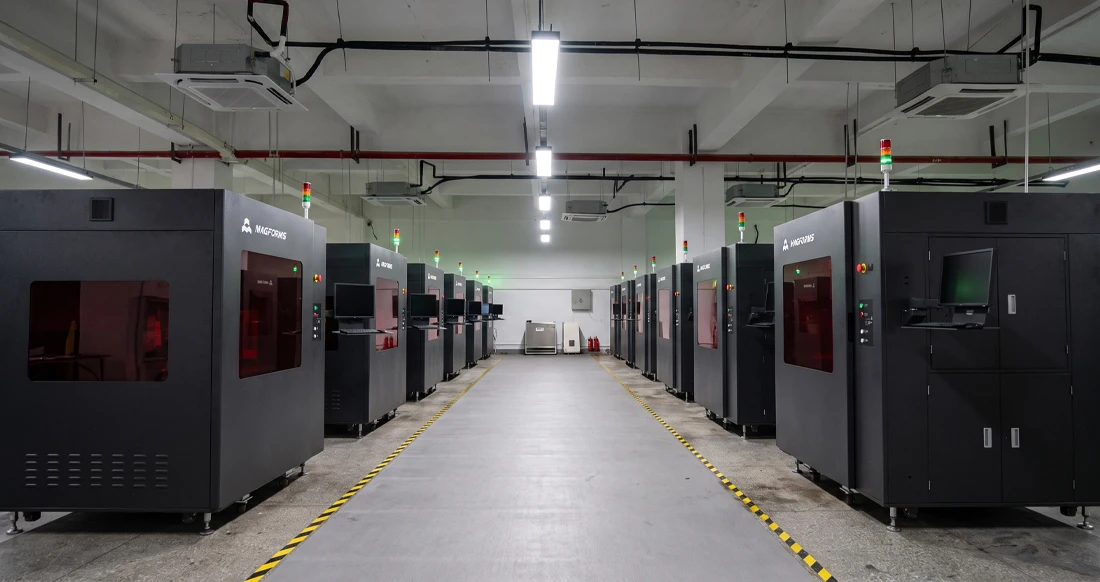
Magforms stands as a trusted big format SLA 3D printer supplier offering integrated solutions combining precision hardware with optimized materials. Our systems feature German Scanlab galvanometers and variable spot-size technology delivering 30-50% speed improvements over conventional methods. With 22 patents and proven reliability across 300+ enterprises globally, we provide comprehensive support, including 24/7 technical consultation and rapid response guarantees. Contact us info@magforms.com to discuss your specific requirements.
References
1. Smith, J. R. “Advanced Stereolithography Systems for Industrial Manufacturing Applications.” Journal of Additive Manufacturing Technology, Vol. 45, 2025, pp. 123–145.Smith, JR
2.Chen, L., and Rodriguez, M. “Application of Variable Spot-Size Laser Technology in Large-Format 3D Printing.” Proceedings of the International Conference on Digital Manufacturing, 2025, pp. 67–89.
3.Thompson, K. “Material Compatibility and Cost Optimization in Industrial SLA Systems.” Manufacturing Engineering Review, Vol. 32, No. 4, 2025, pp. 201–218.
4.Williams, P., et al. “Precision Requirements and Quality Control in Aerospace 3D Printing Applications.” Aerospace Manufacturing Quarterly, Vol. 18, 2025, pp. 45–62.
5.Anderson, R. “Total Cost of Ownership Analysis for Large-Scale Additive Manufacturing Equipment.” Industrial Equipment Economics, Vol. 29, 2025, pp. 112–134.
6.Martinez, S. “Future Trends and Market Applications of Stereolithography Technology.” 3D Printing Industry Analysis, 2026 Edition, pp. 78–95.

Magforms makes design and manufacture easier.
Popular Blogs
-
 Industry InsightsManufacturing Industry
FDM vs. SLA Printer: Which Technology Is Right for Your Project?
-
 Industry InsightsManufacturing Industry
Top 5 Applications of Industrial 3D Printers in Manufacturing Today
-
 Industry InsightsManufacturing Industry
Why Stereolithography 3D Printers Are Unmatched for Microfluidic Device Prototyping?