Future-Proof Your Factory with an Industrial SLA 3D Printer Today
Today, people in charge of manufacturing have to make a big choice: they can either change to new production methods or risk falling behind rivals who are open to new ideas. Buying an Industrial SLA 3D Printer is more than just buying tools; it's a long-term strategy for improving operating flexibility, making precise products, and staying competitive. Stereolithography technology has evolved from a prototyping solution into an advanced manufacturing technology for functional prototypes, tooling applications, and low-volume production. It can now achieve excellent dimensional accuracy, exceptional surface finishes, and a wide range of engineering materials that enable applications difficult to achieve with traditional manufacturing methods. When factories have industrial-grade SLA systems, they can quickly respond to changes in the design, avoid expensive tooling delays, and make complex geometries that were either impossible or too expensive to make before.
Industrial SLA vs Other 3D Printing Technologies: Making the Right Choice
To choose the best additive manufacturing platform, you need to know how the different technologies work differently. Depending on the needs of the application, the amount of production, and the properties of the material, each method has its own benefits, especially when selecting an Industrial SLA 3D Printer.
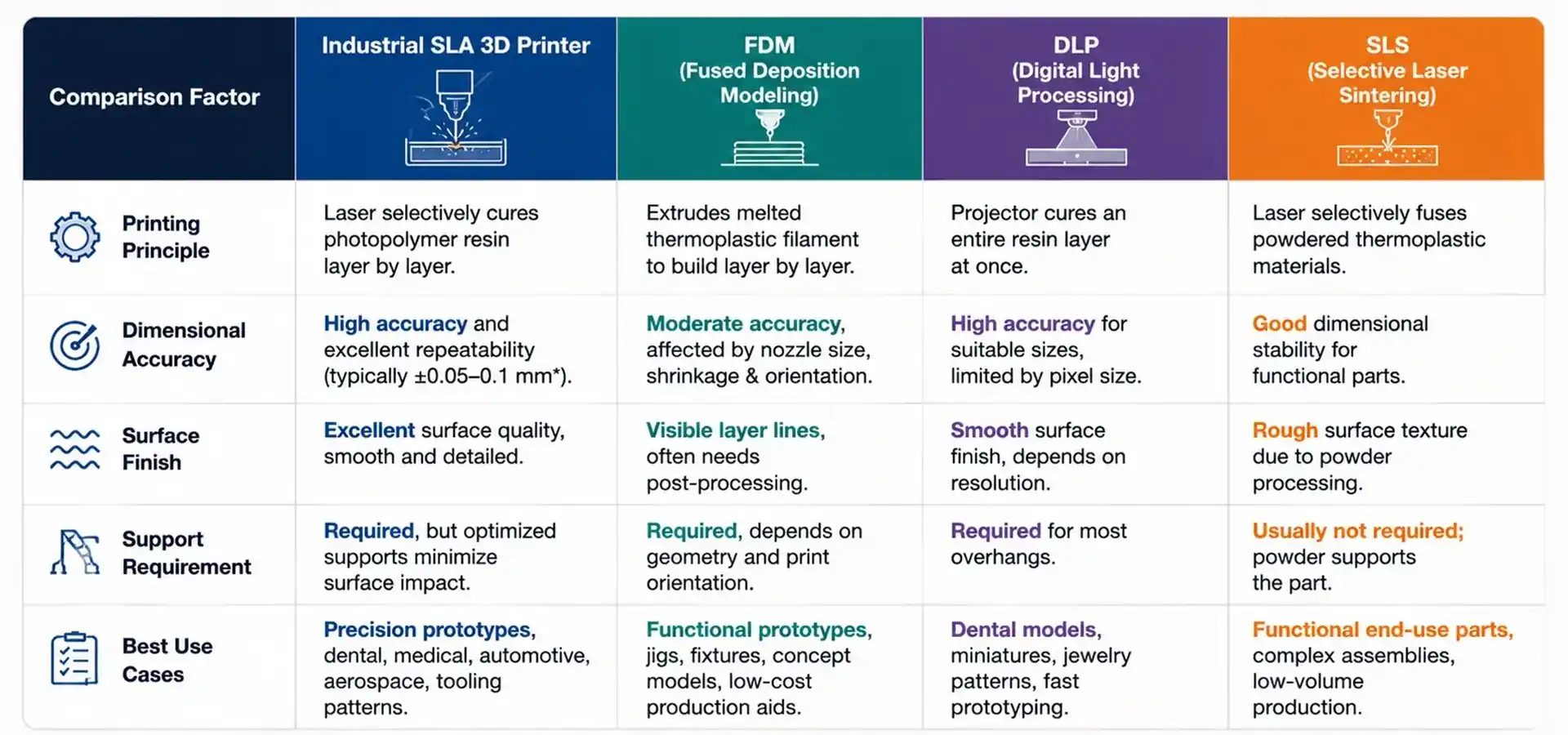
Comparative Analysis of Additive Technologies
Selective Laser Sintering (SLS) is great at making strong nylon parts without the need for support structures. This makes it a good choice for useful samples that need to be strong. SLS parts generally have a more textured surface finish compared with SLA, and additional finishing processes may be required when smoother cosmetic surfaces are needed. Digital Light Processing (DLP) uses a digital projector to expose an entire resin layer simultaneously, which can provide high printing efficiency, especially for parts that fit within the projected area. This makes the building process faster, but the achievable XY resolution depends on projector resolution, pixel size, optical design, and build area. Laser-based SLA systems offer flexible spot-size control, which can provide advantages in accuracy and surface quality for large industrial parts. Fused Deposition Modeling (FDM) offers affordable equipment and a wide range of thermoplastic materials. However, its layer-by-layer extrusion process can create visible layer lines and anisotropic mechanical properties, especially compared with resin-based technologies that provide smoother surfaces and finer details.
Industrial stereolithography is special because it can make surfaces that look like they were made with an injection mold, and also be accurate enough for engineering uses. This technology works with a wide range of resin formulations, such as those that are ABS-like, polypropylene-like, clear, resistant to high temperatures (HDT > 100°C), and flexible.
👉 What is SLA 3D printing technology
Application-Specific Technology Selection
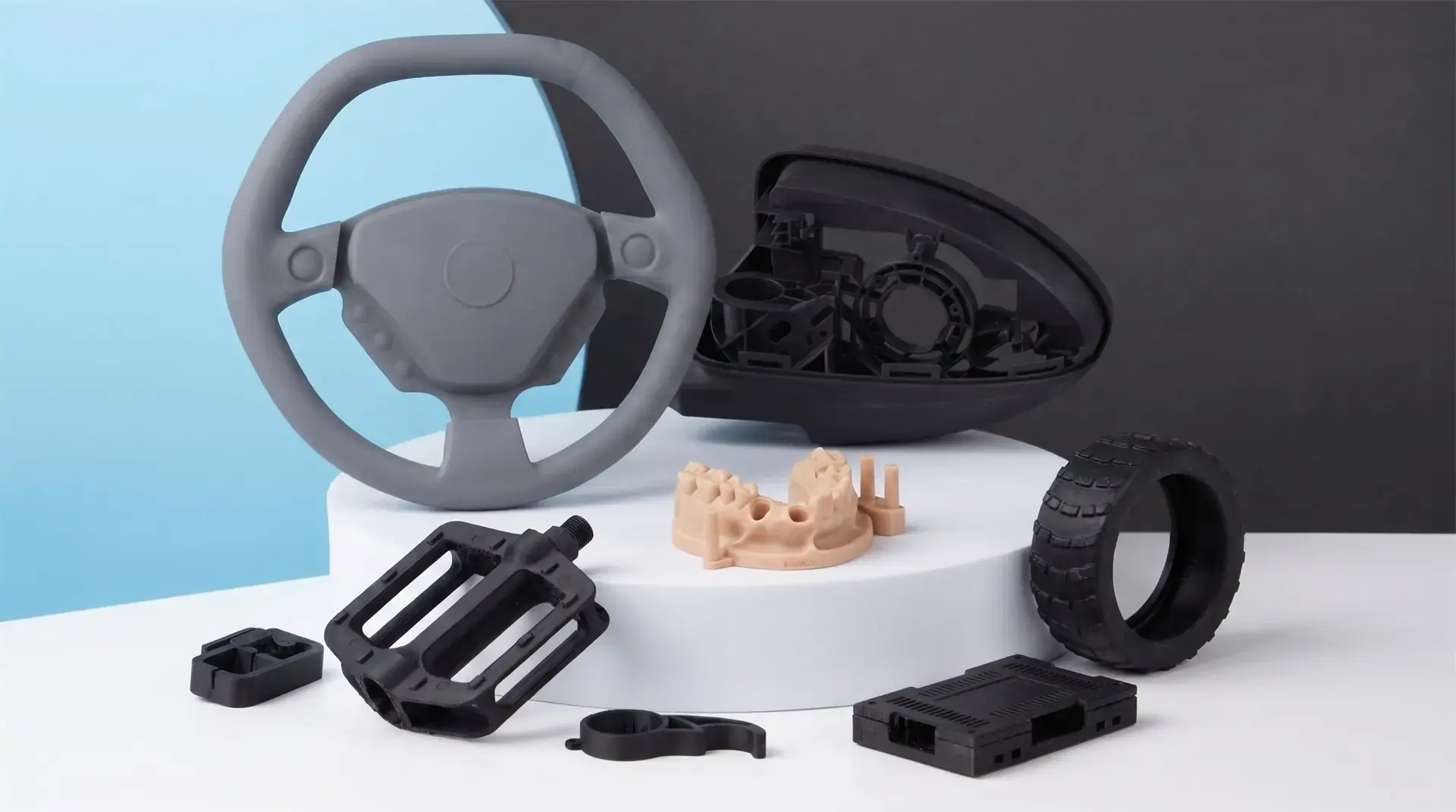
SLA technology is used by automotive development teams to make dashboard prototypes that are evaluated for fit, form, and surface finish before expensive tooling commitments are made. Aerospace component makers use the technology to make complex joints and parts with odd shapes in small batches. This is valuable because traditional machining often requires complex fixtures, multiple setups, and specialized tooling for similar geometries. Dental labs use SLA technology to produce orthodontic models and dental applications with specialized biocompatible resins that meet relevant regulatory requirements. Consumer electronics companies quickly change the cases and insides of wearable tech, which fits with the industry's tendency for short product cycles.
👉 Explore how Industrial SLA technology is applied in real production environments through our Industrial SLA 3D printing application cases.
How to Procure the Right Industrial SLA 3D Printer for Your Factory
Making decisions about purchases is more than just comparing specification sheets. To choose the right tools, you need to think about the total cost of ownership, the stability of the provider, and how well it fits with your current production needs and your plans for growth in the future.
Defining Technical Requirements and Budget Parameters
First, write down specific use cases: Is the main purpose of the equipment fast development, low-volume production, or making tools? What are the largest part sizes that your applications need? What are the most important qualities of a material? Are they strength, resistance to temperature, clarity, or flexibility? By answering these questions, you can define requirements for build volume, optical configuration, scanning performance, material compatibility, and overall system capability. The budget should include the cost of the initial equipment purchase, the ongoing resin use, the cost of replacing optical parts, and the yearly repair contracts. Ventilation systems, post-processing equipment (like washing stations and UV drying rooms), and training for operators are some of the hidden costs that should be considered during planning, including facility preparation, post-processing equipment, and operator training.
Evaluating Component Quality and System Architecture
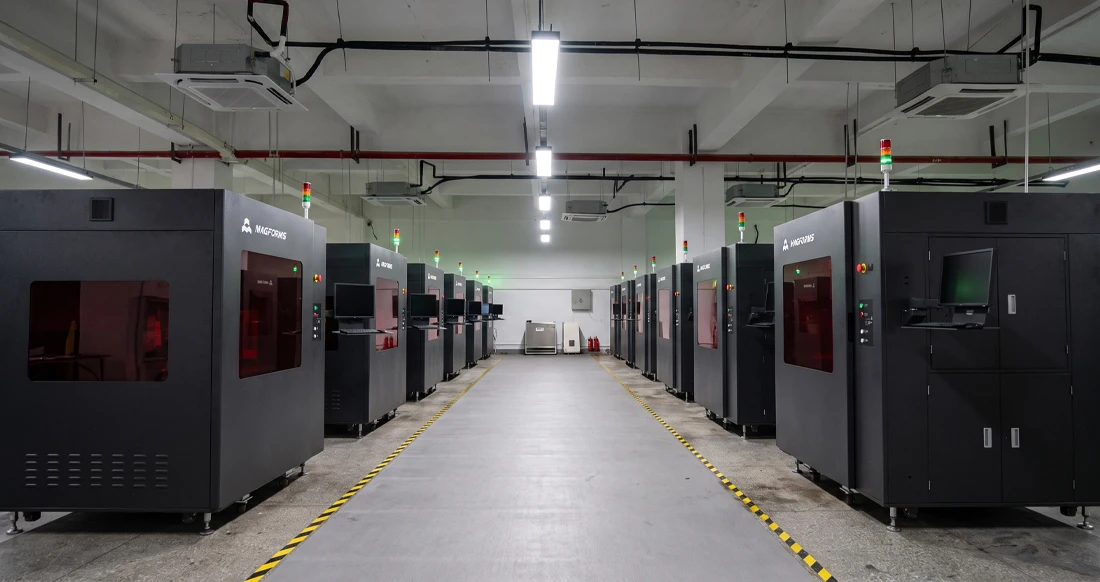
The dependability of equipment has a direct effect on the consistency of production. Magforms systems are a good example of this principle because they use well-known parts from around the world, such as AOC lasers that provide stable output for continuous industrial operation, German Scanlab galvanometers designed for high-speed and precise laser positioning, and Panasonic servo motors that allow precise movements with little error accumulation. Long-term operating safety is shown by the use of electrical parts from Schneider and UV curing components from Philips. The mechanical design of Industrial SLA 3D Printer systems focuses on rigid structures, optimized internal layouts, and high-flatness build platforms to maintain dimensional stability throughout the printing process.
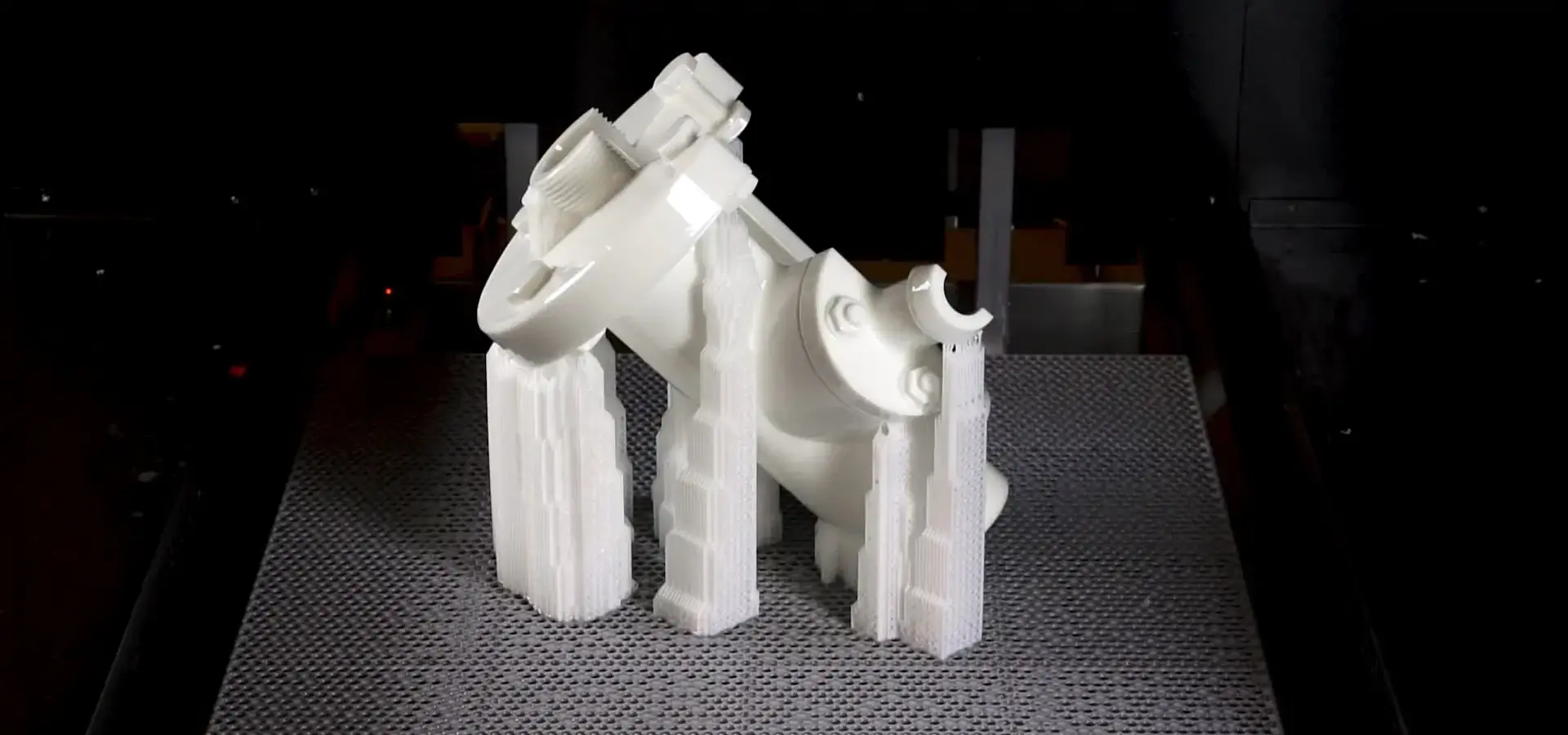
For manufacturers requiring large-format industrial SLA capability, the Magforms SL800 Industrial SLA 3D Printer is designed for applications such as automotive prototypes, industrial tooling, investment casting patterns, artistic models, and low-volume production parts. With an 800 × 800 × 550 mm build volume, the SL800 combines large-format printing capability with 355nm laser technology and precision scanning control, making it suitable for industrial prototyping, tooling, and low-volume manufacturing applications.
Supplier Assessment and After-Sales Support
Your relationship with the company that sold you the tools lasts for decades after the first buy. Evaluate manufacturers based on how quickly they respond to technical help requests, how easy it is to get replacement parts, and how they handle software updates. Magforms has a professional team of people who can answer customer questions within 24 hours. This keeps production from being held up, which can happen when equipment problems aren't fixed. The company's iBuild 2.0 control software provides an intuitive workflow for file preparation, printing management, and equipment operation. This enables operators to monitor printing status and manage production workflows more efficiently. Another important thing to think about is the flexibility of the materials. Systems with open resin platforms let you test third-party formulations and make custom materials, while proprietary material locks make it harder to change things and raise the costs of doing business.
Implementing Industrial SLA 3D Printing in Your Factory Workflow
Technical skill doesn't mean anything if it can't be properly integrated into the way things are made now. For execution to go smoothly, everything from setting up the hardware to training operators to improving processes and making sure quality standards are met must be carefully planned out.
Workflow Integration and Operational Setup
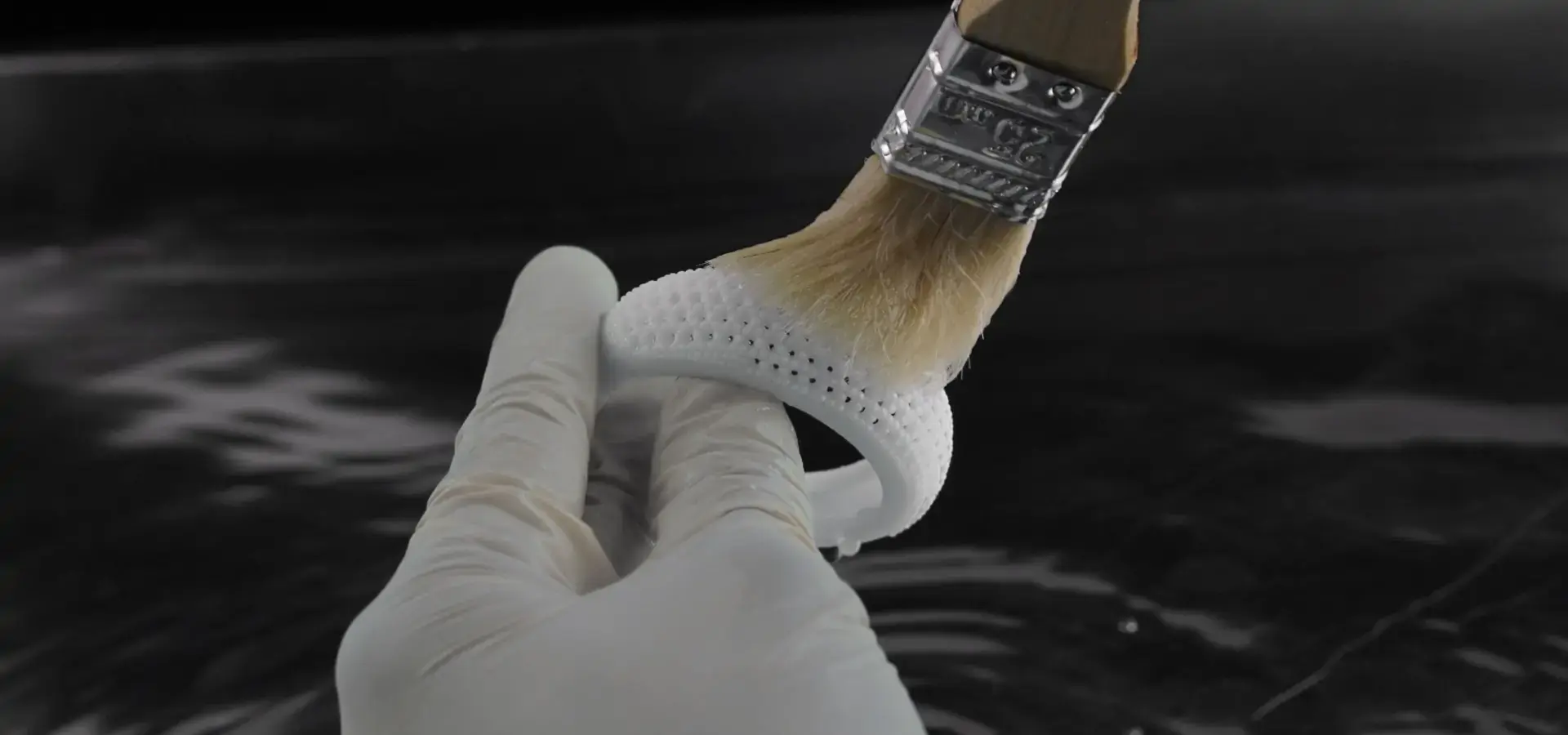
Industrial SLA production requires proper environmental control because resin viscosity can change with temperature variations. The SL800 integrates temperature management features to help maintain stable resin conditions during printing. This keeps the print quality consistent throughout the year. Make sure there is enough air flow to handle the photopolymer vapours, and set up different areas for pre-processing (preparing the file and making the support), printing, and post-processing (washing, drying, and removing the support). When training operators, they should learn how to optimise CAD files, set up support structures, print in the best orientation, and fix common failure modes like layer adhesion problems or incomplete curing.
Quality Control and Performance Monitoring
Using procedures for measurement testing makes sure that printed parts meet engineering requirements. Coordinate Measuring Machines (CMM) or optical 3D scanners check important measurements against the original CAD data, finding mistakes that need to be fixed by calibrating the machine. Keep an eye on key performance measures like the percentage of prints that go well, the average build time per part, the efficiency of material use, and first-pass yield (FPY). By looking at these measures, you can find ways to make things better, like optimizing parameters such as layer thickness, exposure settings, scanning strategy, and support structures to balance speed, accuracy, and surface quality.
Implementations in the real world show measured results. Many manufacturers can significantly reduce outsourcing time and accelerate product development cycles by bringing prototyping capabilities in-house. In medical and customized manufacturing applications, additive manufacturing can reduce tooling requirements and improve production flexibility. Advanced systems increasingly integrate software optimization, process monitoring, and data analysis to improve printing consistency and operational efficiency. These technologies can help optimize scanning strategies and reduce unnecessary trial-and-error during production.
Future Trends and Innovations in Industrial SLA 3D Printing
Additive manufacturing with Industrial SLA 3D Printer is changing quickly because of new discoveries in materials science, the use of AI, and the need to be more environmentally friendly in manufacturing around the world.
Advanced Materials Expanding Application Possibilities
New developments in resin chemistry have improved mechanical performance, allowing some engineering resins to approach the requirements of functional prototype and end-use applications. New versions improve their resistance to impact, chemical compatibility, and temperature stability. This means that it can be used for more than just testing and can now be used to make parts for production. Biocompatible plastics that are approved for making medical devices make it possible to make implants that are specific to each patient, and visually clear materials don't need to be polished as much as clear parts usually do. Magforms' knowledge as a materials expert makes sure that their printers get the best results with this growing range of resins. They especially do a great job with clear resin printing, which is notoriously difficult and needs precise exposure calibration.
Industry 4.0 Integration and Smart Manufacturing
Industrial SLA 3D Printers can be used in connected manufacturing ecosystems to schedule jobs automatically, use predictive maintenance algorithms, and keep an eye on production in real time. Advanced additive manufacturing workflows can integrate with digital manufacturing systems, production management platforms, and factory data environments. Production data analysis can help engineers identify optimal parameters for future builds and improve process repeatability. This cuts down on trial-and-error and speeds up time-to-market.
Sustainability and Circular Economy Considerations
Environmental duty is becoming more and more important in purchasing decisions. Additive manufacturing naturally wastes less material than subtractive methods because it builds parts only where material is needed instead of cutting it away from solid stock. New developments in closed-loop material systems and recyclable resins make sustainability profiles even better. Laser systems that use less energy and tracking methods that work better than others lower the amount of power needed for each part. This lowers both running costs and carbon footprints. These improvements help industrial operations better align with corporate sustainability goals.
Conclusion
Investing strategically in an Industrial SLA 3D Printer such as the Magforms SL800 gives manufacturing companies a flexible solution for high-precision prototyping, tooling applications, and low-volume production. With micron-level accuracy, wide material compatibility, and short production processes, this technology solves major problems in the automobile, aircraft, medical, electronics, and consumer goods sectors. Modern systems are reliable because they use high-quality parts, are easy to use because they have smart software, and are worth investing in for the long term because they have a full support infrastructure. When factories have industrial additive manufacturing, they can respond faster to market needs, cut down on development costs, and make complex shapes that can't be made any other way. The technology isn't just production equipment; it's also a big step toward manufacturing ecosystems that are flexible and digitally integrated, ready to adapt to changing market needs.
FAQ
1. What is the typical lifespan of an Industrial SLA 3D Printer?
High-quality systems built with premium components typically operate effectively for 8-12 years with proper maintenance. Industrial laser sources are designed for long operational lifetimes, and regular calibration helps maintain consistent energy output during extended use. Regular maintenance of mechanical components such as linear guides and recoater systems extends equipment longevity.
2. How does printing speed compare to traditional manufacturing methods?
Production time depends heavily on part complexity and volume. Simple prototypes print in 4-8 hours compared to weeks for outsourced machining. Variable spot-size technology can improve scanning efficiency by adapting laser parameters for different areas of a part, helping optimize the balance between speed and surface quality. Batch production of multiple parts simultaneously maximizes build platform utilization.
3. What post-processing steps are necessary for printed parts?
Parts require washing in isopropyl alcohol or specialized cleaning solutions to remove uncured resin, followed by UV post-curing to achieve final mechanical properties. Support structure removal and optional surface finishing (sanding, painting, coating) complete the workflow. Total post-processing typically requires 30-90 minutes per build, depending on part complexity.
4. Can Industrial SLA 3D Printers handle large-scale production?
While additive manufacturing excels at low-to-medium volumes (1-1000 units), it becomes less cost-effective than injection molding at high volumes due to per-part production time. The technology optimally serves rapid prototyping, bridge production during tooling development, and customized or low-volume end-use parts where tooling costs are prohibitive.
Partner with Magforms: Your Trusted Industrial SLA 3D Printer Manufacturer
Magforms brings decades of materials science expertise and manufacturing excellence to help future-proof your production capabilities. Our integrated approach combines self-developed resins with precision-engineered equipment, eliminating compatibility issues that plague mixed-vendor solutions. With 22 patents and 30 registered trademarks, we've established technological leadership serving over 300 enterprises across dozens of countries.
Our Industrial SLA 3D Printer systems feature German Scanlab galvanometers, AOC lasers, Panasonic servo motors, and comprehensive safety features, including optical protection covers and laser safety systems. The open material architecture supports most 355nm resins, providing operational flexibility while our proprietary formulations deliver exceptional results for challenging applications like transparent parts. The professional after-sales team responds within 24 hours, preventing costly production interruptions.
Contact our technical specialists at info@magforms.com to discuss your specific requirements. We provide detailed application assessments, sample part validation, and tailored recommendations matching your production needs and budget parameters. Discover why leading manufacturers choose Magforms as their Industrial SLA 3D Printer supplier for mission-critical applications.
References
1. Gibson, I., Rosen, D., & Stucker, B. (2021). Additive Manufacturing Technologies: 3D Printing, Rapid Prototyping, and Direct Digital Manufacturing. Springer International Publishing.
2. Jacobs, P.F. (2019). Stereolithography and Other RP&M Technologies: From Rapid Prototyping to Rapid Tooling. Society of Manufacturing Engineers.
3. Wohlers, T. (2022). Wohlers Report 2022: 3D Printing and Additive Manufacturing Global State of the Industry. Wohlers Associates.
4. ISO/ASTM 52915:2020. Standard Specification for Additive Manufacturing File Format (AMF) Version 1.2. International Organization for Standardization.
5. Chua, C.K., & Leong, K.F. (2020). 3D Printing and Additive Manufacturing: Principles and Applications. World Scientific Publishing.
6. Gebhardt, A. (2021). Rapid Prototyping: Industrial Applications and Technologies for Advanced Manufacturing. Hanser Publications.

Magforms makes design and manufacture easier.
Popular Blogs
-
 Industry InsightsManufacturing Industry
FDM vs. SLA Printer: Which Technology Is Right for Your Project?
-
 Industry InsightsManufacturing Industry
Top 5 Applications of Industrial 3D Printers in Manufacturing Today
-
 Industry InsightsManufacturing Industry
Why Stereolithography 3D Printers Are Unmatched for Microfluidic Device Prototyping?