How Can SLA 3D Printers Improve Speed and Stability in Manufacturing?
With changeable spot-size laser systems and AI-optimized scanning paths, SLA 3D Printer technology changes the way things are made and makes them much faster. It also makes them much more stable with precision galvanometer controls and built-in material-equipment optimisation. These stereolithography systems can make things 30–50% faster than traditional methods while still being accurate to the micron level. This makes them perfect for industries like electronics, aerospace, medicine, and automotive that need rapid prototyping, small-batch production, and high-precision manufacturing.

Understanding SLA 3D Printing Technology and Its Role in Manufacturing
Stereolithography represents the pinnacle of vat photopolymerization technology, utilizing high-precision UV lasers to cure liquid photopolymer resins layer by layer. The fundamental process involves a computer-controlled galvanometer system that directs laser energy onto a resin vat, creating cross-linked polymer structures with exceptional dimensional accuracy and surface quality.
Core Components and Workflow Architecture
Many important parts are built into modern SLA 3D printers that have a direct effect on how well they make things. Laser pointing is very accurate with German Scanlab galvanometers (accuracy measured in micrometres), and AOC laser systems provide steady power output that is needed for even curing. The movement of the build platform, which is usually managed by Panasonic AC servo motors, makes sure that the layers are perfectly aligned and that the machine stays stable during the printing process. The process starts with preparing the CAD model. This is where advanced slicing software creates the best printing lines. During production, the laser lines up each cross-section on the resin surface, which starts photopolymerization processes that make solid networks of polymers. As each layer is finished, the build platform moves up and down, letting fresh glue flow over the hardened surface to start the next layer.
Industry Applications and Manufacturing Advantages
Stereolithography technology solves important problems in a wide range of industrial fields. Engineers in the car industry use these systems to make quick prototypes of customised interior parts and special tools, which cuts down on development times by a large amount. When it comes to making complex shapes with internal channels and negative drafts, which are impossible to do with standard machining methods, the aerospace industry uses SLA.The biocompatible resin choices and high-quality surfaces work especially well in medical and dental settings. Stereolithography is used to make surgical guides, orthodontic models, and custom implant samples because it is accurate and consistent. The technology makes it possible to make parts that are waterproof, have the same shape all the way through, and have good mechanical properties for functional testing and end-use applications.

Key Factors Influencing Speed and Stability in SLA 3D Printing
Manufacturing efficiency in stereolithography depends on SLA 3D Printer several interconnected variables that manufacturers must optimize to achieve maximum productivity while maintaining quality standards. Understanding these factors enables informed decision-making regarding equipment selection and process optimization.
Resolution and Build Speed Optimization
The size of the laser spot determines the XY precision, which in turn affects the printing speed and level of detail. Using 0.5–0.6 mm spots for quick internal filling and 0.18–0.2 mm spots for precise outlines is a big step forward in variable spot-size technology. This smart method gets around the usual trade-off between speed and accuracy, allowing up to a 50% increase in speed without lowering the quality of the details.The choice of layer height changes both the build time and the finish of the surface. While 25-micron layers give you a lot of detail, 100-micron layers usually give you good enough quality while taking a lot less time to print. Advanced slicing algorithms look at the shape of the part and automatically find the best layer heights, only using higher resolution for important features when they are needed.
Material Properties and Compatibility
The choice of resin has a big effect on both the reliability of printing and the performance of the end part. High-temperature resins (HDT >238°C) and tough formulas (simulating ABS properties) are examples of engineering-grade materials that can be used in more situations and are still very easy to print. Open-source material compatibility gets rid of vendor lock-in, so makers can get specialised formulations while also cutting costs. How the materials are handled and stored has a big effect on how consistent the printing is. Filtration that works right gets rid of partially cured particles that can ruin prints, and temperature control makes sure that the viscosity and drying properties stay the same. Modern systems keep an eye on the properties of resin in real time and let workers know about any problems before they affect the quality of the production.
Hardware Integration and System Stability
Stable laser power and good beam quality have a direct effect on how evenly the build platform cures. High-quality laser systems keep changes in power output to within ±2%, which makes sure that all printed parts have the same mechanical qualities. Dimensional accuracy is affected by galvanometer accuracy. Industrial systems can achieve positioning consistency of ±10 micrometres or better. The mechanics of the build platform are very important for keeping the dimensions correct and avoiding print fails. Vibrations that could throw off the alignment of the layers are kept to a minimum by using precise linear guides and strong support structures. Force monitoring devices find peel forces that are too high and could damage delicate parts or cause them to come off during printing.

Overcoming Common Challenges for Stable and Fast SLA Manufacturing
Successful stereolithography implementation requires proactive management of potential issues that can disrupt production schedules and compromise part quality. Identifying common failure modes and implementing preventative measures ensures consistent manufacturing output.
Print Failure Prevention and Quality Assurance
Support structure optimization represents a critical factor in preventing print failures while minimizing post-processing time. Advanced software algorithms analyze part geometry to generate minimal support structures that provide adequate anchoring without leaving excessive marks on finished surfaces. Proper support design prevents warping, reduces peel forces, and enables the successful printing of complex geometries. Resin curing inconsistencies often result from contamination, improper mixing, or environmental factors. Regular filtration removes debris and partially cured particles, while proper storage in dark, temperature-controlled environments maintains resin properties. Quality control protocols include regular test prints to verify dimensional accuracy and that mechanical SLA 3D Printer properties meet specifications.
Maintenance Protocols and Equipment Longevity
Regular calibration procedures ensure continued precision throughout the equipment's lifespan. Laser power verification, galvanometer accuracy checks, and build platform leveling should be performed according to manufacturer recommendations. Preventive maintenance schedules reduce unexpected downtime and extend component life, protecting manufacturing investments. Cleaning procedures significantly impact system reliability and part quality. Proper vat maintenance prevents resin contamination, while optical component cleaning ensures consistent laser power delivery. Automated cleaning systems reduce labor requirements while maintaining thorough decontamination between different materials or production runs.
Post-Processing Workflow Optimization
Efficient post-processing workflows contribute significantly to overall manufacturing speed. Automated washing systems ensure complete uncured resin removal without manual intervention, while programmable curing chambers provide consistent final properties. Integration of these systems with production scheduling reduces handling time and minimizes contamination risks. Parts handling and finishing procedures affect final quality and production throughput. Proper support removal techniques minimize surface damage, while automated finishing equipment can achieve consistent surface textures across production batches. Quality inspection protocols verify that dimensional accuracy and surface finish meet specifications before parts enter downstream processes.
Comparing SLA 3D Printers with Other Technologies: Speed and Stability Analysis
Manufacturing technology selection requires careful evaluation of speed, quality, and reliability characteristics relative to specific application requirements. Stereolithography offers distinct advantages in certain scenarios, while other technologies excel in different manufacturing contexts.
SLA Versus FDM Technology Comparison
Fused deposition modeling (FDM) systems typically offer faster build speeds for large, simple geometries but struggle with fine details and smooth surface finishes. SLA 3D Printer technology excels in applications requiring high resolution, complex geometries, and superior surface quality. While FDM materials often cost less per volume, SLA parts require minimal post-processing to achieve finished quality. Dimensional accuracy represents a significant differentiator between technologies. SLA systems routinely achieve tolerances of ±0.1 mm or better, while FDM systems typically deliver ±0.2-0.5 mm accuracy depending on part geometry and printing parameters. For precision applications such as tooling, fixtures, and functional prototypes, this accuracy advantage often justifies the technology selection.

Desktop Versus Industrial SLA Capabilities
Desktop stereolithography systems provide excellent detail quality but limited build volumes and throughput capacity. Industrial SLA 3D Printer systems offer larger build platforms, higher-power laser systems, and enhanced reliability for production environments. Build volumes ranging up to 600x800 mm enable batch production of multiple parts or single large components, which is impossible on desktop systems. Reliability and uptime represent critical factors for production environments. Industrial systems incorporate redundant subsystems, advanced monitoring capabilities, and robust mechanical components designed for continuous operation. While desktop systems serve well for prototyping and small-batch work, production environments typically require the enhanced capabilities of industrial platforms.
Cost-Benefit Analysis for Manufacturing Applications
Initial equipment investment varies significantly across system capabilities and manufacturers. Desktop systems start around $3,000-5,000, while industrial platforms range from $50,000-300,000, depending on build volume and features. However, the total cost of ownership includes material costs, maintenance requirements, and labor efficiency factors that often favor higher-capability systems for production applications. Production volume analysis helps determine optimal technology selection. Low-volume, high-precision applications typically favor SLA 3D Printer over SLA technology despite higher per-part material costs. High-volume production may benefit from injection molding or other traditional methods, while SLA serves well for tooling, fixtures, and specialized components within these workflows.
Strategic Procurement of SLA 3D Printers to Enhance Manufacturing Outcomes
Successful integration of stereolithography technology requires careful evaluation of equipment capabilities, supplier support, and long-term strategic alignment with manufacturing objectives. Proper procurement strategies maximize return on investment while ensuring reliable production capabilities.
Equipment Specification and Supplier Evaluation
Technical specifications must align with specific application requirements and anticipated production volumes. Build volume, laser power, resolution capabilities, and material compatibility represent primary selection criteria. Advanced features such as variable spot-size technology and AI-optimized scanning paths can provide significant productivity advantages that justify premium pricing. Supplier evaluation should encompass technical support capabilities, training programs, and warranty coverage. Companies offering 24/7 remote support and guaranteed response times provide valuable assurance for production environments. Technical training programs ensure operators can maximize equipment capabilities while maintaining safety and quality standards.
Integration and Implementation Strategies
As part of preparing a facility, air controls, ventilation systems, and safety gear needed for working with resin and protecting against UV exposure are all required. When you plan ahead, installation goes smoothly and starting times are kept to a minimum. Integrating with current CAD/CAM processes needs checking to see if the software is compatible and may need training. To improve the flow of work in production, you need to come up with custom standard operating procedures, quality control methods, and maintenance schedules. Working with suppliers who have a lot of knowledge can help you learn about best practices and possible problems that could happen during implementation. Material supply chain management makes sure that output can be maintained while costs are kept as low as possible. Open-source material compatibility lets you choose your seller and negotiate prices in a variety of ways. Having relationships with more than one resin source lowers the risks in the supply chain and gives you access to unique formulations for specific uses.
Conclusion
The SLA 3D Printer technology makes production much faster and more stable by using advanced laser systems, smart scanning algorithms, and built-in material optimisation. Manufacturers can make things 30–50% faster than before by using variable spot-size technology, precise galvanometer controls, and full quality management systems together. This is possible while still keeping high levels of accuracy and surface quality. Because of these features, stereolithography is very useful for industries that need to make prototypes quickly, work with complicated shapes, and make things with a high level of accuracy, like those in the medical, aerospace, electronics, and automotive industries. To make sure long-term manufacturing success and a high return on investment, implementation plans must carefully look at technical requirements, supplier skills, and integration strategies.
FAQ
1. How much faster is SLA printing compared to other 3D printing technologies?
SLA systems with variable spot-size technology achieve 30-50% faster printing speeds compared to conventional stereolithography methods. When compared to FDM technology, SLA often prints similar volumes faster while delivering superior surface quality and dimensional accuracy, particularly for complex geometries with fine details.
2. What maintenance practices ensure long-term SLA printer stability?
Regular calibration procedures, including laser power verification and galvanometer accuracy checks, maintain system precision. Proper cleaning protocols for optical components and resin vats prevent contamination issues. Following manufacturer-recommended maintenance schedules and using genuine replacement parts extends equipment lifespan and reduces unexpected downtime.
3. Can SLA technology handle high-volume manufacturing requirements?
Industrial SLA 3D Printer systems excel at small to medium batch production, typically ranging from prototyping to several thousand parts annually, depending on size and complexity. While not suitable for high-volume injection molding applications, SLA provides excellent solutions for specialized components, tooling, and custom manufacturing where precision and flexibility outweigh pure volume considerations.
Discover Advanced SLA 3D Printer Solutions with Magforms
Magforms delivers cutting-edge stereolithography technology that transforms manufacturing speed and stability through innovative variable spot-size systems and integrated material optimization. Our industrial-grade SLA 3D Printer solutions feature German Scanlab galvanometers, precision laser systems, and AI-enhanced scanning algorithms that achieve 30-50% faster production rates while maintaining micron-level accuracy. With comprehensive technical support, open-source material compatibility, and proven reliability across global manufacturing applications, Magforms provides the complete solution for your precision manufacturing needs. Contact our expert team at info@magforms.com to explore how our SLA 3D printer manufacturer capabilities can enhance your production efficiency and quality standards.
References
1. Gibson, Ian, et al. "Additive Manufacturing Technologies: 3D Printing, Rapid Prototyping, and Direct Digital Manufacturing." Springer, 2021.
2. Melchels, Ferry P.W., et al. "A Review on Stereolithography and its Applications in Biomedical Engineering." Biomaterials, vol. 31, no. 24, 2010, pp. 6121-6130.
3. Jacobs, Paul F. "Fundamentals of Stereolithography." Society of Manufacturing Engineers, 2019.
4. Chartrain, Nicholas A., et al. "A Review on Fabricating Tissue Scaffolds Using Vat Photopolymerization." Acta Biomaterialia, vol. 74, 2018, pp. 90-111.
5. Quan, Huan, et al. "Photo-curing 3D Printing Technique and Its Challenges." Bioactive Materials, vol. 5, no. 1, 2020, pp. 110-115.
6. Stansbury, Jeffrey W., and Mike J. Idacavage. "3D Printing with Polymers: Challenges among Expanding Options and Opportunities." Dental Materials, vol. 32, no. 1, 2016, pp. 54-64.

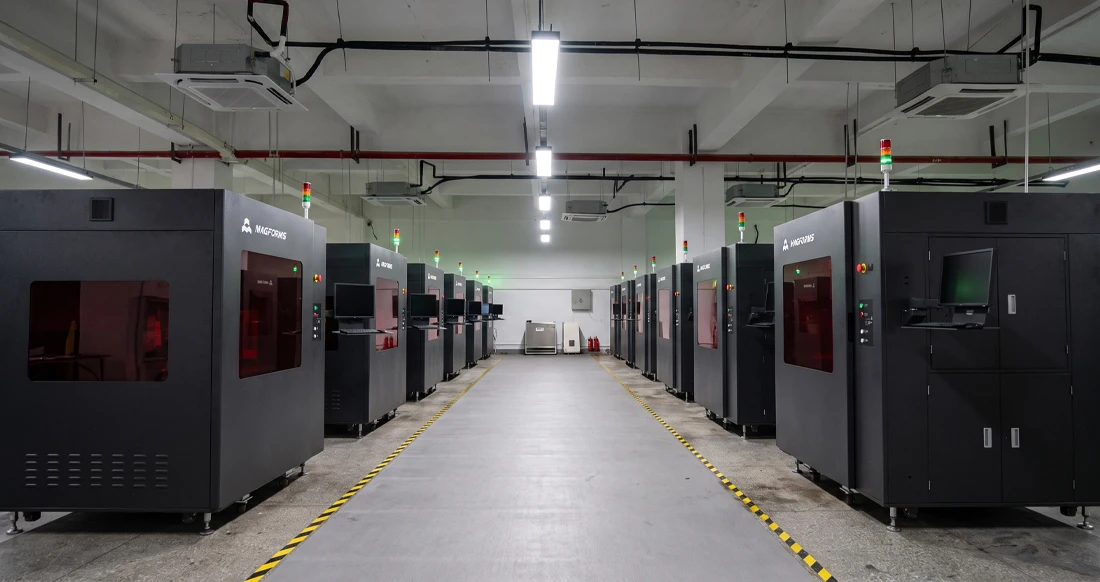
Magforms makes design and manufacture easier.
Popular Blogs
-
 Industry InsightsManufacturing Industry
FDM vs. SLA Printer: Which Technology Is Right for Your Project?
-
 Industry InsightsManufacturing Industry
Top 5 Applications of Industrial 3D Printers in Manufacturing Today
-
 Industry InsightsManufacturing Industry
Why Stereolithography 3D Printers Are Unmatched for Microfluidic Device Prototyping?