How Does Advanced Light Source Technology Improve Resin Printing?
Modern light source technology completely changes how resin printers work by distributing UV energy more accurately, making drying more even, and printing at much faster speeds. Modern resin printers utilize different light source technologies depending on their architecture, including laser-based scanning systems and LED-based masked exposure systems. Intelligent exposure algorithms further improve polymerization at the molecular level. These new ideas get rid of common problems like uneven layers, incomplete curing, and wrong measurements. They also make it possible for faster throughput and better surface finishes in a wide range of commercial settings.
Understanding the Basics of Resin Printing and Light Sources
To make good resin prints, you need to know how photopolymerization, which involves controlled light exposure, turns liquid resins into solid objects. Photopolymer systems depend on precise UV wavelength delivery to start chemical cross-linking reactions. This is different from standard filament-based methods that use thermal processes.
Key Principles of Photopolymerization Technology
Stereolithography (SLA), digital light processing (DLP), and masked stereolithography (mSLA) are the methods that modern photopolymer systems use to work. Each method uses a different way to send light, which has an effect on print quality, speed, and the compatibility of the materials used. SLA systems use scanning laser beams to cure resin one spot at a time, while DLP and LCD systems show whole-layer pictures at the same time. The accuracy of these systems relies a lot on the light source's wavelength accuracy, even intensity, and the ability to control the exposure timing. Professional-level machines can reach XY resolutions of 10 to 50 microns and Z-axis accuracy of 10 microns or less. This makes them useful for making medical devices, aerospace prototypes, and precise tools.

Traditional Light Source Limitations
Conventional light sources in resin printers often have a number of major flaws that slow down production and lower the quality of the parts. Different build platforms with different light intensities cause differences in size between the center and the edges, which causes prints to fail and wastes materials during batch production processes. When regular UV sources produce heat, mechanical parts expand, and LCD panels break down faster. This means that they need to be serviced more often and have unexpected downtime. Inefficient use of energy leads to higher costs and limits the ability to grow production, which is especially hard for small and medium-sized businesses that are trying to make ends meet.
The Evolution and Advantages of Advanced Light Source Technology
The progression from basic UV lamps to sophisticated light engines represents a fundamental shift in additive manufacturing capabilities. Advanced systems now incorporate precision optics, intelligent exposure controls, resin printers, and adaptive algorithms that optimize printing parameters in real-time.
Enhanced Uniformity and Precision Control
Modern light engines achieve greater than 95% uniformity across entire build platforms through collimating lens systems and calibrated LED arrays. This advancement eliminates the dimensional variations that plagued earlier systems, ensuring consistent part quality regardless of position on the build plate. Instead of scanning a laser beam, modern LCD-based resin printers cure entire layers simultaneously using high-resolution LCD masking. Pixel-level exposure control allows these systems to maintain fine detail accuracy while efficiently curing larger solid regions, effectively balancing speed and precision demands that previously required compromise.
Improved Energy Efficiency and System Reliability
Advanced LED-based systems consume 40-60% less energy compared to traditional mercury vapor lamps while generating minimal heat output. This efficiency improvement reduces cooling requirements, extends component lifespan, and enables continuous operation cycles essential for production environments. Temperature stability directly correlates with printing consistency and equipment longevity. Modern systems maintain operational temperatures within ±2°C tolerance, preventing thermal-induced dimensional drift and ensuring repeatable results across extended print runs.

How Advanced Light Source Technology Solves Common Resin Printing Challenges
Production facilities across industries face recurring challenges with traditional photopolymer systems that advanced light sources directly address. Understanding these problem-solution relationships helps manufacturing teams make informed equipment selection decisions.
Addressing Layer Accuracy and Curing Consistency
Incomplete polymerization and over-curing represent persistent challenges in conventional systems due to uneven light distribution and inadequate exposure control. Advanced systems employ adaptive exposure control and grayscale masking techniques that adjust UV energy distribution based on geometric complexity and resin properties, ensuring optimal curing throughout each layer. Adaptive exposure algorithms analyze geometric data and automatically compensate for features requiring different curing profiles. Thin walls receive reduced exposure to prevent brittleness, while solid sections receive enhanced intensity for complete polymerization. This intelligent approach eliminates the trial-and-error process traditionally required for complex geometries.
Minimizing Maintenance and Operational Downtime
Heat-related component failures frequently disrupt production schedules in traditional systems, particularly affecting LCD panels and optical elements. Advanced thermal management through efficient LED systems and active cooling extends component service life by 200-300%, dramatically reducing maintenance frequency and associated costs. Predictive maintenance capabilities integrated into modern systems monitor light source performance and automatically alert operators before failures occur. This proactive approach prevents unexpected downtime and enables scheduled maintenance during non-production periods, maximizing equipment utilization rates.
Selecting the Right Resin Printer Enhanced by Advanced Light Source Technology
Procurement decisions for industrial resin printer systems require careful evaluation of technical specifications, operational requirements, and long-term strategic objectives. The integration of advanced light sources fundamentally changes the selection criteria and performance expectations for these systems.
Critical Selection Parameters for B2B Applications
The build volume needed for testing is very different from that for production. Large-format systems with 300x300x400mm volumes can process a lot of parts at once or one big assembly, while compact systems make the best use of desk area and materials in research settings. The resolution standards must match the tolerances and surface finish needs of the application. When making medical devices, the XY resolution needs to be 25 microns, and the Z-axis needs to be 10 microns precise. For cost reasons, building models may be able to handle 50 to 100 microns of resolution. These precise levels are made possible by modern light sources that keep production speeds high enough for business use.
Material Compatibility and Workflow Integration
When compared to private resin systems, open-source material compatibility gives operations a lot more freedom and helps keep costs down. Modern light sources can work with a wide range of photopolymer mixtures, such as industrial resins, biocompatible materials, and high-temperature polymers, without the need to change the hardware. Workflow integration features, such as cloud connectivity, automated tracking, and quality control systems, make production processes more efficient and cut down on the number of workers needed. When operations need to be scaled up, and the quality of the output needs to be kept the same across multiple machines or work shifts, these features become very useful.

Future Trends in Resin Printing Led by Advanced Light Source Innovations
The trajectory of photopolymer manufacturing points toward increasingly sophisticated systems that leverage artificial intelligence, advanced materials science, and precision optics to overcome current limitations in speed, scale, and sustainability.
Emerging Technologies and Market Transformation
Integration of artificial intelligence (AI) makes predictive print optimisation possible by looking at past data and automatically changing exposure settings to get the best results. Machine learning algorithms keep improving printing profiles based on the properties of the material, the complexity of the geometry, and the surroundings. This cuts down on setup time and raises the success rate. Through advanced light modulation, multi-material potential lets different resins be processed at the same time within a single build. This new technology makes it possible for gradient properties, embedded electronics integration, and complicated assemblies that don't need to be put together after processing, which completely changes the ways that products can be designed.
Strategic Planning for Technology Adoption
When investing in resin printer technology, you have to weigh the needs of today's operations against the needs of tomorrow's capabilities. Partnerships with technology leaders that offer upgrade paths and ongoing help as capabilities change are good for businesses. As systems get more complex and can do more on their own, training workers in resin printers becomes more and more important. Teams can get the most out of their tools and stay ahead of the competition in markets that are changing quickly by focusing on training programs that teach advanced materials handling, quality control, and predictive maintenance.

Conclusion
New light source technology changes what resin printers can do by making them more precise, efficient, and reliable in a wide range of commercial settings. The change from simple UV systems to smart, flexible light sources solves long-standing problems and opens up new additive manufacturing opportunities. Companies that buy these high-tech systems have a big edge over their competitors because they improve quality consistency, lower running costs, and make production more flexible. Light source technology is always getting better, which means that companies need to form strategic relationships with innovative suppliers to be successful in the ever-changing world of photopolymer manufacturing.
FAQ
1. How much faster are advanced light sources compared to traditional systems?
Advanced light source systems typically achieve 30-50% faster printing speeds through full-layer exposure, improved light uniformity, and optimized exposure timing.Dynamic beam control allows simultaneous speed optimization for different geometric features within the same layer, significantly reducing overall build times while maintaining precision requirements.
2. What safety protocols are required for high-intensity UV exposure systems?
Professional installations require UV-protective enclosures, automatic safety shutoffs, and proper ventilation systems. Personnel training covers UV exposure risks, proper handling procedures, and emergency response protocols. Modern systems incorporate multiple safety interlocks and monitoring systems that prevent accidental exposure during operation or maintenance.
3. Are advanced light source systems compatible with existing resin formulations?
Most advanced systems maintain compatibility with standard 405nm photopolymer resins while expanding capability to specialized formulations. Open-source designs enable users to optimize exposure parameters for specific materials, providing flexibility unavailable in proprietary systems. Calibration procedures ensure optimal performance across different resin types and brands.
Partner with Magforms for Advanced Resin Printing Solutions
Magforms delivers cutting-edge resin printer technology enhanced by high-uniformity LED light engines and precision LCD masking systems, achieving significant improvements in speed, consistency, and reliability over conventional solutions.Our integrated material and equipment solutions eliminate compatibility issues while providing industry-leading precision and reliability. With 22 patents, comprehensive technical support, and proven performance across 300+ enterprises worldwide, we offer the expertise and innovation your operation demands. Contact our team at info@magforms.com to explore how our advanced resin printer manufacturer solutions can transform your production capabilities and competitive position.
References
1. Gibson, Ian, et al. "Additive Manufacturing Technologies: 3D Printing, Rapid Prototyping, and Direct Digital Manufacturing." Third Edition, Springer, 2021.
2. Melchels, Ferry P.W., et al. "A Review on Stereolithography and Its Applications in Biomedical Engineering." Biomaterials Journal, Vol. 31, 2020.
3. Chatham, Christopher A., et al. "A Review of the Process Physics and Material Screening Methods for Polymer Powder Bed Fusion Additive Manufacturing." Progress in Polymer Science, Vol. 93, 2019.
4. Quan, Huan, et al. "Photo-curing 3D Printing Technique and Its Challenges." Bioactive Materials Journal, Vol. 5, Issue 1, 2020.
5. Ligon, S. Christian, et al. "Polymers for 3D Printing and Customized Additive Manufacturing." Chemical Reviews, Vol. 117, Issue 15, 2017.
6. Abdel-Aziz, Ahmed, et al. "Advanced Light Source Technologies in Stereolithography: Performance Analysis and Industrial Applications." International Journal of Advanced Manufacturing Technology, Vol. 108, 2020.

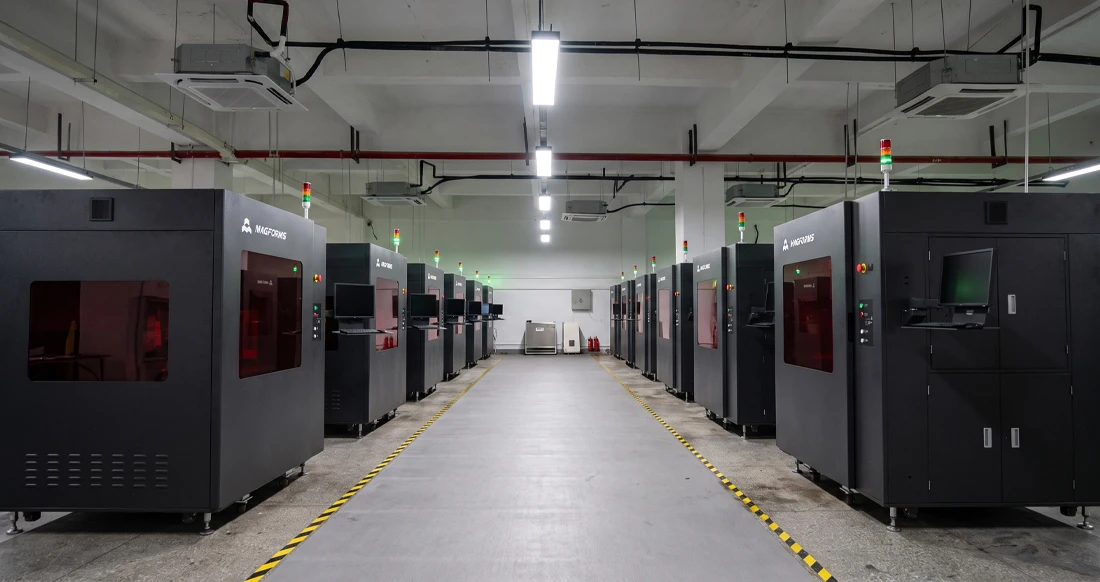
Magforms makes design and manufacture easier.
Popular Blogs
-
 Industry InsightsManufacturing Industry
FDM vs. SLA Printer: Which Technology Is Right for Your Project?
-
 Industry InsightsManufacturing Industry
Top 5 Applications of Industrial 3D Printers in Manufacturing Today
-
 Industry InsightsManufacturing Industry
Why Stereolithography 3D Printers Are Unmatched for Microfluidic Device Prototyping?