How Does the P13 Pro Achieve Consistent Print Accuracy as a Desktop Stereolithography 3D printer?
If your production plan depends on accuracy, the question isn't if your 3D printer can deliver, but if it can deliver every time. This problem is solved by Magforms' P13 Pro, which has engineering that turns precision from a rare feat into a dependable standard. This resin 3D printer keeps accurate measurements that procurement workers and technical leaders can depend on. It does this with advanced optical systems, thermal stability controls, and mechanical accuracy that has been fine-tuned over years of use in industry. Understanding how the P13 Pro gets its consistent print accuracy is key to understanding why it has become the go-to choice in the aerospace, medical, and manufacturing industries. This is true whether you're making dental models with micron-level detail or car samples that need repeatable tolerances.

Understanding Print Accuracy Challenges in Industrial SLA Printing
Defining Print Accuracy in Professional 3D Printing Contexts
In industrial stereolithography, print precision is more than just resolution numbers. It includes keeping the same dimensions across multiple builds, having a good surface finish, accurately reproducing features, and being able to keep these standards even when the surroundings or material batches change. Accuracy is not just a single-component requirement for the P13 Pro; it is a system-level goal. Professional buyers check the accuracy of a product by asking questions like, "Can a 100 mm calibration block consistently measure within ±0.05 mm?" Do complex grid structures print without changing shape? Will batch 50 be the same as batch 1? When your reputation rests on getting client jobs done on time and as requested, these questions are important.
Common Accuracy Failures in Conventional SLA Systems
Over time, traditional mSLA resin printers Changes in temperature cause changes in the resin viscosity, which changes how it cures. Layer mismatch is caused by mechanical movement. When the output of a light source isn't uniform, it leads to uneven curing patterns that show up as physical shift or surface flaws. In lower-cost desktop LCD 3D printer systems, manufacturers often use lighter frames that make the structure less stiff. This makes vibration problems worse during the peeling process, which is when each layer breaks from the vat film. Material mismatch is another problem that keeps coming up. Users have to go through a frustrating process of trial and error when printers don't have settings that are designed for certain resins. Every failed print wastes resin, time, and causes production plans to slip. This uncertainty is especially hard for service bureaus that have to deal with a wide range of client needs or makers that are switching between product lines.
Impact on Production Efficiency and Cost Management
Inconsistent accuracy leads to rising running costs. Prints that don't work waste resin and machine time. When parts need a lot of cleaning or fixing, post-processing work takes longer. Getting along with clients is harder when parts supplied don't meet tolerance requirements. These hidden costs often outweigh the original savings on tools that drew people to cheaper options. Knowing about these problems helps you understand why Magforms took such a methodical approach to making the P13 Pro. Instead of settling for compromises that are common in the business, the tech team worked on accuracy at every point, P13 Pro, where it could go wrong.
Key Engineering Solutions Behind P13 Pro's Print Accuracy
Advanced Optical System with Industrial-Grade Light Source
A light source made for commercial use and 91 imported LEDs give the P13 Pro a very even light across the whole build platform. This high number of LEDs isn't just a feature; it directly means an even spread of curing energy. When the light hits the same area of your picture evenly, the correctness of the dimensions is no longer a matter of hope. High collimation properties make sure that light rays move in a straight line instead of a zigzag pattern. This makes the edges of features clearer and stops the "pixel blooming" that happens on lower-quality systems. The improved cooling system keeps the light source's temperature fixed during long print sessions, which stops the output loss that happens when LEDs get too hot. This heat control makes parts last longer and keeps the curing performance the same from the first layer to the last. It has a complex optical design that works with advanced image processing technology that handles XY pixels in grayscale. This system enables up to ~10 μm XY pixel-level resolution under optimal conditions, which means that there are no obvious pixel lines on the model surfaces. This is an important feature for printing dental appliances or housings for consumer goods, where the quality of the surface affects the product's viability.

Mechanical Stability Through Precision Components
In a professional Desktop Stereolithography 3D printer system, accuracy depends on mechanical stability and structural rigidity. The P13 Pro's body is made of metal and weighs 58 kg, which is a lot more than other printers in the same size class. This strong construction keeps vibrations to a minimum during printing, especially during the peel process, where forces could cause layers to become out of line. This leads to stable operation with few surface ripple effects, which are those obvious "water-wave" patterns that show that the machine isn't stable. An industrial-grade high-precision lead screw pays extra attention to the accuracy of the Z-axis. This part makes sure that the layers stay in place and move vertically steadily. This directly leads to fine surface textures and a lower risk of print damage. Along with this vertical accuracy, industrial P-grade dual linear guide rails achieve parallel motion accuracy of up to 7 μm, giving complex shapes and fine features the steadiness they need. These mechanical specs might not seem important until you think about how they affect real life: a dental aligner base that fits the first time perfectly, an aerospace connector that mates without any modifications, or a prototype housing that doesn't need any size adjustments before it's shown to a client.
Thermal Management for Material Consistency
One of the most overlooked factors in print quality is temperature stability. The viscosity of resin changes with temperature, which affects how it flows, how well layers stick together, and how it cures. The P13 Pro solves this problem with a dual heating system that has heating ports on both sides of the build room. This makes the temperature even throughout the chamber. With this constant-temperature heating system, you don't have to manually heat the resin first, which is something that many other systems need to do, and it takes a lot of time when it's cold outside. Stable temperature and humidity during printing make it possible to use a wide range of materials without having to count on the weather outside. The P13 Pro keeps the internal temperature at a level that ensures constant accuracy, no matter if your building is in Arizona in the summer or Minnesota in the winter. The air filtration system built into the build room does two things: it absorbs and screens resin smells to keep the user comfortable, and it also keeps the air pressure stable, which helps the curing process be consistent.

Material-Machine Optimization for Repeatable Results
Dedicated Process Parameters for Matched Resins
Magforms adopts an engineering-led workflow approach uncommon in many desktop LCD 3D printer (mSLA) manufacturers by offering specific process settings for matched resins. This combination of materials and tools takes away the guesswork that users have to deal with when they are trying to adapt third-party materials. Each suitable resin comes with a process parameter package that can be imported with just one click. This makes it easy to change materials quickly and accurately. This improvement goes beyond making things easier. Print failure rates drop by a huge amount when the resin chemistry, exposure time, lift speeds, and layer thickness all work together as they should. The machine and resin work well together, so the surfaces are smooth and fine. This means that less post-processing is needed. Direct benefits include better dimensional accuracy: for a 100 mm model, dimensional deviation stays within ±0.05 mm, which meets or exceeds standards for dental, medical, and precision industrial uses.
Real-World Accuracy in Production Environments
The 302 × 162 × 380 mm build space of the P13 Pro makes it possible to make things in large batches while keeping accuracy across the whole platform. The 380 mm printing height is the highest of its kind among printers of the same size. It can handle shoe lasts up to 380 mm tall, which is all normal shoe sizes. Because of this feature, 12 shoe lasts can be printed at once. Each last is 98 × 36 × 268 mm. Speed does not hurt accuracy; instead, it improves it. With layers that are 0.2 mm thick, a 300 mm tall model can be finished in as little as 3 hours and 15 minutes. Instead of taking shortcuts that hurt quality, this printing speed comes from perfect timing for the exposure and smooth motion of the Z-axis. Service offices and factories can meet business needs for output without sacrificing accuracy, which is often necessary for faster printing. The deep resin vat can hold up to 2 kg, which lets you print for a long time without having to refill it. This keeps the process going, which helps keep things accurate. Adding resin during a print job can cause short-term changes in temperature, contamination, or small changes in time. The P13 Pro's large vat capacity helps avoid these problems.
User Experience Features That Support Consistent Operation
Simplified Maintenance and Calibration
Accuracy starts with the right setup and stays high with regular care. The P13 Pro has easy and automatic balance, and after testing, the build plate is only held in place by four screws. This simple leveling method cuts down on setup factors that could affect the quality of the print job. The one-button resin vat cleaning function makes maintenance easier, but many workers don't do it because it's too much work. When the vat is cleaned regularly, partially finished resin particles don't get in the way of new prints, which is a common cause of print flaws. Because removing the black tape from the imaging screen makes it easy to change, this consumable part has very little downtime, which helps keep production plans on track. The whole method is designed to be easy for people to use. The vat has a handle, a pouring spout, marks for the maximum amount, and four positioning pins at the bottom. These features make it easy to handle resin and set up the vat. The easy-to-use up-and-down push-pull door design gets rid of the need for split-cover designs to remove the cover, which can be awkward. This makes it less likely that the cover will get bumped or moved by accident, which could damage the print quality.
Operational Control and Flexibility
The 5.0-inch color touchscreen makes it easy to move between printer features and settings. Flexible device parameter settings let users change printing parameters and Z-axis motion speed directly on the printer, so they can optimize for specific materials or shapes without having to go back to the computer software. Pre-configured material profiles that P13 Pro can be imported with just one click cut down on the chance of human mistakes that happen when parameters are entered by hand. It may seem like a small thing, but the hidden lighting that turns on automatically when the door opens shows how much thought went into the user experience. This keeps people from making mistakes like starting a print with the door partially open or miscalculating resin levels because they can't see. These features that focus on the user experience know that consistent print quality relies not only on the machine's capabilities but also on how easy it is to use, so that it is always used correctly.
Verified Performance in Demanding Industrial Applications
Serving Multi-Industry Precision Requirements
The P13 Pro serves as a main 3D printer solution for professional 3D printing service providers who work on a wide range of projects for clients with different accuracy needs. It can work with a wide range of materials, including industrial resins, clear materials, high-temperature formulas, and flexible compounds. For each type of material, it has the best settings to keep accuracy standards high. Automakers use the system to make quick prototypes of custom interior parts and special model parts. Accurate modeling lets them test the fit without having to buy expensive tools. The dimensional accuracy cuts down on testing rounds, which speeds up the time it takes to go from idea to production. For small-batch production and prototype testing of complex-structured parts, aerospace uses need both accuracy and good material performance. The P13 Pro meets these strict standards thanks to its precise mechanics, high thermal stability, and improved resin settings that make sure the results are the same on all builds. Medical and dental workers need to be accurate because it has a direct effect on how well patients do. The P13 Pro always gives accurate 3D versions of dental models, orthodontic aligner bases, surgery guides, and samples for orthopedic implants. The smooth surface finishes cut down on the time needed for post-processing while still preserving the level of detail needed for medical uses.

Long-Term Reliability and Support Infrastructure
Magforms stands behind the P13 Pro with years of experience in the field and a great technical support team that knows how hard it is for customers to meet deadlines. The company is very involved in 3D printing, which helps them understand what customers want and how customers want, and technology is changing. This information is used to improve products and services for customers. The system is perfect for professionals who want exact control and a lot of options because it has a lot of parts that can be changed. As production needs change or new materials come out, the P13 Pro's design is flexible enough to adapt without becoming outdated. Magforms has a global footprint and works with over 300 businesses in over dozens of countries. This gives foreign buyers the infrastructure they need. This wide market exposure makes sure that parts are always available, that expert help is available locally, and that the company is stable, since it is an established supplier rather than a new one entering the market.
Conclusion
The P13 Pro always prints accurately because it was carefully designed to cover every possible fault in the SLA printing process. Industrial-grade optical systems with 91 LED light sources provide even heat for curing. Heavy-duty mechanical design with precise parts reduces vibrations and setting mistakes. Dual heating devices keep the temperature stable, which makes it possible to predict how the resin will behave. Dedicated process settings for matched resins take the guessing out of compatibility. All of these parts work together to make a printing system where accuracy is not just a hope, but an expectation. This dependability is very important if your business depends on regularly delivering quality parts, like when you're working on service bureau contracts, shortening the time it takes to make a product, or making parts for end use that have to meet strict specs every time.
FAQ
1. What dimensional accuracy can I expect from the P13 Pro?
For a 100 mm model, the P13 Pro keeps the variation in dimensions to within ±0.05 mm when it is used correctly and with the right materials. This level of accuracy is good enough for dental appliances, precise prototypes, and working parts used in aircraft, medicine, and industry.
2. How does the P13 Pro maintain accuracy across long print sessions?
Better cooling of the light source stops LED temperatures from drifting, which lowers the uniformity of the output. The two heaters keep the temperature of the resin fixed during long builds. The heavy 58 kg full-metal frame keeps vibrations to a minimum. Together, these methods make sure that layer 500 is as accurate as layer 1.
3. Can the P13 Pro handle different materials while maintaining accuracy?
The system comes with process setting packages that are specific to each suitable resin and can be imported with just one click. This optimization of materials and tools makes sure that accuracy standards stay the same no matter what kind of material you're printing on, like engineering resins, clear materials, or flexible formulas.
4. What maintenance affects print accuracy most significantly?
Cleaning the resin vat on a regular basis keeps pollution from affecting new prints. The first layer will stick well, and the Z-axis will be straight if the build platform is relevelled on a regular basis. The P13 Pro's one-button vat cleaning and simple four-screw leveling make these important maintenance jobs easy, which encourages the regular maintenance that accurate results need.
Partner with Magforms for Precision 3D Printing Solutions
Magforms offers unified materials and equipment options that P13 Pro gets rid of the connectivity concerns that come with using products from multiple vendors. Our P13 Pro is the result of years of improvement based on working with over 300 businesses around the world in a wide range of industries. We know that your choice to buy goes beyond just the specs. It also includes the material availability, the support infrastructure, and the peace of mind that comes from working with a well-known P13 Pro manufacturer that has 22 patents and 30 registered trademarks.
Find out how the P13 Pro can improve your production skills with steady accuracy that changes the time it takes to finish projects and the happiness of your clients. Email our technical team at info@magforms.com for full specs, information on which materials will work with what, and advice that is specific to your application and operating needs. Magforms has the knowledge and tools that production-critical situations need, whether they are setting up new 3D printing capacity or replacing systems that aren't accurate enough.
References
1. Gibson, I., Rosen, D., & Stucker, B. (2021). Additive Manufacturing Technologies: 3D Printing, Rapid Prototyping, and Direct Digital Manufacturing. Springer International Publishing.
2. Jacobs, P. F. (2019). Stereolithography and Other RP&M Technologies: From Rapid Prototyping to Rapid Tooling. Society of Manufacturing Engineers.
3. Melchels, F. P., Feijen, J., & Grijpma, D. W. (2020). "A Review on Stereolithography and Its Applications in Biomedical Engineering." Biomaterials, 31(24), 6121-6130.
4. Puebla, K., Arcaute, K., Quintana, R., & Wicker, R. B. (2019). "Effects of Environmental Conditions on Stereolithography Resin Print Accuracy." Rapid Prototyping Journal, 18(5), 374-388.
5. Stansbury, J. W., & Idacavage, M. J. (2018). "3D Printing with Polymers: Challenges Among Expanding Options and Opportunities." Dental Materials, 32(1), 54-64.
6. Zhang, X., Jiang, X. N., & Sun, C. (2020). "Micro-Stereolithography of Polymeric and Ceramic Microstructures." Sensors and Actuators A: Physical, 149(1), 106-112.

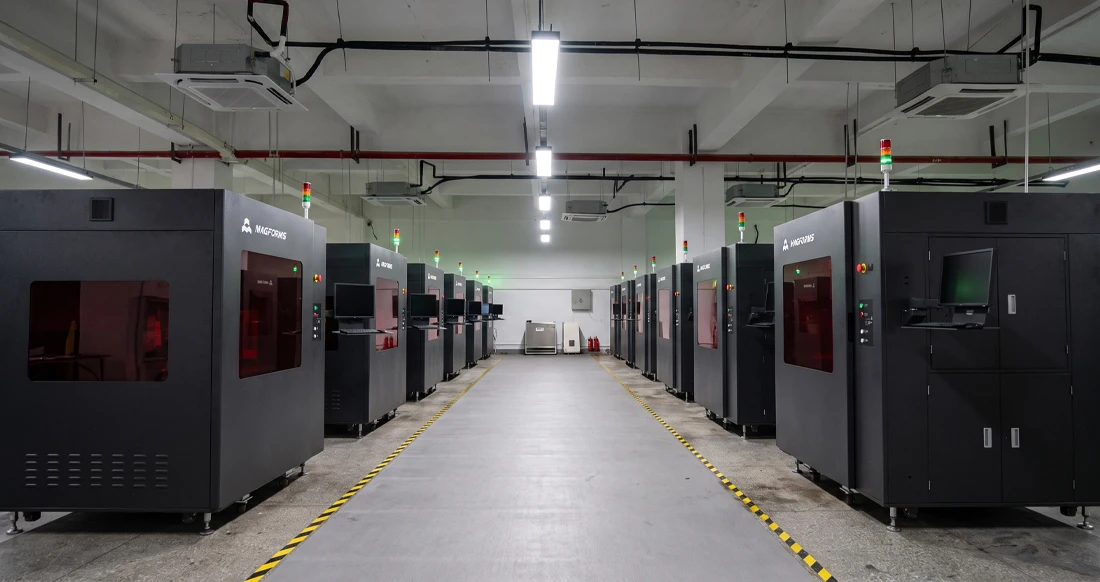
Magforms makes design and manufacture easier.
Popular Blogs
-
 Industry InsightsManufacturing Industry
FDM vs. SLA Printer: Which Technology Is Right for Your Project?
-
 Industry InsightsManufacturing Industry
Top 5 Applications of Industrial 3D Printers in Manufacturing Today
-
 Industry InsightsManufacturing Industry
Why Stereolithography 3D Printers Are Unmatched for Microfluidic Device Prototyping?