Industrial SLA 3D Printer Applications in Medical Device Manufacturing
The medical device manufacturing sector has experienced a remarkable transformation through stereolithography additive manufacturing systems. An Industrial SLA 3D Printer leverages vat photopolymerization technology to produce intricate medical prototypes and components with high dimensional accuracy, fine feature reproduction, excellent surface quality, and access to application-specific photopolymer materials. These advanced systems use laser-based vat photopolymerization, with UV lasers operating at 355 nm, sophisticated galvanometer scanning mechanisms, and precision-engineered build platforms to support the production of medical prototypes and components within manufacturers' applicable quality management and validation processes. Medical device manufacturers increasingly use this technology for surgical guide development, patient-specific implant prototyping, dental model and appliance production, and functional testing of complex anatomical models—applications that require repeatable dimensional performance and appropriate material documentation for their intended use.
Key Applications of Industrial SLA 3D Printing in Medical Device Manufacturing
Rapid Prototyping for Accelerated Development Cycles

Rapid iteration is valuable in medical device development. With an Industrial SLA 3D Printer, engineers can move from a digital design to a physical prototype within a significantly shorter development cycle than is often required for conventional tooling-based methods. Orthopedic device manufacturers can use this technology to evaluate implant geometries and patient-specific anatomical interfaces by producing prototypes or anatomical models for fit assessment and selected biomechanical testing. The galvanometer scanning system enables precise and efficient laser exposure, while optimized scanning strategies can adjust exposure paths according to part geometry and process requirements. Variable laser spot technology can further balance production efficiency and feature resolution by using a larger spot for broad exposure areas and a smaller spot for fine features and detailed geometries. When medical device OEMs use stereolithography during design verification and prototyping, they can shorten iteration cycles by reducing the need for dedicated tooling during early development stages.
Patient-Specific Customization and Personalized Medicine
Individualized treatment plans are becoming more and more important in healthcare. Industrial SLA 3D Printers are used by dental labs to make crown-and-bridge models, implant surgery guides, and customized orthodontic models based on accurate intraoral scans. High positioning accuracy and controlled laser exposure can help reproduce patient-specific geometries consistently, while final dimensional accuracy and fit should be verified according to the requirements of the intended application. Neurosurgeons can use patient-specific cranial models generated from CT data for preoperative planning, helping them evaluate complex anatomy and determine an appropriate surgical approach before the procedure. Fine laser scanning and exposure-control technologies can help reproduce detailed anatomical geometries and reduce the visual impact of layer transitions, depending on the source data, layer thickness, material, and printing parameters. These models help with discussions about informed consent because they let patients see their unique bodies and the changes that are going to be made during surgery.
Low-Volume Production Economics and Regulatory Validation
Because medical products are usually only used by a small group of people, standard injection molding is not a good way to get into the market at first. An Industrial SLA 3D Printer can address this challenge by making selected low-volume applications more economically viable without requiring dedicated tooling. Hearing-aid manufacturers, for example, can use SLA to produce customized shells and earpieces based on scanned ear geometry, particularly for applications requiring individualized designs and low-volume production. An open material system can allow manufacturers to evaluate photopolymer resins from different suppliers, while each material and process still needs to be qualified for its intended application. This can give manufacturers greater flexibility in material sourcing and cost evaluation, while application-specific biocompatibility and regulatory documentation must still be established for the selected material. The mechanical properties of SLA parts depend on resin formulation, exposure conditions, build orientation, and post-curing. Manufacturers should therefore use material-specific mechanical data when evaluating parts for functional applications. Consistent and documented printing processes can support design verification, traceability, and quality documentation within the manufacturer's applicable quality management system.
Functional Testing and Performance Validation
Surgical tool designers use stereolithography to make working samples that are tested for ergonomics, drop resistance, and articulation cycle resistance. Cardiovascular device manufacturers can produce multiple iterations of catheter insertion tools to evaluate grip geometry, insertion forces, and assembly requirements before investing in production tooling. SLA parts can provide smooth surfaces suitable for visual, dimensional, and tactile evaluation, although surface roughness varies with layer thickness, part orientation, resin formulation, and post-processing conditions. Magforms' industrial SLA equipment provides controlled dimensional performance that can support applications such as assembly verification jigs and manufacturing aids when the required tolerances are within the system's validated capabilities. This versatility can increase equipment utilization by allowing the same system to support R&D prototyping, manufacturing aids, and selected quality-control applications.
👉 Explore more Industrial SLA medical manufacturing applications and real-world application examples.

Comparative Insights: Industrial SLA vs Other 3D Printing Technologies in Medical Manufacturing
Resolution and Surface Quality Benchmarks
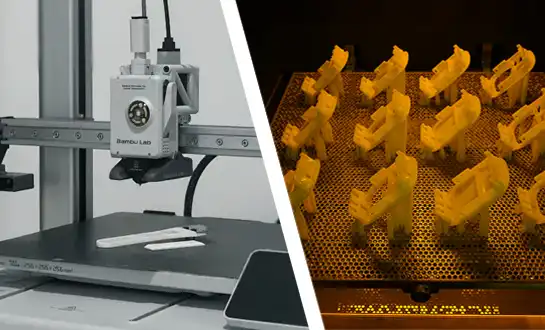
When used in medicine, additive manufacturing technologies show important differences. Fused Deposition Modeling (FDM) systems can be cost-effective for prototypes, anatomical models, fixtures, and other selected medical applications, but their extrusion-based process can produce more visible layer lines and rougher surfaces than SLA in applications requiring fine details and smooth curved geometries. Digital Light Processing (DLP) can provide high throughput by exposing an entire layer or defined region at once, while an Industrial SLA 3D Printer uses a focused laser to selectively cure the resin surface through galvanometer-controlled scanning. Focused laser scanning in an Industrial SLA 3D Printer can provide high dimensional accuracy and fine feature reproduction, depending on the optical system, process parameters, material, and machine configuration. The focused laser spot used in an Industrial SLA 3D Printer avoids the fixed pixel-grid exposure pattern associated with projection-based systems, while the AOC laser and Scanlab galvanometer work together to provide controlled laser scanning. In dental applications, SLA can provide smooth and detailed surfaces that are well suited to models with complex occlusal geometries, although actual surface quality depends on the selected material and process parameters. Surface quality and dimensional accuracy can influence the fit and functional evaluation of dental components, although final fit depends on the complete digital and manufacturing workflow. Variable laser spot technology can help balance fine feature reproduction and exposure efficiency, making it useful for applications involving detailed geometries such as channels, edges, and other small features.
👉 Industrial SLA 3D Printer types and solutions
Material Compatibility and Certification Pathways
Material selection limitations have a big effect on how long it takes to make a medical device. Many industrial 3D printers use proprietary resin cartridges or identification chips, which can limit material sourcing to a single provider and increase material costs. Such restrictions can also make it more difficult for manufacturers to compare alternative resin formulations and optimize material performance for different applications. The open architecture of Magforms' Industrial SLA 3D Printers allows manufacturers to evaluate selected 355 nm photopolymer formulations from different suppliers, subject to material compatibility and process validation. Procurement teams can compare resins from different suppliers based on material cost, technical performance, and available biological evaluation data for the intended application. A temperature-controlled build environment can help maintain more stable resin-processing conditions by reducing viscosity variations during printing, although curing behavior still depends on the specific resin formulation and validated process parameters. This flexibility is particularly useful when optimizing material properties for medical device prototypes and application-specific components.
Scalability and Production Throughput Analysis
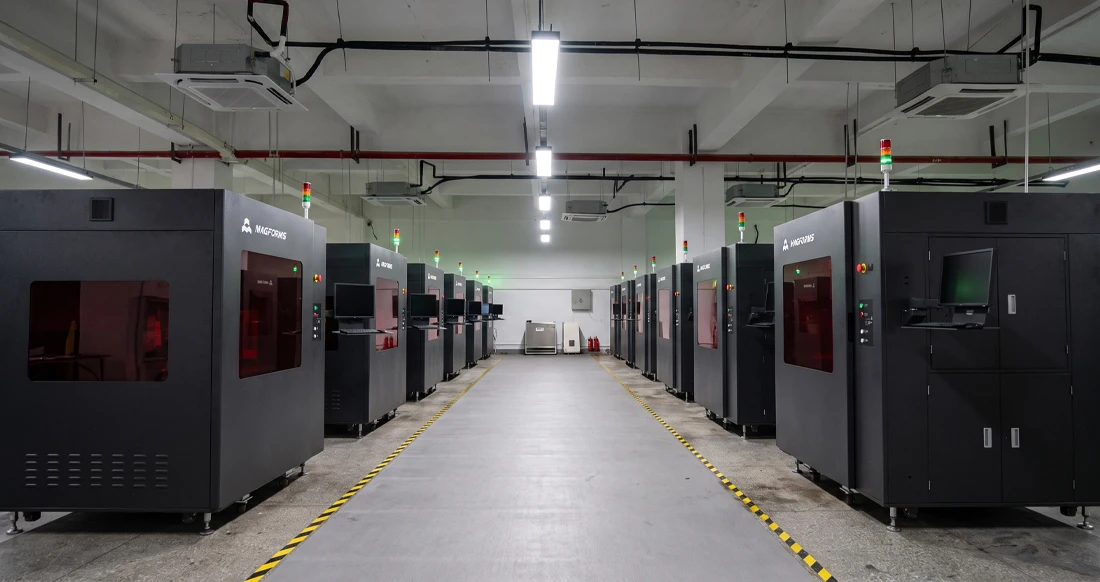
Desktop resin systems generally target smaller-format prototyping and production applications, while industrial SLA systems are designed for larger build volumes, higher production demands, and more demanding process-control requirements. Medical device manufacturers require reliable equipment that can support repeatable production workflows. Components such as Schneider electrical systems, Panasonic servo motors, and rigid machine structures can contribute to the stability and repeatability required for long-term industrial operation. Platforms with build envelope options ranging from 300mm to 800mm can handle batch production strategies. Larger build platforms can support batch production of multiple dental models in a single build, depending on model dimensions, orientation, layer thickness, and required production volume. The industrial AOC laser is selected to provide stable UV exposure for demanding production environments, while laser performance should be monitored and maintained according to the equipment manufacturer's specifications. Regular calibration and maintenance should be performed according to the equipment manufacturer's specifications to maintain consistent printing performance. Optimized scanning strategies can improve exposure efficiency for specific part geometries, although actual throughput gains should be evaluated using application-specific printing data.

Procurement Considerations for Industrial SLA 3D Printers in Medical Device Manufacturing
Total Cost of Ownership and ROI Modeling
When investing in equipment, choices go beyond the price of the item itself. Cost-per-part economics must be looked at by procurement professionals. This includes resin consumption, post-processing labor, and maintenance costs. Variable spot technology can reduce exposure time for certain geometries by balancing broad-area exposure with fine-feature scanning, potentially improving overall production efficiency. An open material system can also give procurement teams greater flexibility when comparing material suppliers, pricing, and performance. This can give manufacturers greater flexibility to compare material prices and performance rather than relying on a single proprietary material source. Magforms can support different procurement approaches depending on market and customer requirements, including direct purchase, financing, leasing, and multi-system procurement where available. For medical device startups, leasing or financing may help spread equipment costs over time, depending on the company's cash-flow strategy and procurement conditions. Larger organizations may also standardize equipment platforms across multiple facilities when production volume and operational requirements justify multi-system procurement. Warranty coverage, spare-parts availability, remote diagnostics, and service response terms should be evaluated as part of the total cost of ownership and procurement agreement.
Supplier Reliability and Service Infrastructure
Long periods of equipment downtime are not acceptable in medical manufacturing. Criteria for procurement must look at a supplier's service skills, such as their reaction time promises, the number of spare parts they keep on hand, and the availability of their field service engineers. Magforms provides after-sales technical support to help customers troubleshoot equipment and process-related issues remotely and, where required, through field service. For issues requiring on-site service, response and resolution times depend on the location, issue complexity, spare-parts availability, and applicable service agreement. Magforms' intellectual property portfolio reflects its ongoing investment in additive manufacturing technologies and product development. Magform has set up distribution and service networks that make sure spare parts are easy to find and expert training is easy to get. Magforms has experience serving industrial customers across different application sectors and participating in international additive manufacturing and medical technology events. Procurement teams like it when suppliers offer full operator training programs, since the right way to use equipment has a direct effect on part quality consistency and the number of first prints that work.
Regulatory Compliance and Documentation Support
Companies that make medical devices have to follow strict quality management systems. Equipment suppliers should provide appropriate technical documentation, calibration information, process guidance, and quality-related records to support medical device manufacturers' applicable quality management and validation activities. Depending on the manufacturer's quality system and the intended use of the equipment, installation, operational, and performance qualification activities may be incorporated into the equipment validation process. These qualification activities can provide documented evidence that equipment performance and process parameters meet predefined acceptance criteria. Magforms can provide measurement documentation and calibration certificates with traceability to applicable national or international metrology standards. This makes validation tasks easier. The iBuild 2.0 control program can record relevant build information and printing parameters, providing production data that may support traceability and process documentation. Whether these electronic records meet applicable 21 CFR Part 11 requirements depends on the complete software, data-management, access-control, audit-trail, and validation environment. Technical specs include tolerances for laser power stability, galvanometer positioning accuracy, and platform flatness. This type of objective documentation can help procurement and quality teams evaluate suppliers, define acceptance criteria, and establish appropriate inspection procedures.
Choosing the Right Industrial SLA 3D Printer for Medical Device Manufacturing
Aligning Equipment Capabilities with Production Requirements
Medical device applications involve different levels of part complexity and production requirements. Making dental appliances is all about getting things done quickly, which requires a reasonable level of accuracy across many parts at the same time. Orthopedic implant prototyping may require large components with tight dimensional requirements. When making surgical instruments, it's important to use a variety of materials so that they can be tested for functionality across both stiff and bendable resin families. The procurement teams compare the build volume to the average part size to make sure that the platform's capacity is enough to support batch production strategies without leaving too much empty space. Dental laboratories can select a smaller or mid-size industrial SLA platform when the typical model dimensions and required batch volume are compatible with the available build envelope. Orthopedic and medical-device manufacturers may choose larger platforms, such as 600 × 600 × 500 mm or 800 × 800 × 550 mm build envelopes, when producing large anatomical models, prototypes, or multiple components in a single build. Build-platform flatness and machine rigidity can influence first-layer consistency and overall process repeatability, but their effect on final part geometry should be evaluated together with material behavior, supports, exposure parameters, and post-processing.

Evaluating Brand Positioning and Technological Differentiation
In the market for additive production, there are both well-known companies like 3D Systems and Formlabs and new companies that are just starting out. Legacy brands have large application libraries and support systems that are well-established. Newer companies often offer better price-to-performance ratios and new features that solve specific problems.
Magforms combines experience in photopolymer materials with the development of industrial SLA equipment. Its technical team has experience in photopolymer chemistry and the interaction between laser exposure and resin behavior. This materials background can support the optimization of laser exposure, grayscale processing, scanning strategies, and material-processing parameters for different SLA applications. The equipment is made up of high-quality parts, such as AOC lasers that provide stable power for industrial use, German Scanlab galvanometers that ensure accurate scanning, Taiwanese HIWIN motion systems that provide repeatable placement, and Schneider electrical panels that ensure reliable control. For procurement teams, the use of established industrial components can be an important consideration when evaluating equipment reliability, maintainability, and long-term service requirements.
Long-Term Strategic Value and Innovation Partnership
Buying equipment is more than just a purchase of goods; it starts a relationship with technology. Suppliers who are actively working on next-generation materials and process improvements are good for companies that make medical devices. Magforms continues to develop photopolymer materials with different combinations of mechanical, thermal, optical, and processing characteristics for specialized applications, including selected medical and healthcare-related uses. Customers in Europe, Asia, and North America are served by the company, which gives them cross-industry application knowledge. Experience from demanding industries such as aerospace and automotive can also contribute to improvements in process control, prototyping workflows, and material development that may be relevant to medical-device applications. Workflows used for rapid prototyping in cars can be used to make surgical instruments. Cross-industry experience can contribute to software, process, and application improvements that may also benefit medical-device development workflows. When you buy equipment, you also get technical training classes that cover advanced support structure design, orientation optimization, and post-curing routines. This is important for getting the most out of your Industrial SLA 3D Printer in medical manufacturing settings.
Conclusion
When making medical devices, you need accuracy, dependability, and compliance with regulations, which are all things that Industrial SLA 3D Printers can provide. These systems combine high dimensional accuracy, fine feature reproduction, compatibility with application-specific photopolymer materials, and industrial production capabilities. They can be used for a wide range of tasks, from developing patient-specific anatomical and implant prototypes to producing functional prototypes of surgical instruments. The technology can shorten product development cycles, improve the economics of selected low-volume applications, and enable physical prototypes to be evaluated before manufacturers proceed to later-stage verification, validation, and regulatory activities. When procurement professionals look at stereolithography equipment, they need to look at how accurate the dimensions are, how open the material system is, how good the parts are, and how well the supplier's service infrastructure works. Magforms offers cutting-edge capabilities through variable laser spot technology, high-quality hardware integration, full after-sales support, and material expertise. These qualities make the company a valuable partner for medical manufacturers seeking a competitive edge through adopting advanced additive manufacturing.
FAQ
What materials work best for medical SLA printing applications?
For parts that come into contact with patients, manufacturers should select photopolymer resins with biological evaluation data appropriate to the intended contact type and duration, together with other required material and performance documentation. The open material design of an Industrial SLA 3D Printer enables the use of certified formulations from a variety of sources, allowing for cost savings while still upholding regulatory compliance. Transparent resins can be useful for anatomical visualization, while high-temperature materials may be suitable for sterilization applications when the specific resin and finished part have been validated for the intended autoclave cycle. For example, rigid engineering resins can be used for selected surgical-guide development applications, while flexible elastomeric materials can be useful for anatomical and soft-tissue simulation, depending on the material's validated properties and intended use. Procurement teams should verify that supplier documentation provides the biological evaluation data and other material information appropriate to the device's intended contact type, duration, and regulatory pathway.
How does industrial SLA accelerate medical device development timelines?
Rapid iteration speeds up development processes in a basic way. Using CNC to make a traditional prototype takes days of programming the toolpath, setting up the fixtures, and doing operations on multiple axes. An Industrial SLA 3D Printer can convert CAD designs into physical prototypes within a short production cycle, allowing design engineers to evaluate multiple iterations without waiting for dedicated tooling. Variable laser spot technology and optimized scanning strategies can improve exposure efficiency for suitable geometries, while dimensional performance depends on the material, layer thickness, build orientation, calibration, and post-processing conditions. By reducing tooling requirements during early-stage development, SLA can help medical device manufacturers shorten selected prototyping and iteration stages. This can help manufacturers move through development and verification stages more efficiently and respond more quickly to design feedback during testing.
What factors determine the best printer for our medical manufacturing needs?
The best equipment choice is based on the resolution needs, the expected production volume, and the compatibility of the materials. When it comes to dental applications, throughput efficiency is important for batches of 20 to 40 parts, and mid-range platforms that have proven performance with transparent resin are preferred. For orthopedic prototyping, larger build envelopes can be valuable when producing large anatomical models or full-scale prototypes while maintaining the dimensional performance required by the application. Check the specifications for platform flatness, laser power stability, galvanometer accuracy, and servo motor positioning precision. Procurement teams should also evaluate warranty coverage, spare-parts availability, service response terms, and the quality of operator training. Magforms' technical support and service infrastructure can help manufacturers address equipment and process issues while reducing the risk of prolonged production interruptions.
Partner with a Leading Industrial SLA 3D Printer Manufacturer
Choosing the right technology partner is important for companies that make medical devices. Magforms offers industrial stereolithography solutions incorporating German Scanlab galvanometers, industrial AOC lasers, and variable laser spot technology to balance scanning efficiency, feature reproduction, and dimensional performance. Our open material architecture gives manufacturers greater flexibility to evaluate compatible photopolymer resins from different suppliers, including materials with application-specific biological evaluation data where required. We support industrial customers with application-focused equipment, technical expertise, and after-sales service designed to support reliable long-term operation. Find out how our Industrial SLA 3D Printer technology can support faster prototyping, more flexible material evaluation, and application-specific manufacturing workflows. Email our engineering team at info@magforms.com to talk about how you want to make a medical device and to get detailed technical specifications.
References
1. Gibson, I., Rosen, D., & Stucker, B. (2021). Additive Manufacturing Technologies: 3D Printing, Rapid Prototyping, and Direct Digital Manufacturing (3rd ed.). Springer International Publishing.
2. American Society for Testing and Materials. (2023). ASTM F2792-12a: Standard Terminology for Additive Manufacturing Technologies. ASTM International Committee F42 on Additive Manufacturing Technologies.
3. U.S. Food and Drug Administration. (2022). Technical Considerations for Additively Manufactured Medical Devices: Guidance for Industry and Food and Drug Administration Staff. Center for Devices and Radiological Health.
4. ISO/ASTM International. (2021). ISO/ASTM 52915:2020 - Specification for Additive Manufacturing File Format (AMF) Version 1.2. International Organization for Standardization.
5. Melchels, F. P., Feijen, J., & Grijpma, D. W. (2020). A review on stereolithography and its applications in biomedical engineering. Biomaterials, 31(24), 6121-6130.
6. Ventola, C. L. (2019). Medical Applications for 3D Printing: Current and Projected Uses. Pharmacy and Therapeutics, 39(10), 704-711.

Magforms makes design and manufacture easier.
Popular Blogs
-
 Industry InsightsManufacturing Industry
FDM vs. SLA Printer: Which Technology Is Right for Your Project?
-
 Industry InsightsManufacturing Industry
Top 5 Applications of Industrial 3D Printers in Manufacturing Today
-
 Industry InsightsManufacturing Industry
Why Stereolithography 3D Printers Are Unmatched for Microfluidic Device Prototyping?