What 3D Printer Can Make Shoes?
A shoe 3D printer is a special kind of additive manufacturing machine made to make parts for shoes with great accuracy and the ability to work with a variety of materials. Advanced technologies such as Stereolithography (SLA), Digital Light Synthesis (DLS), and Selective Laser Sintering (SLS) are used by these industrial-grade systems to produce high-precision shoe molds, midsoles, insoles, and custom orthotics. Among these, SLA stands out for mold production due to its superior surface finish and dimensional accuracy. Unlike traditional ways of making things, these printers don't need expensive tools, allow a lot of people to customize things, and support complex grid shapes that improve performance while lowering material waste.

Understanding Shoe 3D Printing Technology
Additive manufacturing has changed the way shoes are made by giving designers more freedom and making the production process more efficient. The basic process starts with computer design files that show exactly how the shoe parts should be put together. These files are then used to build shoe components or molds layer by layer using specialized materials.
Core Technologies and Materials
Modern shoe printing is based on a number of advanced technologies, each of which has its own benefits in certain situations. Digital Light Synthesis offers high-speed production and excellent material performance, while SLA provides superior precision and surface quality, making it ideal for detailed footwear molds and prototypes. It uses continuous liquid interface production to get rid of standard layer lines and make surfaces smooth. Selective Laser Sintering makes materials very strong and can hold complicated shapes without the need for extra support structures. This makes it perfect for making useful prototypes and parts that will be used in real life. Choosing the right material is a very important part of figuring out how well printed shoes work. SLA-compatible photopolymer resins are used in industrial shoe 3D printing. Flexible resins provide elasticity and comfort for midsoles and insoles, while rigid resins deliver high strength and dimensional stability for structural components or molds. Advanced resin formulations also support biocompatibility and recycled content, meeting environmental standards without compromising performance.
Manufacturing Process Advantages
In the old way of making shoes, expensive metal models are needed, and the process takes a long time. It can take months from idea to production. These problems are solved by additive manufacturing, which lets you make things directly from digital files. This change cuts the time to develop shoe molds and components from months to just a few weeks, and lowers minimum order quantities. Using physiological data and SLA-compatible flexible resins, designers can create custom lattice structures for insoles and midsoles, improving comfort and performance. This allows small-batch, customized footwear production to be cost-effective while leveraging SLA technology.

Comparing Shoe 3D Printers – Finding the Best Fit for Your Business
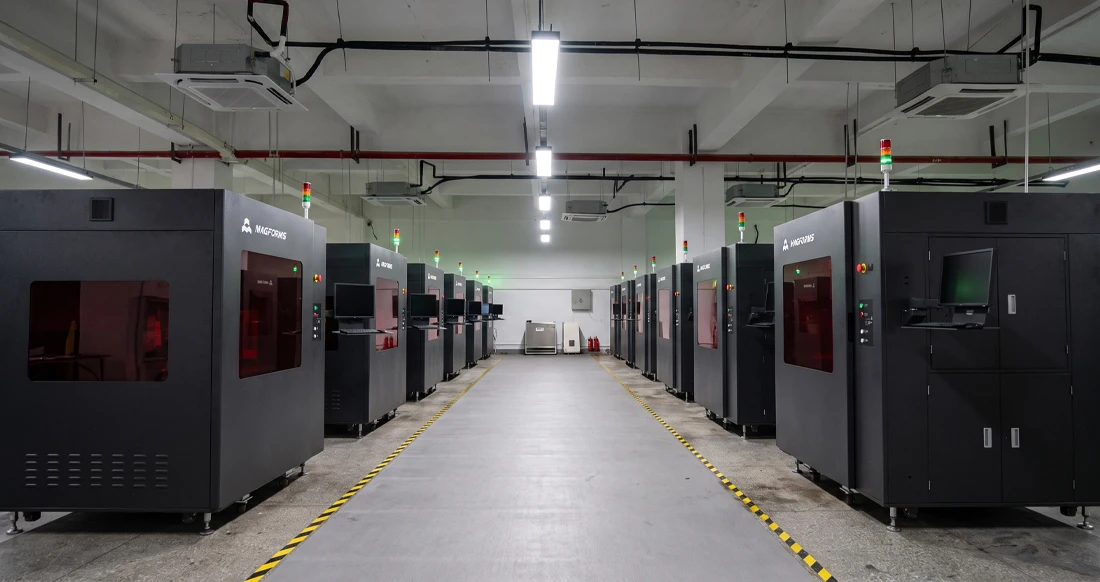
To choose the right tools, you need to know the main differences between laptops and industrial-grade systems. Desktop units usually have lower initial costs, but they might not be precise enough or work with all kinds of materials for making shoes for a living. Industrial systems such as the Magforms SL800 offer superior build quality, higher print rates, and broader material compatibility required for professional footwear applications.
Desktop vs Industrial Performance Metrics
Layer resolutions on desktop printers are usually between 100 and 200 microns, which is fine for testing but not good enough for making shoes that will last. Industrial systems such as the SL800 can achieve an accuracy of ±0.1 mm (L ≤ 100 mm), which is critical for high-precision footwear mold production. They maintain high stability thanks to precision components such as German Scanlab galvanometers and AOC lasers, ensuring consistent laser positioning and scanning accuracy. Another important difference is print speed. Advanced systems use variable spot-size laser printing technology, which makes printing 30–50% faster than with traditional methods. Large laser spots are used for internal filling, and fine spots are kept for exact contours. This smart design strikes a good balance between speed and quality standards.
Material Compatibility and Cost Considerations
Customers can choose photopolymer resins from several sources, which is a big practical benefit of open-source material compatibility. This level of adaptability is very different from private systems, which limit the materials that can be used and raise the costs over time. Equipment that works with a lot of different materials can help you save money while still meeting high standards for all of your production needs. Material limits have effects on the economy that go beyond the direct costs. They also have an effect on the flexibility of operations and the resilience of the supply chain. Supporting multiple material sources lowers the risk of being dependent on one seller and allows for competitive sourcing strategies that are necessary for operations to grow.
How to Choose the Right 3D Printer for Your Procurement Needs
To get the best return on investment, procurement choices must match technical skills with specific business needs. Knowing how much you want to produce, how much flexibility you need, and the quality standards you want allows you to choose equipment that meets both your current needs and your plans for growth in the future.

Critical Evaluation Criteria
The print precision has a direct effect on the quality of the finished shoe parts. For applications that need parts that people will see to have smooth surfaces, they need better resolution than working prototypes. It's important to think carefully about the link between sharpness and print speed, since more accuracy usually means longer production times. Build volume tells you how many and what size parts can be made at the same time. Large-format powers allow for the production of multiple parts in bulk or of large parts in a single piece, breaking the usual size limits of traditional manufacturing. Magforms offers a range of tools, from a laptop to an industrial-grade, shoe 3D printer, to meet the needs of both small-batch prototyping and large-scale production.
Supplier Reliability and Support Infrastructure
The level of technical help has a big effect on how well operations run and how long equipment lasts. Production problems are kept to a minimum by professional support teams that can respond quickly and offer 24/7 remote advice and promised response times. On-site technical help and regular training programs improve technical skills and make sure that equipment is used in the best way possible. Years of experience in the field help you better understand the problems and answers that are unique to each application. Suppliers with a large market footprint and a history of success make it easier to trust that the relationship will last and that innovation will continue to be supported.
Maintenance and Operational Best Practices for Shoe 3D Printer Systems
To keep machinery working at its best, regular repair, calibration processes, and operational optimization must be done in a planned way. Following the right repair procedures will make tools last longer and ensure consistent output quality, which is important in business production settings.
Preventive Maintenance Protocols
Cleaning sensitive optical parts on a regular basis keeps the print quality high. Laser sights need to be cleaned in a certain way so that pollution doesn't happen, which lowers the quality of the beam and makes printing less accurate. To keep different materials from getting contaminated, resin handling systems need to be flushed, and their filters changed on a regular basis. Calibration methods make sure that the whole build platform is accurate in terms of its dimensions. Platform leveling affects how well layers stick together and the quality of the part, while laser calibration keeps the accuracy of the geometry. These steps should be taken exactly as the maker says and written down so that the state of the equipment can be tracked over time.
Workflow Optimization Strategies
Adding suitable software tools makes the process of going from planning to production easier and makes the best use of the equipment. Advanced slicing software improves support creation, which cuts down on the amount of material needed and the amount of post-processing that needs to be done. Print schedule software allows batch processing optimization, which raises output while lowering the need for human involvement. Quality control measures, such as checking the dimensions and testing the materials, make sure that the standards of the result are always met. Statistical process control methods help find patterns that could mean that equipment is breaking down or the process is drifting, which lets repair happen before quality problems happen.

Future Trends and Innovations in Shoe 3D Printer Technology
Innovations in materials science, printing speed, and industrial integration are all being driven by progress in technology. Knowing about new trends helps with strategic planning and toolsthat show 3D printers will work in the future while also meeting current needs.
Sustainable Material Development
Bio-based plastics and recovered materials are two growing areas that help the environment while still meeting performance needs. Advanced material recipes use biodegradable plastics and natural fibers without affecting the mechanical qualities needed for footwear. Closed-loop recycling systems let production trash and end-of-life goods be used again, which lowers the cost of materials and supports the ideas of the circular economy. For these systems to work, they need tools that can work with them and handle recycled materials to the same high standards of quality.
Manufacturing Integration and Automation
Post-processing systems that are automated cut down on the amount of work that needs to be done and make part finishing more consistent. Integration with automatic handling systems makes it possible to produce standard parts without turning on any lights. This lowers operating costs and makes it easier to scale up. Digital inventory management systems make it possible to produce goods only when they are needed. This cuts down on storage costs and makes it easier to meet market needs. This change from "make-to-stock" to "make-to-order" models is especially helpful for custom shoe users, where standard inventory methods don't work well.
Conclusion
Shoe 3D printer technology has changed the way shoes are made by getting rid of the limitations of traditional tools and allowing for more customization than ever before. Industrial-grade systems with variable spot-size laser technology, a wide range of material compatibility, and a full support infrastructure are what make production processes competitive. The technology is important for current footwear development and production plans because it shortens the time it takes to get shoes to market, lowers the minimum order quantity, and can work with complex geometries.
FAQ
1. Can industrial 3D printers produce market-ready footwear?
Advanced production systems that use technologies like Digital Light Synthesis and Selective Laser Sintering can make parts for shoes that meet standards for toughness and performance. The right choice of materials and process improvements ensures that the end products are good for uses like sports shoes and custom orthotics.
2. What materials work best for different shoe components?
Industrial SLA 3D printers use specialized photopolymer resins for footwear parts. Flexible resins provide elasticity for midsoles and insoles, ensuring comfort and energy return, while rigid resins maintain high strength and precise geometry for structural components and molds. Elastomeric or lattice-capable resins allow complex lattice structures that improve support, cushioning, and custom fit. Material selection should align with the performance requirements and function of each component.
4. How do you calculate ROI for 3D printing investments?
When figuring out ROI, you should look at things like lower hardware costs, shorter development processes, and the ability to make changes. Getting rid of expensive models saves money right away, and a shorter time-to-market speeds up the process of making money. When you can mass customize something, you can set higher prices that make more money than with standard manufacturing methods.
Partner with Magforms for Advanced Shoe 3D Printer Solutions
Magforms offers state-of-the-art additive printing options that are designed to make the best shoes possible. Our industrial-grade systems have German Scanlab galvanometers, changeable spot-size laser technology, and the ability to work with open-source materials. These features give current shoemakers the accuracy and adaptability they need. We offer complete shoe 3D printer options backed by the best technical support in the business. We have 22 patents, 30 registered brands, and a track record of helping over 300 businesses around the world.
Get in touch with our knowledgeable staff at info@magforms.com to find out how our cutting-edge printing systems can change the way you make shoes. Our specialized experts offer quick technical support and can set up demos that show you how our tools can be used in your unique situations. As a reputable company that makes 3D printers for shoes, we're dedicated to giving your company the accuracy, speed, and new ideas it needs to succeed in today's market.
References
1. Gibson, Ian, et al. "Additive Manufacturing Technologies: 3D Printing, Rapid Prototyping, and Direct Digital Manufacturing." Springer Publishing, the year 2021.
2. Thompson, Mary K., et al. "Design for Additive Manufacturing: Trends, opportunities, considerations, and constraints." CIRP Annals - Manufacturing Technology, Vol. 65, Issue 2, 2016.
3. Ligon, S. Christian, et al. "Polymers for 3D Printing and Customized Additive Manufacturing." Chemical Reviews, American Chemical Society, 2017.
4. Ventola, C. Lee. "Medical Applications for 3D Printing: Current and Projected Uses." Pharmacy and Therapeutics Journal, Vol. 39, No. 10, 2014.
5. Wohlers, Terry, et al. "Wohlers Report 2023: 3D Printing and Additive Manufacturing Global State of the Industry." In 2023, Wohlers Associates.
6. Singh, Rupinder, et al. "Current Status and Future Directions of Fused Filament Fabrication." Journal of Manufacturing Processes, published by Elsevier in 2020.

Magforms makes design and manufacture easier.
Popular Blogs
-
 Industry InsightsManufacturing Industry
FDM vs. SLA Printer: Which Technology Is Right for Your Project?
-
 Industry InsightsManufacturing Industry
Top 5 Applications of Industrial 3D Printers in Manufacturing Today
-
 Industry InsightsManufacturing Industry
Why Stereolithography 3D Printers Are Unmatched for Microfluidic Device Prototyping?