Why Choose an Industrial SLA 3D Printer for Complex Parts?
Many businesses today find that an Industrial SLA 3D printer is the best way to make complicated parts with exact measurements and high standards for surface finish. These high-tech stereolithography systems offer unmatched accuracy, uniform mechanical properties, and better surface quality that is hard to achieve with more traditional manufacturing methods. Unlike traditional production methods, industrial SLA technology is great at making complex geometries, internal channels, and fine details while keeping dimensional accuracy within 0.1mm. This makes it essential for aerospace, medical, automotive, and electronics applications that need parts to be very accurate.
Understanding Industrial SLA 3D Printing Technology
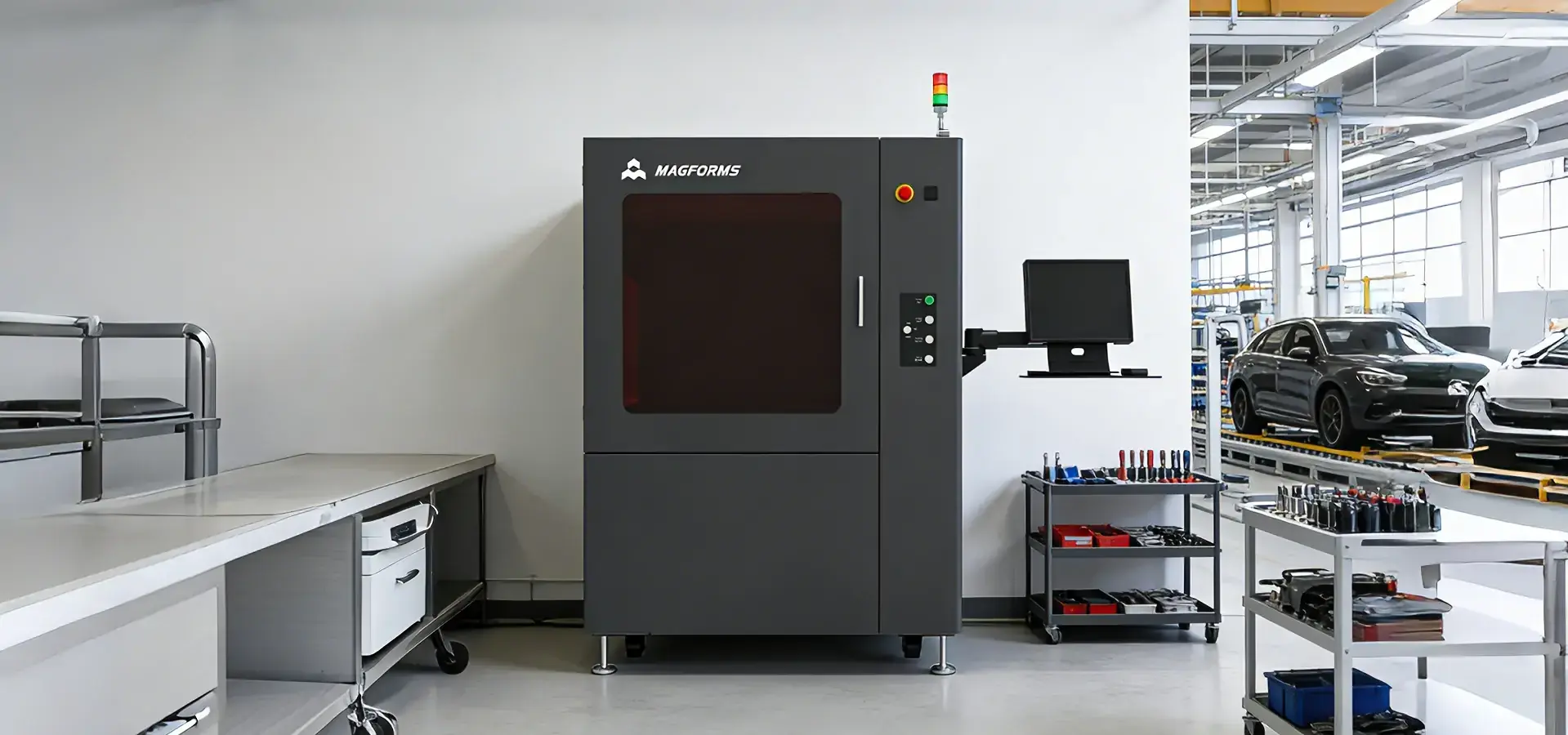
Under ultraviolet (UV) light, industrial SLA (3D printers) use advanced photopolymerization technology to build precise parts one layer at a time. Industrial SLA systems have bigger build volumes, better resolution, and long-lasting parts made for high-throughput, ongoing production settings, compared to desktop 3D printer units that are made for smaller-scale or prototyping jobs.
Advanced Photopolymerization Method
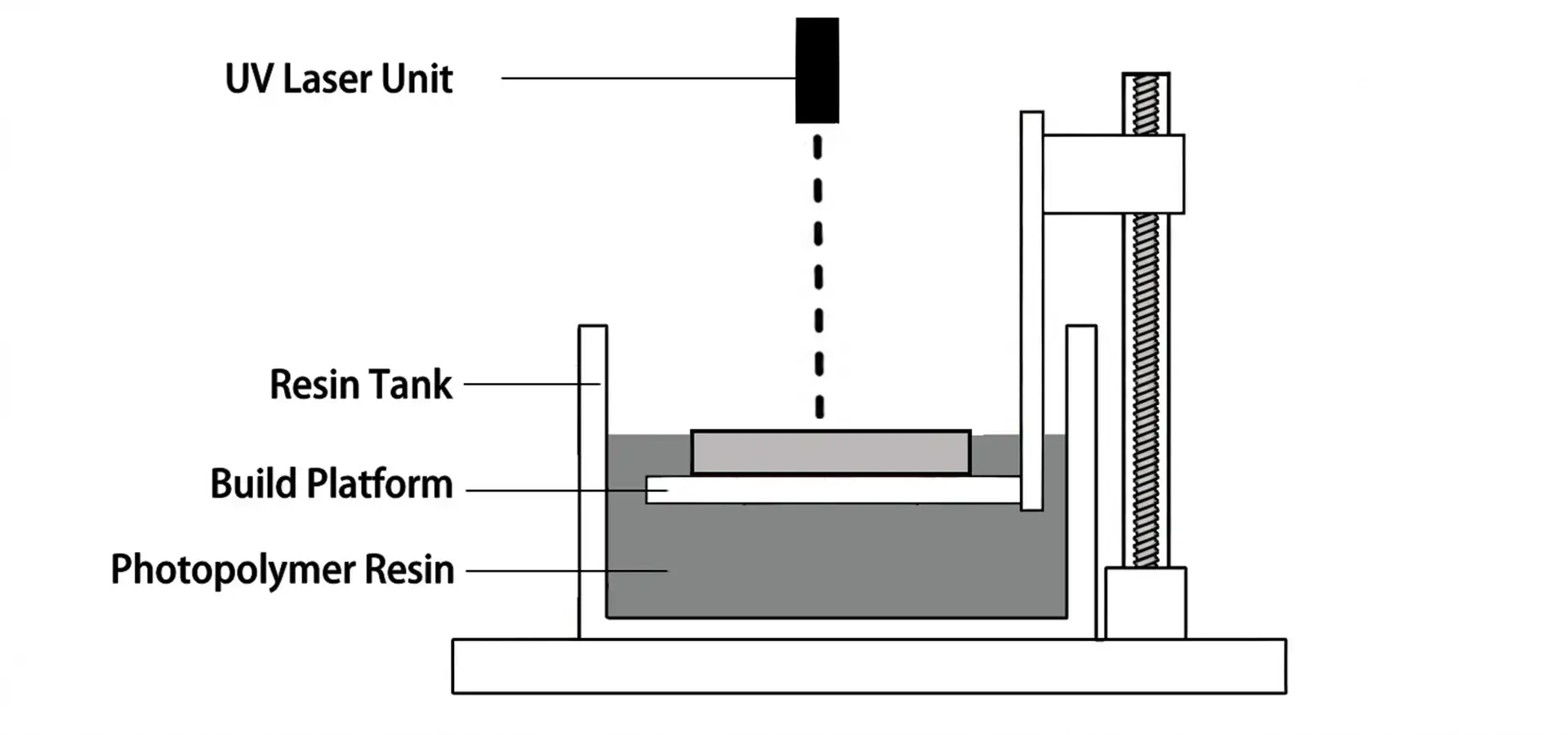
A very accurate UV laser is used to start the stereolithography process. It is managed by complex galvanometer scanning tools. With spot sizes usually between 0.08mm and 0.80mm, these systems are very good at guiding the laser beam across a vat of liquid photopolymer resin. When UV light hits the resin, it hardens right away, making cross-linked polymer chains that make solid, long-lasting parts with the same mechanical qualities everywhere.
Today's industrial SLA systems use changeable spot-size technology to print more quickly without lowering the quality. Large laser spots speed up the filling process inside the body, while small spots make sure that the curves and features are perfectly shaped. This new technology solves a problem that has been around for a long time: how to balance speed and accuracy.
Performance and versatility of the material
Industrial SLA printers can use a wide variety of specialized resins, each of which is made to have its own specific mechanical and visual qualities. For useful development, these materials include formulations that are like ABS, clear resins for optical uses, materials that can withstand temperatures above 100°C, and biocompatible resins for medical uses.
Leading manufacturers use an open-source design mindset that lets customers use photopolymer resins from different sources. This gets around the problems that come with proprietary material systems. This gives buying workers the freedom to find the best prices on materials while still meeting quality standards for a wide range of production needs.
Why Industrial SLA 3D Printers Excel in Producing Complex Parts
Industrial SLA 3D printers are unique because they offer better accuracy and surface finish quality than many other additive production technologies. Their accuracy of less than 50 microns makes it possible to accurately reproduce complex design features, which is important for parts in aircraft, medicine, and cars that need to fit together tightly.
Unmatched Accuracy in Dimensions
The powerful control systems and laser-based curing process in industrial SLA technology make it possible to be very precise. High-end systems with German Scanlab galvanometers and AOC lasers can print with an accuracy of 0.1 mm for sizes up to 100 mm. With this level of accuracy, samples that are as good as injection molds can be made without having to buy expensive hard tools. This cuts down on development costs and time to market by a large amount.
The stable base that parts like marble bases provide improves physical stability even more, making sure that results stay the same over long production runs. This dependability is very important for makers who need the same standard every time during batch production.
Better Quality Surface Finish
SLA technology can produce surfaces with very high quality, usually with roughness levels below 1 micrometer (Ra < 1Ⴍm). This injection-mold-like quality gets rid of the obvious layer lines that come with filament-based printing, making parts that are ready to use right away in situations where smooth surfaces are needed.
The better surface quality cuts down on or gets rid of the need for post-processing, which speeds up production and lowers the total cost of making the product. SLA is great for making samples and final products that look good because the parts can be painted, plated, or polished right away without having to go through a lot of surface preparation.
Capabilities for Complex Geometry
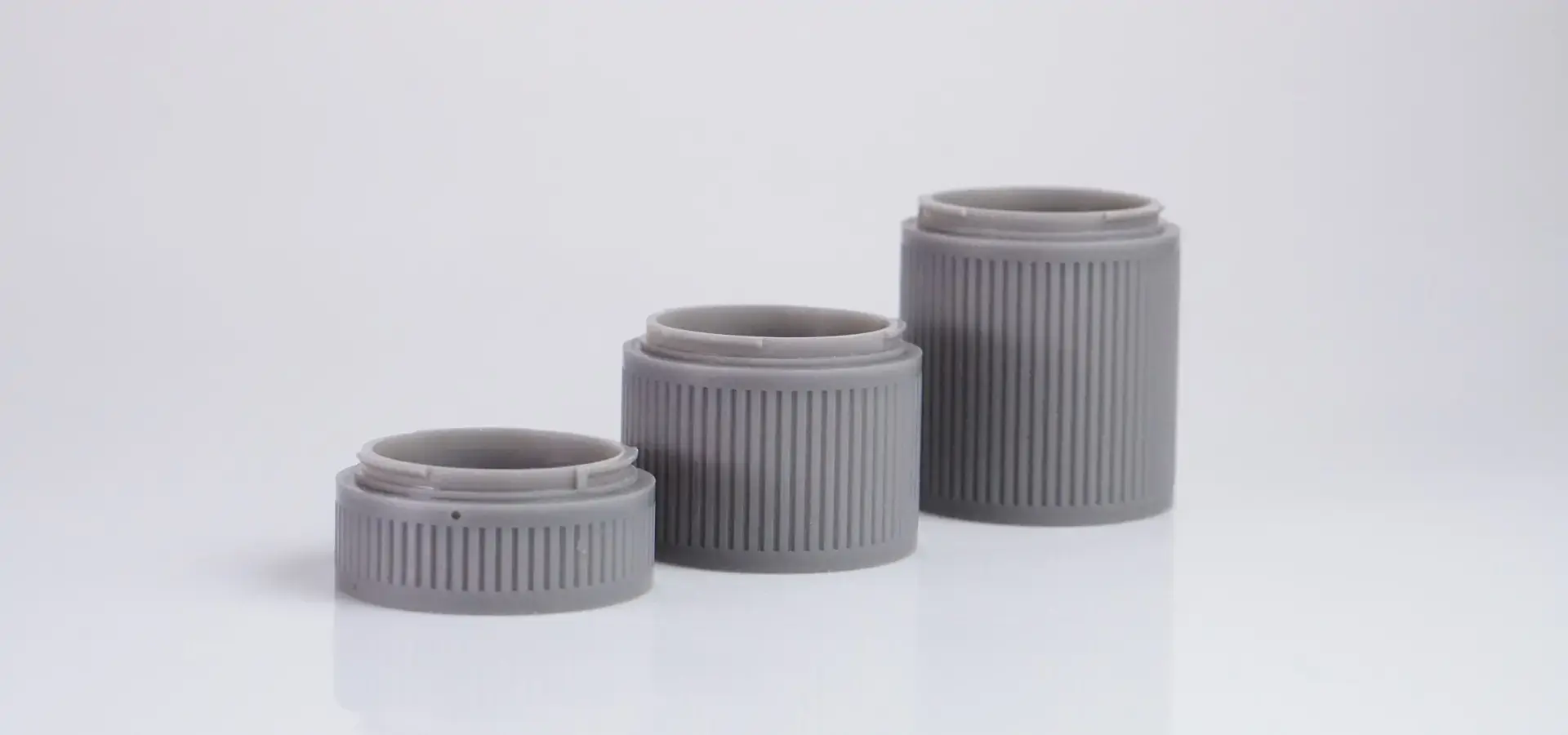
When it comes to making shapes that can't be made any other way, industrial SLA printers are the best. The technology makes it possible to make internal cooling channels, negative drafts, undercuts, and complex grid structures without having to take support out of places that can't be reached.
In the aircraft industry, where lightweight, complex structures improve performance, this geometric freedom comes in very handy. It also helps doctors, whose patients' anatomical shapes need detailed copy. Being able to print multiple parts as a single assembly cuts down on setup time and possible failure spots even more.
Comparing Industrial SLA 3D Printers with Alternative Technologies
When looking at additive manufacturing choices, industrial SLA printers are better than Selective Laser Sintering (SLS) and Digital Light Processing (DLP) because they use a more precise laser, work with resin-based materials, and can record finer details.
Better performance than SLS technology
Powder bonding in SLS technology gives it great mechanical qualities, but SLA technology has a better surface finish and more accurate measurements. When compared to SLS parts, which often need a lot of cleaning and finishing, SLA parts don't need as much post-processing. The SLA liquid resin method also makes better use of materials, which cuts down on trash and prices.
Pros and Cons Compared to DLP Systems
Through photopolymerization, DLP and SLA technologies are similar, but industrial SLA systems can handle larger build volumes and have more precise laser control. SLA's point-by-point laser curing spreads energy more evenly over big build areas than DLP's area-based exposure, which makes the properties of the parts more regular.
Analysis of Cost-Effectiveness
When thinking about costs, you need to think about both the initial payment and the ongoing costs. When compared to standard tooling methods, industrial SLA systems offer lower per-part costs for small to medium batch output. They achieve the best balance between accuracy and operational efficiency. Photopolymer methods are more cost-effective in the long run because they produce less trash and use less energy.
Open-source compatibility lowers the cost of materials by letting buying teams get resins from more than one seller and find the best prices based on the needs of each application. This adaptability is better than unique material systems that make it harder to control costs.
Procurement Guide for Industrial SLA 3D Printers
To find commercial SLA 3D printers, you need to look at approved dealers and manufacturers that are known for their innovation and great customer service. Professionals in procurement have to think about a lot of things, such as technical specs, support services, and the total cost of ownership.
Key Criteria for Selection
Some important specs are the laser spot size range, the build volume, the layer thickness choices, and the scanning speed. Dynamic focusing galvanometers in modern systems allow scanning speeds of up to 15m/s, which greatly cuts the time needed to make complex parts.
The size of the build platform in an Industrial SLA 3D printer directly affects the freedom of production. Larger systems make it possible to make parts that are too big or too small, or to process many parts at once more efficiently. For example, the SL600 model shows how stable mechanical bases, like marble bases, help keep accuracy high over long production runs.
Services for evaluating and helping suppliers
Because industrial SLA technology is so precise, it's important to have reliable technical help. Leading providers offer remote consultations 24 hours a day, seven days a week, with promised reaction times of one hour and answers for urgent problems within four hours. On-site engineering help makes sure that even the most difficult technology problems are solved quickly.
Training classes and technical workshops help operators get better at using equipment and get more of it used. To keep up with the competition, full support packages should include advice on how to manage equipment, help with optimizing processes, and software changes.
Important Infrastructure and Accessories
Supporting tools like wash stations, UV curing units, and air systems are needed for full SLA production systems. Along with products like resin tanks, FEP films, and cleaning solvents, these tools need to be included in funds for buying things.
Logistics issues include how to ship precise equipment, how to clear customs for foreign deals, and how to make sure that installation help is provided to ensure proper system commissioning. Production keeps going as long as there are reliable supply lines for parts and materials.
Maximizing ROI and Operational Success with Industrial SLA 3D Printers
For industrial SLA printing technology to be effectively integrated, it needs to be strategically aligned with current production workflows, and operational procedures must be continuously optimized.
Production workflow integration
To make adoption go smoothly, you must first look at how products are currently being made and find places where SLA technology can be most useful. Early-stage prototyping, design validation, functional testing, and low-volume production situations are all common integration spots.
Variable spot-size technology's speed benefits—30–50% faster printing than traditional methods—allow for quick iteration processes that shorten the time it takes to build a new product. Deep learning algorithms make things even more efficient by finding the best scanning lines and process parameters.
Maintenance and Quality Assurance
Proactive repair plans make sure that equipment keeps working well and is the right size throughout its lifetime. Part quality and production speed don't go down when tuning processes, laser power checks, and resin quality checks are done on a regular basis.
To make sure that the result is always the same, quality assurance procedures should include checking the sizes, measuring the surface finish, and testing the mechanical properties. Statistical process control methods help find patterns and make sure that settings are set correctly for each application.
Changing technology and planning for the future
Resin science is always getting better, which means that more uses and better results are possible. New formulas offer better mechanical properties, better heat resistance, and specific functions like electrical conductivity or magnetic properties.
Automation improvements in post-processing processes cut down on the need for workers and make cleaning and curing more consistent. When you use both additive and subtractive manufacturing methods together, you can finish complex parts more easily and put them together more easily.
Conclusion
Industrial SLA 3D printers are a revolutionary way to make complicated parts with unprecedented quality and accuracy. Advanced laser systems, a wide range of materials, and complex control algorithms make it possible to make things that standard ways of making things can't do as cheaply. Companies can use SLA technology to get big competitive advantages in product development speed, geometric complexity, and manufacturing flexibility across a wide range of industries. To do this, they need to carefully consider technical specifications, supplier capabilities, and total ownership costs during the procurement process.
FAQ
Why do Industrial SLA 3D printers work well with complicated shapes?
Layer-by-layer photopolymerization, which is what makes industrial SLA technology great at complicated geometries, can make internal channels, undercuts, and other features that are hard to make with standard machining. The UV laser exactly cures resin in exact designs, which makes it possible to make negative models and complicated assemblies without having to use a lot of support structures or do a lot of work afterward.
How accurate are industrial SLA systems compared to PC SLA systems when it comes to printing?
Industrial SLA systems are much more accurate thanks to improved galvanometer scanning systems, stable mechanical frames, and accurate weather controls. When it comes to accuracy, desktop units usually get between 100 and 300 microns. Industrial systems, on the other hand, can get as accurate as 0.1 mm for parts up to 100 mm, and they can get surface roughness values below 1 micrometer, while desktop systems can only get between 5 and 15 micrometers.
What benefits do open-source SLA tools offer in terms of material compatibility?
Open-source Industrial SLA 3D printer designs don't limit users to using proprietary materials. Instead, they let users choose photopolymer resins from different sources based on their performance needs and budget. When compared to closed systems, this freedom cuts the cost of materials by 20–40% and lets you use specialized formulas like biocompatible, high-temperature, and engineering-grade resins.
How do technologies that use varying spot sizes make printing more efficient?
Variable spot-size technology speeds up the printing process by using big laser spots (0.5 to 0.6 mm) for quick filling inside the lines and small spots (0.18 to 0.2 mm) for precise edges and curves. Compared to set spot-size systems, this method speeds up printing by 30 to 50 percent while keeping edge quality and measurement accuracy very high for parts with complex shapes.
What steps need to be taken after SLA-printed complicated parts are printed?
To get rid of any uncured resin, SLA parts need to be washed in isopropyl alcohol or a special cleaning solution. They then need to be UV-cured to get their final mechanical properties. Industrial SLA technology often doesn't need any extra finishing steps because the surface finish is so good. However, parts may need support removal and light sanding at connection places based on how complicated the geometry is.
Experience Magforms' Advanced Industrial SLA Solutions
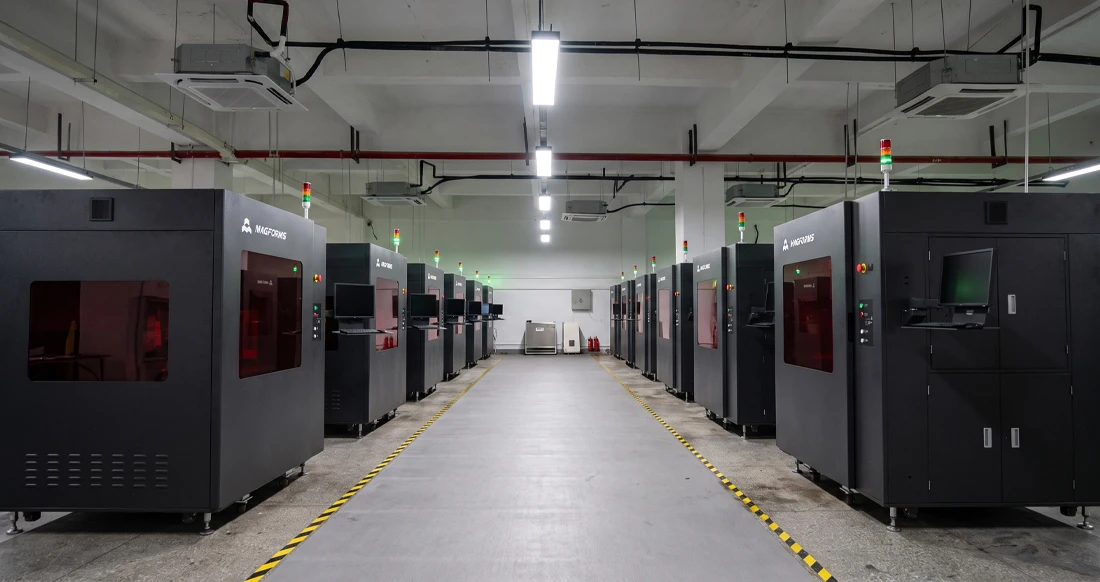
Magforms offers state-of-the-art Industrial SLA 3D printer technology that meets the most difficult needs for making complicated parts in the electronics, aerospace, medical, and automobile industries. Our unified method combines our own custom gear with German Scanlab galvanometers and AOC lasers, along with the best photopolymer materials. This guarantees both high print quality and reliable operation.
Magforms has helped over 300 businesses around the world with their complete Industrial SLA 3D printer solutions. Our technological advances are backed by 22 patents and 30 registered trademarks. Our variable spot-size technology improves speed by 30 to 50 percent while keeping accuracy at the micron level. It comes with 24/7 technical help and quick-response engineering support.
Get in touch with our technical experts at info@magforms.com to talk about your specific problems with making complex parts and find out how our Industrial SLA 3D printer systems can help you improve your production processes and shorten the time it takes to develop new products.
References
1. Gibson, Ian, David Rosen, and Brent Stucker. "Additive Manufacturing Technologies: 3D Printing, Rapid Prototyping, and Direct Digital Manufacturing, Second Edition." Springer Science & Business Media, 2015.
2. Jacobs, Paul F. "Fundamentals of Stereolithography." Society of Manufacturing Engineers, 2019.
3. Melchels, Ferry P.W., Jan Feijen, and Dirk W. Grijpma. "A Review on Stereolithography and Its Applications in Biomedical Engineering." Biomaterials Journal, Vol. 31, Issue 24, 2020.
4. Chartrain, Nicholas A., Christopher B. Williams, and Timothy E. Long. "A Review on Fabricating Tissue Scaffolds Using Vat Photopolymerization." Acta Biomaterialia, Vol. 74, 2021.
5. Stansbury, Jeffrey W., and Mike J. Idacavage. "3D Printing with Polymers: Challenges Among Expanding Options and Opportunities." Dental Materials, Vol. 32, Issue 1, 2022.
6. Ngo, Tuan D., Alireza Kashani, Gabriele Imbalzano, Kate T.Q. Nguyen, and David Hui. "Additive Manufacturing (3D Printing): A Review of Materials, Methods, Applications and Challenges." Composites Part B: Engineering, Vol. 143, 2023.

Magforms makes design and manufacture easier.
Popular Blogs
-
 Industry InsightsManufacturing Industry
FDM vs. SLA Printer: Which Technology Is Right for Your Project?
-
 Industry InsightsManufacturing Industry
Top 5 Applications of Industrial 3D Printers in Manufacturing Today
-
 Industry InsightsManufacturing Industry
Why Stereolithography 3D Printers Are Unmatched for Microfluidic Device Prototyping?