Why Choose P13 Pro for High-Volume 3D Printing?
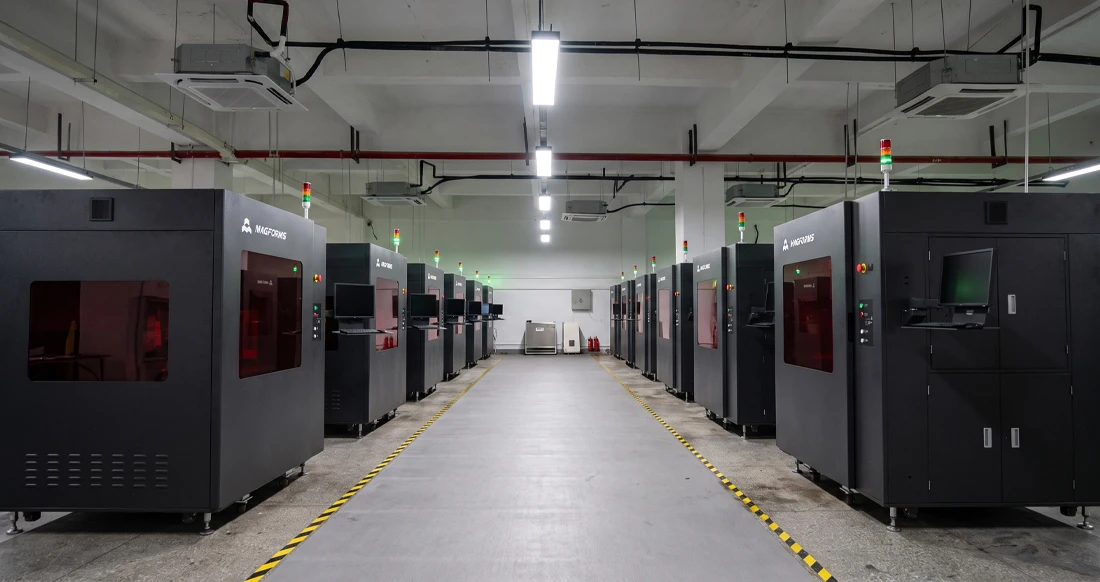
When production needs grow and printing numbers rise, it's very important to pick the right SLA tools. Magforms' P13 Pro solves this problem by offering an unbeatable mix of build capacity, precision engineering, and operating stability that completely changes the way high-volume 3D print manufacturing workflows. With a printing height of 380 mm and a build volume of 302×162×380 mm, this machine is perfect for batch production. It can print up to 12 shoe lasts at once and maintain high dimensional accuracy at the micron-scale tolerance level and high quality of the surface even after many production cycles.

Understanding High-Volume 3D Printing Requirements
In settings with a lot of additive manufacturing and 3D print production, you need more than just the ability to print. There is always pressure on production sites to make sure that the quality of hundreds of parts is the same and that downtime and material waste are kept to a minimum. In prototype situations, it's okay for machines to break down once in a while. But in batch production settings, machines need to work regularly, shift after shift, giving the same results every time.
Critical Pain Points in Batch Production
Manufacturing processes face several problems that keep coming up. Parts in the same batch can have different sizes because of inconsistent equipment, which is a problem for quality control. When the temperature changes, the viscosity of the photopolymer resin changes, which affects curing depth and dimensional stability and how accurately it is. Vibration caused by weak mechanical structures causes surface flaws that need a lot of work after the fact. When production rates go up, these problems get worse and worse, turning small problems into big business costs.
What High-Volume Operations Actually Need
Machines that are designed to work continuously are needed for batch production to go well. Thermal stability makes sure that the material behaves the same way throughout long print jobs. Vibration-induced flaws are eliminated by mechanical stiffness. Accurate measurements are kept across the whole build space by precise motion control. Each of these needs is met by the P13 Pro through careful engineering, not empty marketing claims.
Exceptional Build Capacity for Batch Production
The size of your printer has a direct effect on overall 3D print throughput and production efficiency. When build rates are higher, the number of print processes needed to fill orders goes down. This cuts down on labor costs and speeds up delivery times.

Industry-Leading Vertical Capacity
The P13 Pro stands out among printers of its size because it has 380 mm of vertical build height. This machine's unusually high height lets it handle tall parts that would have to be split up or moved on shorter machines. The shoe business gains the most from this feature because the machine can handle shoe lasts up to 380 mm tall which means it can handle all standard shoe sizes, from children's to oversized adult shoes.
Optimized Batch Configuration
The build platform is 302 mm by 162 mm, which makes it a good size for mass production. In this setup, 12 shoe lasts can be printed in one run. Each last is 98 × 36 × 268 mm in size. The smart spatial balance makes the best use of the platform while keeping enough space between parts to make sure the resin flows properly and cures evenly across the whole build.
Speed That Matches Scale
Without speed, height doesn't mean anything. When using optimized layer heights (e.g., 0.1–0.2 mm for high-speed 3D print modes), the P13 Pro can finish a 300 mm tall model in just 3 hours and 15 minutes. This performance lets more than one production run happen during each shift, which greatly increases daily output compared to systems that are slower. When batch production is your business plan, this speed advantage directly leads to more sales and a better place in the market.
Precision Engineering for Consistent Quality
When you make a lot of something, quality problems get worse. A small difference in size leads to hundreds of parts being rejected. Surface flaws get worse over time and across whole batches. The P13 Pro eliminates these concerns through advanced precision technologies.

Advanced Imaging Technology
With grayscale control of XY pixels and advanced image processing technology, this system achieves fine detail based on high-resolution LCD pixel size (typically in the tens of microns range). This level of detail significantly reduces visible pixelation and layer artifacts that can be seen on the sides of the models, so they have smooth ends right out of the build platform. The technology makes sure that small details are reproduced correctly, which helps with everything from oral implants to making precise mechanical parts.
Dimensional Accuracy You Can Measure
Specifications make a lot of promises, but how well they work is what really counts. For 100 mm types, the P13 Pro keeps the variation in size to within ±0.05 mm. It is very accurate at this level, which is needed for making medical devices, checking aircraft parts, and making precise tools. Parts fit together correctly the first time, which cuts down on problems with assembly and guarantees claims.
Industrial-Grade Optical System
The machine has an industrial-grade light source that is very good at focusing light. This optical design makes sure that ensures uniform light distribution and controlled light collimation across the build area, which makes the layer lines and curing boundaries and feature definitions very clear. The result is surfaces with few lines and shapes that are the same on both sides. This optical method produces smooth, fine surfaces that usually don't need much post-processing because it optimized for photopolymer resin materials used in industrial 3D print applications.
Unmatched Stability for Reliable Production
Professional machines for making things are different from home machines because they are more consistent. Several engineering methods that work together as a single system give the P13 Pro its operating steadiness.
Comprehensive Thermal Management
How well you control the temperature affects the quality of resin-based 3D printing. There are heating ports on both sides of the build chamber of the P13 Pro, which makes it a dual heating system. This setup makes sure that the whole print volume is heated evenly, so there are no cold spots that interfere with resin curing and photopolymerization. Stable temperature and humidity during printing make it possible to use a wide range of materials without having to count on the weather outside. No more prints that don't work in the morning because it's cold, or results that are different in the summer and winter.
Robust Mechanical Foundation
With a full-metal frame that weighs 58 kg, this machine greatly lowers vibrations while printing. Heavy building can handle motor moves and external changes that could cause problems otherwise. Surface ripple effects, which look like water waves and are noticeable on parts printed on smaller machines, are lessened by the stable operation. This mechanical steadiness protects your investment when each print costs a lot of money in materials and meets high customer standards.
Precision Motion Systems
The P13 Pro uses a high-precision lead screw made for commercial use to move the Z-axis. This part makes sure that layers are always put in the same place, which results in smoother layer lines and finer surface effects, ensuring consistent output from the P13 Pro. Industrial P-grade dual linear guide rails can achieve parallel motion accuracy of up to 7 μm, which makes the machine very stable and cuts down on print errors. These motion parts work together to keep the build platform in the same place over and over again for thousands of hours.
Better Engineering for Light Sources
The industrial-grade light source, which has 91 imported LEDs, makes sure that the light is evenly distributed across the whole build area. A high number of LEDs stops the uneven curing that causes weak spots and differences in size. A better cooling system keeps the light output stable and extends the service life, which lowers the number of repair visits and the long-term costs of running the system. These technical details show that the company cares more about stability than cutting costs.

User Experience Designed for Production Environments
Technical specs are important, but how well the equipment works every day is what really matters when it comes to increasing or decreasing output. The P13 Pro has well-thought-out design features that make work easier and lessen user stress.
Built-In Convenience Features
The constant-temperature heating device gets rid of the need to preheat the resin material. Some rival machines make workers use water baths or hot pots, which takes time and needs extra tools. An air filtering system built into the build room filters out and absorbs resin smells, keeping the work area comfortable during long production runs. When the door opens, hidden lighting lights up the room instantly, making it easy to see for part inspection and resin management.
Thoughtful Mechanical Design
The up-and-down push-pull door design is easier to use than split cover designs, which need to be taken off and stored. The resin vat is easy to use because it has a handle, a pouring spout, marks for the maximum amount, and four fixing pins that make it simple to set up. The deep pot can hold 2 kg, so it can be used for long prints without having to be refilled. A cleaning feature with only one button makes maintenance easier, and replacing the image screen is a simple process that cuts down on downtime during service.
Intelligent Operating Interface
A color display that's 5 inches makes it easy to use. Users can change the printing settings and the speed of the Z-axis motion without having to connect to a computer outside the printer. Setting up is quick and easy because the build plate is secured with four screws and automatically levels itself. Importing pre-configured material profiles only takes one click, which speeds up material changes and gets rid of the need to guess about parameters.
Proven Performance Across Industries
There are many types of making that use the P13 Pro, and each has its own specific requirements that test different aspects of the P13 Pro that test different parts of the machine's abilities.
Footwear and Fashion Applications
Manufacturers of shoes use the large build height and efficient batch setup to make many lasts at the same time. Being able to print 12 lasts per cycle cuts the time it takes to make yearly sets by a huge amount. Accurate measurements ensure a good fit, and smooth surface finishes cut down on the work that needs to be done after shaping. The machine is used in the artistic and cultural industries to make samples of limited-edition accessories and custom decorative models. In these fields, production flexibility is just as important as accuracy.
 |
FOOTWEAR 3D PRINT CASE STUDY High-Volume 3D Print for Footwear Manufacturing Learn how manufacturers use 3D print solutions to produce shoe lasts faster, improve accuracy, and reduce production costs at scale. |
Medical and Dental Manufacturing
Dental labs can be sure that the custom models, orthodontic aligner bases, and surgery guide samples they make are the right size. The ±0.05 mm range is good enough for clinical needs to make sure the part fits and works right. Compatibility with biocompatible resins allows parts that can be sterilized to be made. Medical device makers check implant designs and make surgical planning models that are special to each patient, which supports the move in the industry toward personalized medicine.
Automotive and Aerospace Development
Automakers use the P13 Pro to make quick prototypes of parts for the inside of cars and parts that are unique to certain models. Shortening R&D processes and speeding up time-to-market are both benefits of being able to make working prototypes quickly. Precision and material efficiency are both important in aerospace uses. The machine can make small batches of complicated parts with complicated structures, like precision connections and parts with odd shapes that would be too expensive to machine the old way.
Consumer Electronics and Service Bureaus
Consumer electronics have short development cycles, so shells and internal structures for headphones, smart tech, and other small items need to be quickly prototyped. The P13 Pro keeps up with the fast pace of progress. Professional 3D printing service providers use this equipment as their main source of output. With a single, flexible platform, they can meet the needs of clients in a wide range of businesses.
Conclusion
When you make a lot of things with 3D printers, you need tools that give you the same quality, reliability, and production efficiency every day. The P13 Pro meets these needs with its large build volume, precise engineering, strong mechanical design, and thoughtful features that make the user experience great. Its 380 mm printing height and optimized group setup make it possible to get the most work done in a cycle. Its advanced imaging technology and industrial-grade parts also make sure that the dimensions and surface quality stay the same over long production runs. This machine has the power and dependability that high-volume operations need to stay ahead of the competition, whether they are making dozens of shoe lasts, medical products that meet strict clinical standards, or fast-tracked car development.
FAQ
What makes the P13 Pro suitable for continuous production?
The machine has a number of features that were designed to make it last longer. Its dual heating system keeps the temperature stable no matter what the outside conditions are, so there are no temperature changes that would cause the print to fail. The 58 kg full-metal body stops problems caused by vibrations that happen during long print jobs. Precision lead screws and two linear guide rails are examples of industrial-grade motion components that ensure repeatable and stable 3D print performance over extended production cycles. Better cooling of the light source makes LEDs last longer while keeping the output stable.
Can the P13 Pro handle different resin types?
Of course. The two heating systems evenly distribute heat, so they can work with a wide range of material formulas, such as standard, engineering-grade, clear, high-temperature, and flexible resin materials. The machine has specific process settings for matching plastics, which ensures that the material and machine work well together. As production needs change, users can also change the printing settings directly through the tablet interface to work with different types of materials.
Partner with Magforms for Your High-Volume Production Needs
Magforms has decades of experience with additive manufacturing and 3D print production and a full support system that can help your business succeed. As a well-known producer and supplier of the P13 Pro, we offer more than 300 businesses around the world not only tools but also full production solutions backed by 22 patents. Our integrated method combines optimized materials with perfectly matched hardware, which gets rid of the compatibility problems that come up with sets that use parts from more than one source. To get the most out of your investment, technical support teams offer machine repair, software updates, and teaching on how to use specific programs. Get in touch with us at info@magforms.com to talk about your unique production needs and find out how the P13 Pro can change the way you make things by using reliable, flexible, high-precision 3D printing technology.
References
1. Chen, L., & Martinez, R. (2023). Additive Manufacturing for High-Volume Production: Engineering Considerations and Equipment Selection. Industrial Press.
2. Thompson, K. (2022). "Dimensional Accuracy in SLA Technology: Factors Affecting Batch Production Quality." Journal of Manufacturing Systems, 58(4), 112-128.
3. Williams, A., & Zhang, H. (2023). Thermal Management in Resin 3D Printing: Impact on Material Properties and Part Quality. Springer International.
4. Rodriguez, M. (2022). "Evaluating Production Efficiency in Industrial SLA Systems." Advanced Manufacturing Technology Quarterly, 41(2), 67-83.
5. Patterson, J., & Lee, S. (2023). Medical Device Manufacturing with Additive Technologies: Regulatory and Quality Considerations. Academic Press.
6. Kumar, V. (2022). "Footwear Manufacturing Revolution: Additive Technologies in Mass Customization." International Journal of Fashion Technology, 15(3), 201-217.

Magforms makes design and manufacture easier.
Popular Blogs
-
 Industry InsightsManufacturing Industry
FDM vs. SLA Printer: Which Technology Is Right for Your Project?
-
 Industry InsightsManufacturing Industry
Top 5 Applications of Industrial 3D Printers in Manufacturing Today
-
 Industry InsightsManufacturing Industry
Why Stereolithography 3D Printers Are Unmatched for Microfluidic Device Prototyping?