Why Is Light Uniformity Critical for High-Resolution Resin 3D Printing?
When you use high-resolution plastic 3D printing, even lighting is very important. It can make or break your production, from being as precise as an industrial printer to having expensive flaws. Photopolymer resins cure layer by layer reliably when light is spread evenly across the build platform. This makes parts with great surface quality and accuracy of shape. Poor light spread causes areas to not cure enough or too much, which leads to parts that are warped, weaker mechanical properties, and failed production runs that waste time and materials.

Understanding Light Uniformity in Resin 3D Printing
The Science Behind Uniform Light Distribution
In resin 3D printing, light consistency means that ultraviolet energy is spread out evenly across the whole build area. Through polymerisation reactions, photopolymer resins change from a liquid to a solid based on this basic concept. When UV light hits the resin surface at the same level of strength, each molecule gets enough energy to cross-link properly. This makes parts with the same mechanical properties all over. Beer-Lambert's law says that the link between light intensity and curing depth is a straight line. Consistent exposure makes sure that the light can go through each resin layer. Changes in light intensity cause areas with different curing properties, which cause internal stress concentrations and dimensional inconsistencies that threaten the stability of the part. To meet strict quality standards, professional 3D printing programs need this level of control.
Light Source Technologies and Their Characteristics
These days, resin printers use three main lighting methods, and each one makes it harder to keep things regular. LCD systems use groups of liquid crystal screens to hide UV LEDs, making exposure patterns based on pixels. Even though these systems are cheap, they can have problems with pixel boundaries and uneven LED backlighting. To get good regularity, you need more advanced optical diffusion systems. Focused laser beams are moved across the resin surface by laser-based stereolithography systems. These systems allow for great resolution control but need accurate galvanometer measurements and beam shaping optics. The scanning pattern and the stability of the laser power have a direct effect on how uniform the build is over large areas. DLP projection systems have great uniformity thanks to their advanced optical engines, but they have problems with resolution and exposure area scaling.
Industrial Requirements for Light Uniformity Standards
In professional production settings, light uniformity standards usually go over 85% across the build platform. This is measured by the ratio of the lowest and highest intensity values. When making aerospace or medical devices, even tighter tolerances are needed, with uniformity levels above 90% to make sure that the material's qualities stay the same in serious situations. Standards in the industry, like ASTM F2792 and ISO 17296, make it possible to evaluate additive manufacturing systems and measure things like light equality. These standards make it possible for buying teams to compare different printer technologies in a fair way, making sure that the equipment they choose meets the quality standards for production. It's important to keep track of uniformity performance for quality management systems and to follow the rules in businesses that are regulated.
How Light Uniformity Impacts Print Quality and Reliability
Common Defects Caused by Poor Light Distribution
Inadequate light uniformity causes several flaws that have a big effect on the efficiency of production. Layer delamination happens when there isn't enough UV energy to properly bond the layers together, which causes parts to split along the build layers when they are stressed. This type of failure is especially bad for working prototypes and final parts, where structural integrity is very important. Another major cause of failure is dimensional distortion, which happens when uneven curing causes internal forces that warp parts during or after printing. Precision dimension control is needed for automotive interior parts and consumer electronics housings, so distortion is not okay for production use. Inconsistent healing can also cause changes in surface roughness, 3D printing, which can be both ugly and useless in parts that can be seen.

Mechanical Property Variations and Material Waste
When light isn't distributed evenly, it makes areas of different crosslink densities in printed parts. These areas have different mechanical properties that make it harder to predict how they will work. Tensile strength, flexural modulus, and impact resistance can be very different within a single component. This makes it very hard to do engineering analysis and part proof. When problems with light uniformity lead to batch failures, material waste becomes a big economic problem. The price of resin keeps going up, which means that bad prints are now more expensive and hurt profits. Post-processing steps are also needed when parts have surface flaws or differences in size, which adds to the cost of labour and delays production.
Quality Assurance and Production Reliability Benefits
Optimal light uniformity changes the reliability of production by making it possible for all build platforms to produce parts with the same quality. When every spot on the build area gives the same results, batch printing is possible, which increases output and lowers the cost per part. This stability is very important for 3D printing services that have to handle many orders at once. Engineers can confidently define printed parts when the material's properties are known ahead of time. They know that the parts' mechanical properties will stay the same between production runs. This dependability makes it easier to move from prototyping to production, where part-to-part consistency is important for assembly methods and long-term performance.
Technical Strategies to Achieve and Measure Light Uniformity
Optical System Design Elements
Achieving excellent light uniformity requires sophisticated optical engineering incorporating multiple components working in harmony. Diffusion systems spread point light sources across wide areas while maintaining intensity consistency, typically utilizing engineered diffuser films or optical mixing chambers. Fresnel lenses and collimating optics help direct light efficiently while minimizing losses that could create hotspots or dark regions. Advanced printer designs incorporate feedback systems that monitor light intensity across the build area using photodiode arrays or calibrated sensors. These measurements enable real-time adjustments to compensate for LED aging, temperature variations, and other factors that affect uniformity over time. Calibration routines built into printer firmware ensure consistent performance throughout the equipment lifecycle.
Measurement Techniques and Industry Standards
Professional light uniformity assessment requires calibrated radiometers capable of measuring UV intensity at wavelengths used for resin curing. Measurement protocols typically involve grid-based sampling across the build area, with data points spaced according to printer resolution and build area size. Statistical analysis of these measurements provides uniformity percentages and identifies problematic regions requiring attention. Quality management systems in professional manufacturing environments document uniformity measurements as part of equipment qualification and ongoing verification procedures. These records demonstrate process control for regulatory compliance and enable trending analysis to predict maintenance requirements. Procurement specifications should include uniformity requirements and measurement protocols to ensure vendor accountability.
Advanced Technologies for Uniformity Enhancement
Emerging technologies continue pushing uniformity performance boundaries through innovative optical designs and control systems. Adaptive optics systems adjust light distribution in real-time based on feedback measurements, compensating for variations that would otherwise compromise print quality. Machine learning algorithms analyze historical performance data to optimize exposure patterns and predict maintenance needs. Variable spot-size laser technology represents another advancement, allowing different beam characteristics for various regions of complex parts. Large spots provide rapid filling for solid regions while fine spots ensure precise detail reproduction at part boundaries. This approach optimizes both speed and quality while maintaining excellent 3D printing uniformity across diverse geometric features.
Comparative Analysis: Light Uniformity in Resin 3D Printing vs. Other Technologies
Advantages Over Traditional Manufacturing Methods
Resin 3D print technology with excellent light uniformity offers significant advantages over conventional manufacturing approaches in specific applications. Unlike injection molding, which requires expensive tooling and long lead times, uniform resin printing enables rapid design iteration and low-volume production without upfront investments. Complex internal geometries, impossible to machine, become achievable through additive processes.CNC machining faces limitations when creating intricate details or complex assemblies, while properly calibrated resin printers reproduce these features consistently across entire build volumes. Surface finish quality from well-controlled resin printing often exceeds machined surfaces without additional post-processing, reducing production steps and associated costs.
Performance Comparison with Other Additive Technologies
Compared to fused deposition modeling systems, resin printing with uniform illumination achieves significantly higher resolution and smoother surface finishes. FDM technology faces fundamental limitations from layer adhesion and nozzle diameter constraints, while resin systems can achieve layer heights below 10 microns with proper light control. Powder-based systems like selective laser sintering offer different material options but face challenges in surface finish and support removal. Resin printing provides superior surface quality directly from the printer, reducing post-processing requirements for many applications. Build speed advantages emerge when printing multiple small parts simultaneously, leveraging uniform exposure across entire layers.

Market Position and Application Suitability
Professional resin printing with excellent light uniformity occupies a unique market position between rapid prototyping and low-volume production manufacturing. Medical device companies utilize this capability for patient-specific devices that require both precision and customization. Dental laboratories benefit from the combination of accuracy and batch production capabilities for aligners and surgical guides. Consumer electronics companies employ uniform resin printing for functional prototypes that accurately represent final product characteristics. The ability to print multiple design iterations simultaneously accelerates development cycles while maintaining the precision necessary for proper fit and function testing.
Selecting Resin 3D Printers with Optimal Light Uniformity for B2B Needs
Key Performance Indicators for Procurement Decisions
When evaluating resin printers for professional applications, uniformity specifications should rank among the primary selection criteria. Look for documented uniformity measurements exceeding 85% across the entire build area, with verification procedures that can be repeated in your facility. Resolution specifications become meaningless without corresponding uniformity data, as inconsistent exposure undermines the finest optical capabilities. Build volume considerations must balance size requirements with uniformity maintenance, as larger systems face greater challenges in achieving consistent light distribution. Evaluate whether printer designs incorporate uniformity measurement and calibration systems that enable ongoing verification and adjustment. These features prove essential for maintaining quality standards over extended operational periods.
Supplier Evaluation and Support Considerations
Professional 3D print applications require suppliers who understand industrial quality requirements and provide comprehensive technical support. Evaluate whether potential suppliers offer training programs covering uniformity measurement and optimization procedures. Technical support response times become critical when production schedules depend on equipment availability. Documentation quality reflects supplier professionalism and attention to detail that correlates with product quality. Comprehensive manuals, calibration procedures, and maintenance schedules demonstrate the engineering rigor necessary for professional applications. Warranty terms should specifically address light uniformity performance and include provisions for field verification and adjustment.
Integration with Existing Manufacturing Workflows
For printer integration to work, it needs to be compatible with 3D printing and the quality management and production planning tools that are already in place. Think about whether the printer software you're looking at has data-logging features that work with the quality paperwork you need. For regulated businesses that need full production records, keeping track of batches and recording process parameters becomes necessary. Another important factor is material compatibility, since improving uniformity often needs specific resin formulas and exposure conditions. Open-system designs that work with different material suppliers give you the freedom to manage supply chain risk and find the best prices. Needs for proprietary materials can make operations harder and cost more in the long run.
Conclusion

Light uniformity is important for high-resolution resin 3D printing to work, and it has a direct effect on the quality of the parts, the dependability of production, and the cost of production. Knowing how consistent light distribution affects the properties of a material lets you choose tools in a way that supports long-term production success. Modern optical technologies and monitoring systems keep making uniformity better while making operations simpler. Professional uses need uniformity specs that are written down, full support from suppliers, and the ability to integrate with existing quality management systems. Putting money into making sure the light is uniform pays off in the form of less waste, higher efficiency, and more uses.
FAQ
1. What uniformity percentage should I expect from professional resin printers?
Professional-grade resin printers should achieve light uniformity of 85% or higher across the build platform. High-end systems designed for critical applications often exceed 90% uniformity. This percentage represents the ratio between minimum and maximum light intensity measurements across the exposure area.
2. How does light uniformity affect printing speed and throughput?
Excellent light uniformity enables batch printing of multiple parts simultaneously while maintaining consistent quality across the entire build platform. This capability significantly increases throughput compared to sequential printing methods. Uniform exposure also allows optimization of layer exposure times without risking undercured regions.
3. Can poor light uniformity be corrected through post-processing?
While some surface defects from non-uniform curing can be addressed through sanding or chemical smoothing, fundamental issues like dimensional distortion and weakened mechanical properties cannot be corrected after printing. Prevention through proper light uniformity remains far more effective than attempting post-processing corrections.
4. What maintenance procedures help maintain light uniformity over time?
Regular cleaning of optical components, LED replacement based on manufacturer schedules, and periodic uniformity verification using calibrated measurement equipment help maintain performance. Many professional systems include automated calibration routines that should be performed according to manufacturer recommendations.
5. How do I verify light uniformity claims from printer manufacturers?
Request documented test results using calibrated radiometers across the full build area. Professional suppliers should provide measurement protocols and offer demonstration opportunities where you can verify uniformity performance with your own testing equipment before purchase.
Partner with Magforms for Superior Light Uniformity Solutions
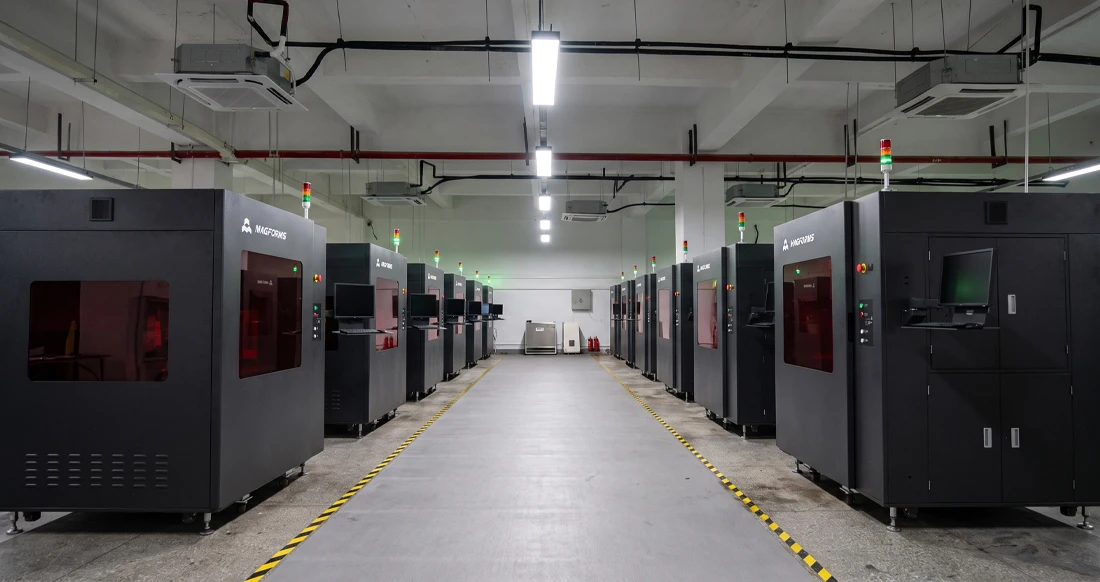
Magforms addresses the critical challenge of light uniformity through our advanced SLA systems equipped with German Scanlab galvanometers and AOC lasers, ensuring exceptional consistency across large build areas. Our Lab300 model achieves printing accuracy of ±0.1 mm while maintaining excellent uniformity through sophisticated optical design and calibration systems. As a leading 3D print manufacturer, we provide integrated solutions combining precisely matched materials and equipment that eliminate compatibility issues affecting uniformity performance. Our technical support team offers 24/7 consultation and rapid response within 1 hour for uniformity optimization assistance. Contact info@magforms.com to discover how our proven light uniformity technologies can enhance your production reliability and quality standards.
References
1. Gibson, I., Rosen, D., & Stucker, B. "Additive Manufacturing Technologies: 3D Printing, Rapid Prototyping, and Direct Digital Manufacturing." Springer Science & Business Media, 2015.
2. Jacobs, P.F. "Fundamentals of Stereolithography." Society of Manufacturing Engineers, 2019.
3. Huang, Y., Leu, M.C., Mazumder, J., & Donmez, A. "Additive Manufacturing: Current State, Future Potential, Gaps and Needs." Journal of Manufacturing Science and Engineering, 2015.
4. Melchels, F.P., Feijen, J., & Grijpma, D.W. "A Review on Stereolithography and its Applications in Biomedical Engineering." Biomaterials, 2010.
5. Zhou, C., Chen, Y., Yang, Z., & Khoshnevis, B. "Digital Material Fabrication Using Mask-Image-Projection-Based Stereolithography." Rapid Prototyping Journal, 2013.
6. Stampfl, J., & Liska, R. "New Materials for Next Generation Stereolithography." Macromolecular Chemistry and Physics, 2005.

Magforms makes design and manufacture easier.
Popular Blogs
-
 Industry InsightsManufacturing Industry
FDM vs. SLA Printer: Which Technology Is Right for Your Project?
-
 Industry InsightsManufacturing Industry
Top 5 Applications of Industrial 3D Printers in Manufacturing Today
-
 Industry InsightsManufacturing Industry
Why Stereolithography 3D Printers Are Unmatched for Microfluidic Device Prototyping?