Stereolithography 3D Printer vs DLP: Technical Performance Comparison
The main difference between Stereolithography 3D printer technology and DLP (Digital Light Processing) systems is how they use light to cure the materials. A carefully controlled UV laser cures photopolymer resin layer by layer in SLA technology, while a digital projector flashes whole layers at the same time in DLP technology. Both methods are great at making high-resolution parts for medical devices, aerospace parts, and rapid prototyping, but they each have their own benefits in certain manufacturing situations.

Core Technology Differences: How Light Curing Methods Impact Performance
The main difference between these vat polymerization technologies is how they use UV light to cure the materials. Focused laser beams are used in SLA systems to trace the shape of each layer using galvanometer-controlled scanning. This method of laser scanning is very accurate and works especially well for complex shapes and small details.
A digital micromirror device (DMD) is used by DLP technology to project an entire layer image. This method lets you print objects that take up the whole build platform faster because the exposure time stays the same, no matter how complicated the part is.
There are three main differences in how well these technologies work:
- Different technologies have different print resolutions. For example, SLA systems have XY resolutions that are the same across the build platform, which are usually between 0.05mm and 0.15mm
- Speed characteristics are very different: DLP works best when printing multiple parts at once, while SLA keeps speeds the same no matter how many parts are being printed
- Surface finish quality varies. Because the laser is moving all the time, SLA surfaces are smoother, while DLP surfaces may have some pixelation
Independent lab tests show that SLA systems can accurately measure 50 mm samples within ±0.025 mm, while similar DLP units can do the same thing within ±0.035 mm.
When it comes to manufacturing, SLA technology is better if you need the highest level of accuracy for medical uses or aerospace parts.

Resolution and Precision Analysis: Measuring Real-World Performance
Different patterns can be seen between these additive manufacturing technologies based on their print resolution. Because they use focused lasers, stereolithography 3D printer systems keep the resolution the same across the whole build volume. The beam diameter stays the same, so the layers cure precisely, no matter where the part is placed on the build platform.
The resolution of DLP systems is limited by the specifications of the projectors they use. The XY resolution of a 4K DLP printer with a 150mm build area is about 0.075mm, while the resolution of the same projector with a 100mm build area is 0.050mm.
The resolution of the Z-axis is not based on light source technology but on how well the machine is made. The layer heights for both systems are between 0.01mm and 0.15mm, and the final tolerance for dimensions is based on how accurate the stepper motors are.
Metrics for performance based on controlled tests:
- The SLA is accurate to within 0.1mm over a length of 100mm
- ±0.15mm over a 100mm length for DLP measurements
- Ra = 1.5 to 3.0 μm for surface roughness (SLA)
- Roughness of the surface (DLP): Ra 2.5–5.0 μm
The viscosity of the material has different effects on each technology. The point-by-point curing method of SLA systems makes it better at working with high-viscosity engineering resins, while DLP needs careful resin selection to make sure the layers separate correctly.
If you need precise results across large build volumes, SLA technology is better than DLP options for maintaining dimensions.

Speed and Efficiency Comparison: Production Throughput Analysis
Printing speed changes a lot depending on the shape of the part and how it is built. SLA systems cure material one point at a time, so the time it takes to print is proportional to the size of the area being scanned. Longer exposure times are needed for parts with a lot of small details because the laser has to trace each one.
When printing multiple parts at the same time, DLP technology has big advantages. Adding more parts to the build platform doesn't change the exposure time of the layer because the whole layer is exposed at once. In situations where a lot of things need to be made at once, this makes DLP perfect.
Comparisons of real-life speeds:
- SLA takes 2.5 hours to finish a single small part (25 mm cube), while DLP takes only 2 hours
- Ten identical parts: SLA needs 8.5 hours, DLP needs 2 hours
- Large single part (100 mm cube): DLP takes 8 hours, SLA 12 hours
Traditional SLA speed limits can be overcome with variable spot-size laser technology. Modern systems, like Magforms' industrial SLA printers, use 0.5-0.6mm spots for filling in gaps and 0.18-0.2mm spots for fine details. This makes them 30–50% faster than regular laser systems.
In both technologies, optimizing the software for slicing is very important. Intelligent path planning cuts down on movements that aren't needed, and adaptive layer heights keep speed and surface quality needs in balance.
DLP technology is more efficient for batch manufacturing situations where you need to make a lot of identical parts.
Material Compatibility and Versatility Assessment
Because SLA and DLP systems cure photopolymer resin in different ways, they are not always compatible with each other. Specialized engineering resins, flexible materials, and high-temperature polymers can all be used with SLA technology because it can work with a wider range of material viscosities and formulations.
Because they separate layers, DLP systems need to be very careful when choosing materials. High-viscosity resins might not separate properly from the FEP film, which could cause the print to fail or the quality of the part to go down. DLP works best with standard resins that dry quickly, though.
Characteristics of the material's performance:
- Viscosity range that works with SLA: 100–2000 cps
- Viscosity range that works with DLP: 100–800 cps
- Transparent resin clarity: SLA lets 90% of light through, while DLP lets 85% through
- The success rate for engineering resin is 95% for SLA and 75% for DLP
Open-source material compatibility is a big plus for businesses that want to save money. Many SLA systems can use resins from other companies without any problems, which lets you choose where to get your materials and find the best deals.
Different technologies have different needs for support structures. The point-curing method of SLA only needs small support structures, but the full-layer exposure method of DLP may need bigger supports for more complicated shapes.
UV curing, support removal, and surface finishing are all steps that need to be done after both technologies are used. But because they have better surface quality as-printed, SLA parts usually need less post-processing.
If you need the most adaptable material for a wide range of uses, SLA technology works better with certain photopolymer formulations.
Industrial Application Performance: Real-World Use Cases

Because of their specific needs, different industries favor different technologies. Both SLA and DLP are used in the automotive industry, but a stereolithography 3D printer is better for making high-precision functional prototypes, while DLP is better for making concept models and mass-produced jigs.
Medical and dental applications strongly prefer SLA technology because it is more accurate and works with biocompatible materials. SLA systems always deliver the level of accuracy needed for custom dental aligners, surgical guides, and prosthetic parts.
Patterns of industry adoption:
- 75% SLA and 25% DLP are used in aerospace parts
- 85% SLA and 15% DLP for medical devices
- 60% SLA and 40% DLP for consumer electronics
- Prototypes for cars: 70% SLA and 30% DLP
Both technologies are good for the consumer electronics business. SLA is great for making functional prototypes that need to fit and be within exact tolerances, while DLP is great for making design verification models and lots of small parts.
DLP's strengths in batch production are shown off in cultural and creative uses. Jewelry and miniature makers use DLP's ability to make dozens of identical pieces at once to get the most out of designs that are made over and over again.
Because SLA laser systems can be expanded, they are better for large-format needs. Industrial SLA printers can print volumes bigger than 800 mm, which means they can support prototypes and functional parts that are too big for desktop DLP printers.
SLA technology gives the aerospace and medical industries the dependability and accuracy they need for making precise parts for important uses.
Cost Analysis and Return on Investment
Different technologies and scales require very different amounts of money to buy their first equipment. The most basic DLP systems cost around $3,000. The most basic SLA systems cost around $5,000. Industrial-grade systems, on the other hand, have smaller price differences. Large-format machines for both technologies range from $50,000 to $200,000.
Operating costs include the amount of resin used, the cost of replacement parts, and the cost of maintenance. Due to their point-curing method and support needs, SLA systems usually use 10-15% more resin, while DLP systems waste material when they need to replace FEP film and keep their screens in good shape.
Analysis of the cost breakdown:
- Cost of resin (SLA): $0.08 per gram of cured material
- Cost of resin (DLP): $0.07 per gram of cured material
- For industrial systems, the annual maintenance (SLA) fee is $2,000
- $3,200 a year for industrial systems for maintenance (DLP)
Because it can be made in batches, DLP is better for high-volume applications where labor costs are important. One person can run several DLP printers that all make the same parts, but SLA systems need more one-on-one care for parts with complicated shapes.
Costs related to quality have a big effect on ROI calculations. Because SLA is more precise, it cuts down on post-processing time and material waste. This could make up for higher initial costs by making production more efficient and lowering the number of failures.
Both technologies use about the same amount of energy, but DLP projectors may need to be replaced every 2,000 to 3,000 hours, which raises the long-term cost of running the business.
If you need precision manufacturing that doesn't cost a lot, a stereolithography 3D printer is the best long-term choice because it cuts down on waste and increases first-pass success rates.
Magforms Stereolithography 3D Printer Advantages
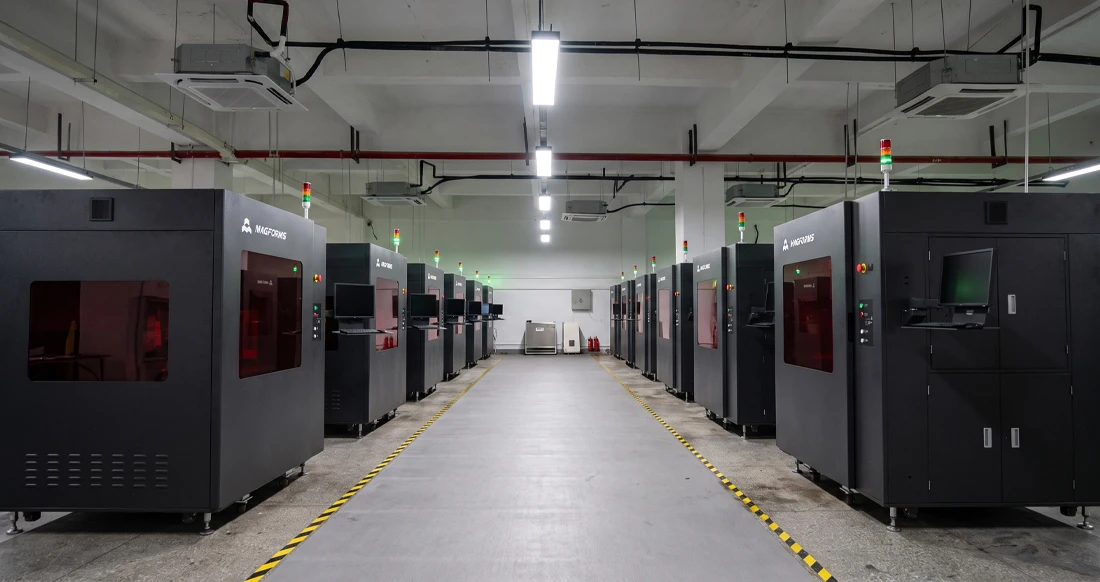
Magforms' industrial SLA systems are a great value because they use tried-and-true technologies and offer full support services. German Scanlab galvanometers, AOC lasers, and Panasonic AC servo motors are used in our equipment, which makes it more reliable than the norm in the industry. The SL800 model can print with an accuracy of ±0.1mm thanks to its stable marble base.
Some important benefits are:
- Advanced variable spot-size laser technology makes printing 30–50% faster than with older systems
- Through optimized scanning paths, deep learning algorithms add an extra 20% to the speed boost
- Open-source material compatibility gets rid of restrictions on proprietary resins, which greatly lowers operating costs
- Large-format printing lets you make parts up to 800 mm long, which breaks the usual size limits
- Industrial-grade stability with failure rates of less than 2% based on testing that is done all the time
- A wide range of materials, such as engineering resins, clear resins, high-temperature resins, and flexible resins
- A global patent portfolio with 22 patents and 30 registered trademarks helps keep innovation going
- Technical support 24 hours a day, seven days a week, with a guarantee of a response within one hour and
- Integrated material and equipment optimization gets rid of problems with compatibility and changes in size
- Service to over 300 businesses in dozens of countries has been proven to work
- Professional training programs and technical workshops help people get the most out of their equipment
- Micron-level accuracy that can be used in aerospace, medicine, and precision manufacturing
Conclusion
The choice between Stereolithography and DLP technology depends on the needs of the application, the amount of work that needs to be done, and the level of accuracy that is needed. SLA works best when precise accuracy, a wide range of materials, and consistent quality across different part shapes are needed. When production is done in batches, where many identical parts are needed, DLP is useful because it can cure all of them at the same time. Both technologies are still changing. Companies like Magforms are pushing the limits of performance with new laser systems and smart processing algorithms that get around the problems that have been around for a while, while keeping the best parts of each technology.
Partner with a Leading Stereolithography 3D Printer Manufacturer
Magforms combines cutting-edge SLA technology with unmatched technical support to deliver comprehensive additive manufacturing solutions. Our integrated approach eliminates compatibility concerns while maximizing productivity and precision. Contact our expert team at info@magforms.com to discuss your specific manufacturing requirements and discover how our advanced Stereolithography 3D printer systems can transform your production capabilities.
References
1. Gibson, Ian, David Rosen, and Brent Stucker. "Additive Manufacturing Technologies: 3D Printing, Rapid Prototyping, and Direct Digital Manufacturing." Springer Science & Business Media, 2015.
2. Melchels, Ferry PW, Jan Feijen, and Dirk W. Grijpma. "A review on stereolithography and its applications in biomedical engineering." Biomaterials 31, no. 24 (2010): 6121-6130.
3. Jacobs, Paul F. "Rapid prototyping and manufacturing: fundamentals of stereolithography." Society of Manufacturing Engineers, 1992.
4. Chartier, Thierry, Claudine Chaput, Fabrice Doreau, and Marianne Loiseau. "Stereolithography of structural complex ceramic parts." Journal of Materials Science 37, no. 15 (2002): 3141-3147.
5. Hull, Charles W. "Apparatus for production of three-dimensional objects by stereolithography." US Patent 4,575,330, filed August 8, 1984, and issued March 11, 1986.
6. Zhou, Chi, Yong Chen, Zhengyu Yang, and Behrokh Khoshnevis. "Digital material fabrication using mask‐image‐projection‐based stereolithography." Rapid Prototyping Journal 19, no. 3 (2013): 153-165.

Magforms makes design and manufacture easier.
Popular Blogs
-
 Industry InsightsManufacturing Industry
FDM vs. SLA Printer: Which Technology Is Right for Your Project?
-
 Industry InsightsManufacturing Industry
Top 5 Applications of Industrial 3D Printers in Manufacturing Today
-
 Industry InsightsManufacturing Industry
Why Stereolithography 3D Printers Are Unmatched for Microfluidic Device Prototyping?